Lariz jauregia: A Baroque Merchant’s Palace in Elorrio, Spain


Site at a Glance
- Rating
- 4.4
- Popularity
- Very Low
- Country
- Spain
- Primary era
- Early Modern
- Eras represented
- Early Modern, Modern
- Civilizations
- Spanish
- Site type
- Domestic
- Remains
- Elite Residence
On this page8 sections
History
Lariz jauregia, also known as Casa Lariz, is a Baroque palace in Elorrio, Spain, completed in 1667 as the residence of the merchant Domingo Lariz Altuna. Its restrained design combines the formal organization of Baroque architecture with the austere classicism associated with Juan de Herrera, whose work at the Monastery of El Escorial influenced Spanish building traditions. The palace forms part of Elorrio’s monumental ensemble and has been protected as a cultural asset since 1998.
Domingo Lariz and the seventeenth-century palace
Domingo Lariz was born in Elorrio in 1625. He exported meat to the Americas through Seville, a commercial activity that greatly increased his wealth and social standing. He commissioned Juan Bautista de Aldariaga and Martín de Garaizabal to construct the palace as his home. Its character belongs to the palaces built in Elorrio during the second half of the seventeenth century, when local residences often expressed a conservative form of classicism rather than a highly exuberant interpretation of the Baroque.
Lariz married Josefa Monasterioguren in 1676. Three of Josefa’s sisters were enclosed Dominican nuns from Ermua. When they came to Elorrio with other companions, they spent their first night at Lariz jauregia. Enclosed Dominican nuns followed a cloistered contemplative form of religious life within the Order of Preachers.
Religious associations and the twentieth century
The palace later became associated with several Catholic figures. Saint Manuel González, a Spanish Catholic bishop and religious leader, stayed at the Assumptionists’ residence in Elorrio in 1923 before accepting invitations to lodge at Lariz jauregia. He stayed there on various occasions from 1927, including the summers of 1932, September in 1934 and 1935, and October 1939. Saint Valentine of Berrio-Ochoa, a nineteenth-century Dominican bishop and martyr, made a prie-dieu, a piece of furniture for kneeling or sitting during prayer, for the palace. The object is preserved in the Berrio-Otxoa Museum.
A chapel was installed on the top floor in 1928, when the present garden layout was also established. The Andra Maria hermitage, a small Christian place of worship, was built in 1930. Since 1882, six generations of the Fernández de Arroiabe family, Atanasio, Alejandro, Pablo, José Mari, Asier, and Ander, have maintained and cared for the palace garden.
During the Spanish Civil War, from September 1936 to April 1937, the house was converted into a field hospital, a temporary medical facility for people affected by military operations. Fighting took place at Elorrio between Republican forces arriving from Gipuzkoa and the Nationalist side represented by Navarra’s I and IV Brigades.
Later ownership and religious use
In 1964, the priest Manuel Sancristoval Murua, a nephew of the owners, expressed interest in acquiring the house for the educational activities of Opus Dei. Opus Dei is a Catholic personal prelature that promotes Christian religious life through ordinary work and daily activities. After the Fundación Promotora de Iniciativas Sociales acquired the palace, the architect Emiliano Amann Puente carried out major interior renovations.
Saint Josemaría Escrivá de Balaguer, a Spanish Catholic priest and founder of Opus Dei, made his first and longest stay at Lariz jauregia from 18 July to 1 September 1964. Álvaro del Portillo and Javier Echevarría accompanied him. From the palace, Escrivá wrote a letter dated 15 August 1964 to Monsignor Angelo Dell’Acqua concerning the definitive juridical configuration of Opus Dei.
Escrivá returned in 1967, staying from 13 to 29 May and again from 13 to 21 September. During one of these visits he worked on the homily later delivered at the University of Navarre on 8 October, known as “Loving the World Passionately.” His fourth and final stay took place from 19 to 25 April 1968.
On 30 May 1908, Pope Pius X granted Antonio María de Murua y Gaytan de Ayala the pontifical title of Count of Lariz. The palace’s later history also includes the planting of two saplings descended directly from the Tree of Guernica, one in 1996 and the other in 2006. The oak is associated with the historic liberties and representative institutions of Biscay and the Basque Country, while descendant trees traditionally express continuity.
Remains
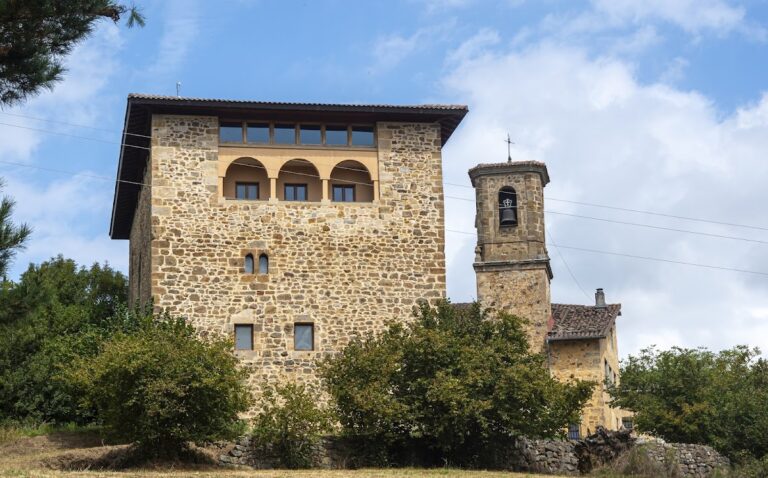
Lariz jauregia stands at 22 Buzkantz Street in the Ganondo suburb of Elorrio, beside a road in a semi-urban setting. The rectangular palace has a principal facade arranged in three levels: a ground floor, a first floor, and an attic. Its severe Baroque appearance is shaped by a conservative classicism derived from the architectural tradition associated with Juan de Herrera.
Palace exterior
Principal facade
The ground floor is centered on a lintelled entrance framed by molded “ear” surrounds, a decorative treatment that projects around the corners of the opening. Two lintelled and barred openings flank the doorway. Above them, the first floor contains three balcony openings. The central opening projects farther from the facade and receives more elaborate treatment, while the two lateral openings form small balconies set flush with the wall. A heraldic shield is placed at the southern edge of the first-floor level.
The attic has three small, perfectly square lintelled openings. Like the openings below, they are framed with molded “ear” surrounds. Together, the regular arrangement of the openings, the balconies, and the heraldic shield give the facade its formal organization while retaining the restrained character associated with Elorrio’s seventeenth-century palaces.
Chapel and grounds
The top floor contains the chapel built in 1928. The grounds include the garden layout established at the same time, a tennis court, and two saplings descended from the Tree of Guernica. The saplings were planted in 1996 and 2006 beside the tennis court. Certificates signed by José María Fernández de Arroiabe, mayor of Elorrio, and Ana Otaduy, president of the General Assemblies of Gernika, are displayed beside the foot of the staircase.
Nearby sites