Schnaditz Castle: A Protected Renaissance Water Castle in Germany


Site at a Glance
- Rating
- 3.9
- Popularity
- Very Low
- Country
- Germany
- Primary era
- Medieval
- External website
- Open
- Eras represented
- Medieval, Early Modern
- Civilizations
- Holy Roman Empire
- Site type
- Military
- Remains
- Castle
On this page11 sections
History
Schnaditz Castle is a protected Renaissance castle and cultural monument in Germany, in the Bad Düben district of Schnaditz. It originated as a water castle built in the marshland of the Mulde probably around 1237. The early complex was associated with the knights Bodo and Otto of Sneuditz and later became a long-standing manorial estate with economic and judicial rights.
Medieval water castle
An unsupported tradition claims that Count Wiprecht of Groitzsch tried to capture a water fortress called Castrum Sneuditz in 1115. The castle’s more securely placed early phase belongs to the thirteenth century. In 1349, Castrum Sneuditz was held as a dower provision for the wife of Otto Wendis de Ilburg of Eilenburg. Nickel von Rabil, who was also lord of Pouch from 1451, was named as its owner in 1455.
Gunter von Zeschwitz, also known as Gunter von Zaschnitz, received Schnaditz as a feudal grant in 1463. His family lived at the castle for most of the period from 1463 to 1655 and was related by marriage to the Steuben family. Reconstruction followed damage caused by the Hussite Wars, fifteenth-century conflicts linked to the religious reform movement founded by Jan Hus, and by the Saxon Civil War.
The Zaschnitz estate
Tietzen von Zaschnitz, Gunter’s son, carried out numerous alterations and new building works in 1466. In 1515, his son Gunter von Zaschnitz became the feudal holder and began reclaiming the Mulde floodplain. The estate’s history later became connected with the Kohlhase disputes of 1532 to 1540, a conflict involving the Berlin merchant Hans Kohlhase.
In 1532, Gunter von Zaschnitz seized Kohlhase’s horses at Wellaune, then an outwork belonging to the Schnaditz estate. The incident later provided material for Heinrich von Kleist’s novella Michael Kohlhaas. The Zaschnitz family retained the estate and feudal authority over additional villages until 1655.
Von Wuthenau and von Steuben ownership
Ludwig von Wuthenau acquired the estate in 1655 and immediately began extensive building work. The castle had deteriorated during the Thirty Years’ War, the European conflict fought from 1618 to 1648 whose military and economic effects damaged and weakened many German estates. The von Bülow family acquired the property in 1659.
Christoph Otto von Steuben bought Schnaditz Castle from the von Bülow heirs in 1678. He moved his residence there, became the hereditary and judicial lord, and formally took possession on 17 July 1678. The estate included a brickworks, a brewery, and a grain distillery. Christoph Liborius von Steuben inherited the castle in 1686 and partly renovated and altered the associated church at Schnaditz in 1717. After his death in 1738, the castle and estate passed to his widow.
Debt, auction, and the Martin family
By 1755, the estate was said to be over-indebted. At the widow’s request, the castle, manor, and 1,300 Morgen of land were placed under compulsory administration, initially by the Düben district office. The property was auctioned in 1764, and Dorothea Maria Justina, Baroness von Görtz, acquired it.
Caroline Wilhelmine von Einsiedel zu Schönfeld and Badria took over the estate in 1789. The Saxon councillor Christoph Samuel Martin became its owner in 1792. The property remained with Martin’s heirs, and later with the Freytag and Martini families, until 1940. Martin also redesigned the approximately 10-hectare park after the model of the Wörlitz palace park near Dessau.
War, land reform, and changing uses
Dr. Erich Wendenburg bought the estate in 1940. It then covered 650 hectares and was threatened with bankruptcy, while members of the Martini family continued to live in the castle. Walter Martini was married to Marie Oster, the sister of Major General Hans Oster, who frequently stayed at Schnaditz.
Oster was chief of the Abwehr, the German Army’s military intelligence service, at the High Command and a leading figure in the military resistance against Adolf Hitler. He took part with Carl Friedrich Goerdeler and Claus Schenk Graf von Stauffenberg in the failed 20 July 1944 plot to assassinate Hitler. Oster was arrested at Schnaditz on 21 July 1944 and murdered at Flossenbürg concentration camp on 9 April 1945.
After the Second World War, the estate was expropriated during the 1945 land reform, and twenty Eastern European refugee families were housed in the castle. During the German Democratic Republic period, the three wings served several communal purposes, including housing, municipal administration, a hairdresser, a post office, and a kindergarten. The buildings later suffered severe structural decline.
Ownership after reunification
The castle stood empty after German reunification. Following Schnaditz’s incorporation into Bad Düben, ownership passed to the city in 1999. Between 1991 and 2006, the city received grants from the monument-protection authority of the former Leipzig regional administration to maintain the cultural monument.
In August 2014, Bad Düben sold the increasingly deteriorated complex to an investor group. The property was sold on 29 August for 120,000 euros to a five-member American group, and Schloss Schnaditz GmbH was entered in the Leipzig commercial register on 16 October 2014. The purchase contract reportedly included an investment obligation. By 2017, the investors had not demonstrated the required investment, and two deadlines had lapsed.
Planned rehabilitation included heating, new windows, replacement plaster, and new water, wastewater, and electricity lines. Proposed uses included a restaurant in the former distillery, event and private-function space in the former knights’ hall, taverns, apartments, hotel rooms, and 28 holiday apartments. A four-room museum was also planned, with subjects including Hans Kohlhase, Hans Oster, and the von Steuben family. In 2016, the city granted an extension because financing had not been secured. By February 2017, the water, wastewater, and electricity lines were said to have been installed, but the wider work remained incomplete.
By the end of 2017, the required work had not been completed and no construction manager meeting German legal requirements had been appointed. Storm depression Friederike caused additional damage in January 2018. On 22 March 2018, the Bad Düben city council unanimously voted to reverse the sale, returning ownership of the land and castle to the city. Helga van Horn and her son Nick, members of the investor group, continued living in the castle while seeking further investors, including possible investors from South Africa. They were forcibly evicted on 14 December 2018.
Since the eviction, Bad Düben has sought a new purchaser. Suggested future uses have included a children’s hotel, youth hostel, or training facility, but the extensive rehabilitation required and the city’s financial constraints have hindered investment. The Kohlhaas Club Schloss Schnaditz, registered on 15 May 2002, has pursued the rehabilitation and use of the castle as a boarding school, European youth academy, cultural venue, and creative workshop. Under the sale agreement, the club received rights to use three rooms on the condition that a museum be established there.
Remains
Castle layout and defensive tower
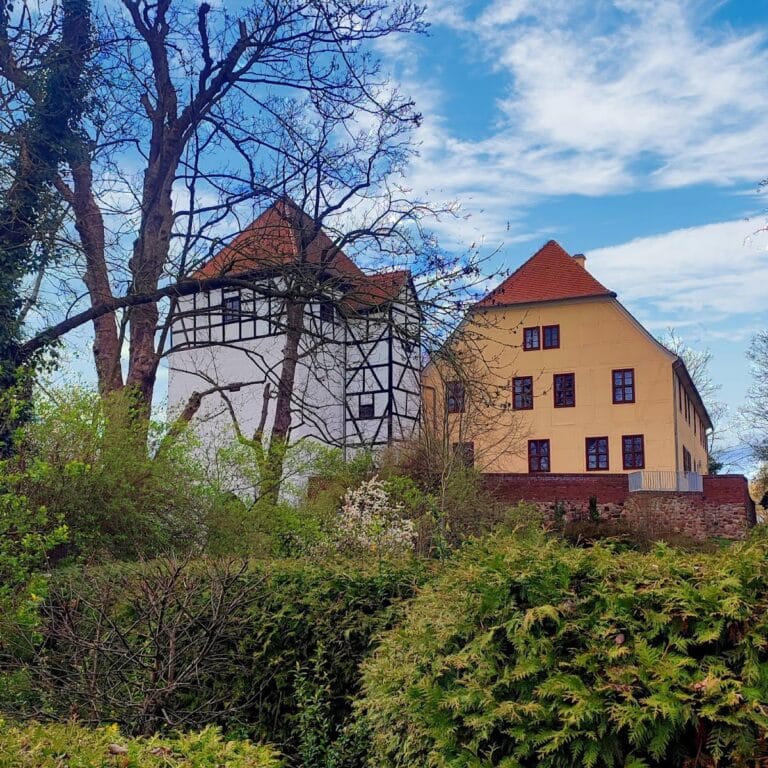
Schnaditz Castle retains the form of a three-wing complex that developed from a water castle in the marshland of the Mulde. Its defensive tower rises 29 metres. The surviving complex reflects the castle’s medieval origins and later Renaissance character, while the buildings also preserve the effects of repeated alteration, changing use, and prolonged deterioration.
Estate buildings and interiors
The wider estate included a brickworks, brewery, and grain distillery. The former distillery was identified as the proposed location for a restaurant during the unsuccessful rehabilitation project. Other interior features include a former knights’ hall, intended for events and private celebrations, an old ground-floor column associated with plans for a beer tavern, and a vaulted cellar proposed for use as a wine tavern.
Park and later physical changes
The castle grounds include a park of approximately 10 hectares. Christoph Samuel Martin redesigned it after the model of the Wörlitz palace park near Dessau. During the German Democratic Republic period, the three wings were divided among residential and municipal rooms, a hairdresser, a post office, and a kindergarten. Later abandonment and structural decline affected the buildings, and storm depression Friederike caused further damage in January 2018.
The 2014 to 2018 rehabilitation effort included planned heating and window installation, replacement of the plaster, and the laying of water, wastewater, and electricity lines. By February 2017, the service lines were said to have been laid, while the broader rehabilitation remained unfinished. The proposed museum was to occupy four rooms and interpret the associations of the castle with Hans Kohlhase, Hans Oster, and the von Steuben family. The city’s contractual museum-use right covered three rooms for the Kohlhaas Club.
Nearby sites