Bad Düben Town Mill: A Water-Powered Mill in Germany
Site at a Glance
- Popularity
- Very Low
- Country
- Germany
- Primary era
- Early Modern
- Eras represented
- Early Modern, Modern
- Civilizations
- Electorate of Saxony, German, Holy Roman Empire, Kingdom of Saxony
- Site type
- Economic
- Remains
- Watermill
On this page11 sections
History
Early milling and expansion
The Bad Düben town mill is a water-powered mill in Germany, built in 1538 on the Schwarzbach. A mill was present at the site by the early seventeenth century, perhaps earlier. The mill is first documented in 1681 as a sawmill administered by an Elector’s district office. An Elector was a prince entitled to vote in choosing the Holy Roman Emperor, and the office governed a district on the prince’s behalf.
The complex grew to serve several kinds of milling. A fulling mill was added in 1689, followed by a flour mill in 1697 and an oil mill in 1708. A coarse-grinding unit also went into operation in 1697. In 1776, a rotary sifter was installed to separate flour from bran, making it possible to produce flour without bran.
Changes in operation and ownership
The Schwarzbach provided the mill’s power. Renovations in 1886 added a turbine, enabling the machinery to be driven by water turbines. After the fulling mill and, later, the oil mill were removed, the sawmill, also known as the Brettmühle, closed in 1914.
The Schüßler family has owned the mill since 1904. Two new turbines were installed in 1947. Peter Schüßler took over in 1955, and the mill became regionally known as Stadtmühle Schüßler after him. He operated it until 2016, producing rye flour for nearby bakers as well as ground animal feed. In 1990, the mill adopted single-pass milling, a process in which grain is milled in one pass. The combined mill-and-dwelling building, its extension, the weir, and the machinery are protected as monuments.
Remains
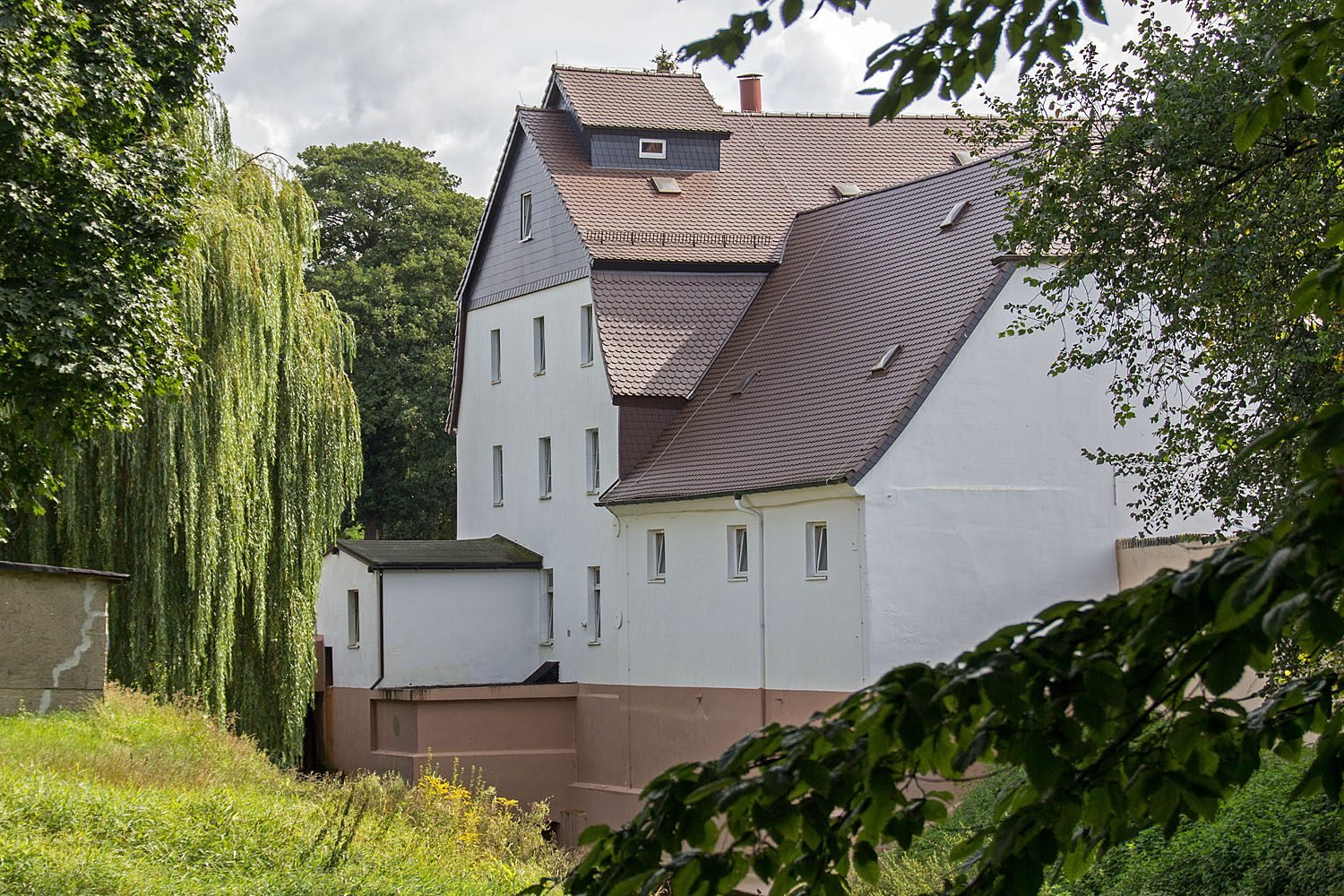
The complex comprises a two-storey mill-and-dwelling building, a solid rear extension, waterworks beside the Schwarzbach, and machinery arranged across several working floors.
Building and waterworks
Main building
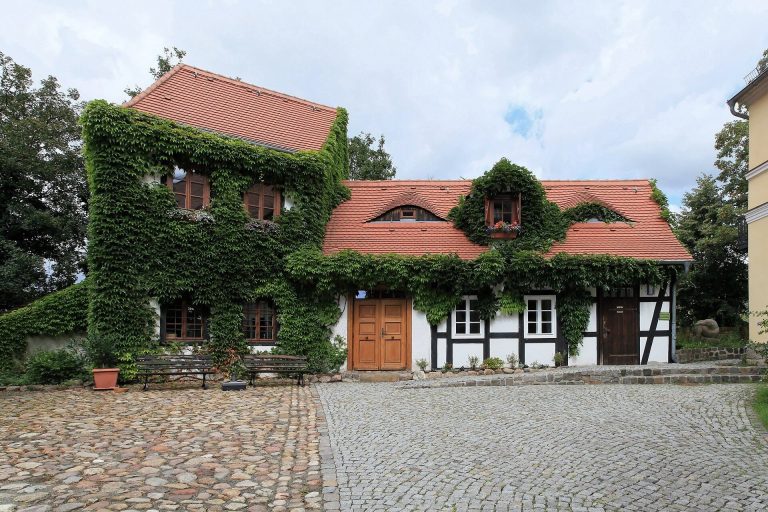
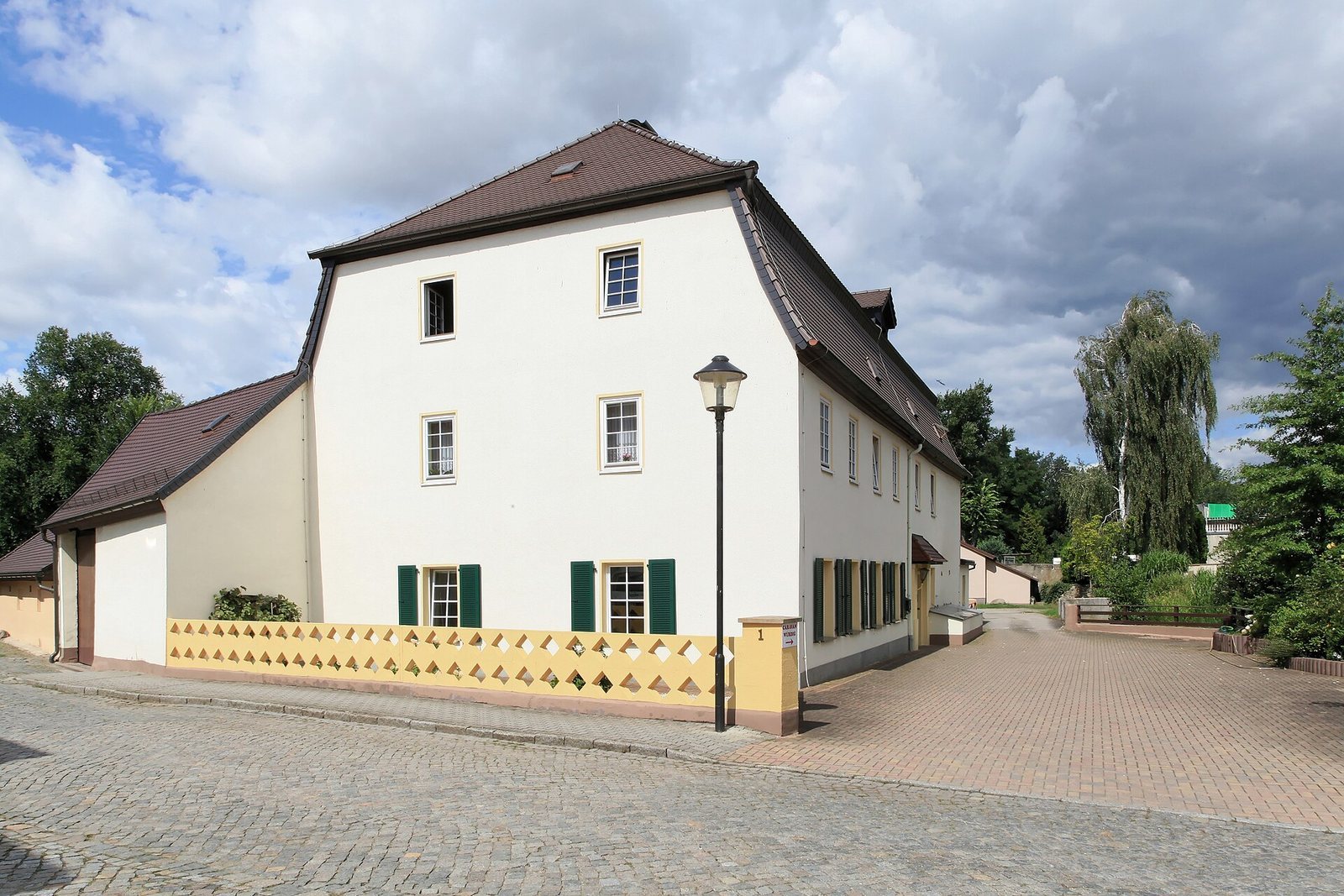
The main building has a solid ground floor and a plastered, half-timbered upper floor. Its tall mansard roof, with a steep lower slope and shallower upper slope, is covered with beaver-tail tiles and includes a dormer. A slightly projecting entrance has a cover. The front door has been renewed, while the shaped wooden eaves are original.
Extension and water system
A solid rear extension has a partly hipped roof covered with beaver-tail tiles. The Schwarzbach runs beside the mill and meets the Mulde river just under 150 metres downstream. The weir bears the inscription Built 1947 A. Felgner.
Machinery and working floors
Power and floor arrangement
The mill’s equipment is preserved in full. Its working levels include the main transmission on the ground floor, a milling floor, a pipework floor, and a sifter floor. A small turbine room adjoins the transmission level. Two horizontal Francis turbines, a type that uses flowing water to drive machinery, were made by A. Wetzig of Wittenberg. Air-driven conveying equipment for moving mill products through pipes dates to 1949–1950, and a brake elevator is distributed across the floors.
Roller-mill floor
A roller mill crushes grain between rollers. The milling floor contains a double roller mill made by MIAG Braunschweig in 1940 and three double roller mills made by MIAG Dresden/Braunschweig in 1948. It also holds a 1965 Fanal flour-finishing machine made by the Bad Frankenhausen milling and machine works, an East German state-owned enterprise, and an A. Wetzig aspirator, which separates lighter material using airflow.
Pipework and sifter floors
The pipework floor, the second upper storey, contains another MIAG Braunschweig double roller mill from 1940 and an A. Wetzig circular filter for the mill’s air-driven system. A grain dehulling machine from 1954, which removes the grain’s outer covering, is located either on this floor or on the milling floor.
On the sifter floor, a plansifter made in 1989 incorporates older parts and separates milled material by particle size. The floor also contains a cyclone dust separator used for cleaning and the winch, with its brake shoes, for the mill elevator.