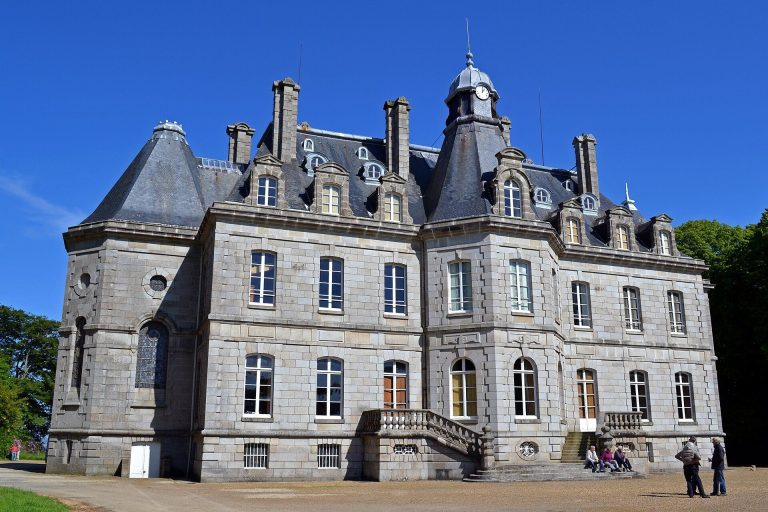
Château de Maillé: A Medieval and Renaissance Castle in Brittany


Site at a Glance
- Rating
- 4.2
- Popularity
- Very Low
- Country
- France
- Primary era
- Early Modern
- Eras represented
- Medieval, Early Modern
- Civilizations
- Duchy of Brittany, French
- Site type
- Military
- Remains
- Castle
On this page11 sections
History
Château de Maillé is a historic castle in France, in Plounévez-Lochrist, Brittany, whose stone construction probably began in the fourteenth century under the Kermavan family. It developed from an earlier wooden castle on a feudal mound and acquired its Renaissance form through later additions by the Carman branch of the Kermavan lineage.
From Coëtseizploë to the stone castle
The predecessor of Château de Maillé was Château de Coëtseizploë, a timber fortress raised on a feudal mound, or motte, which was an earthwork supporting a medieval fortification. The name Coëtseizploë referred to a jurisdiction extending over seven parishes. The Kermavan lineage was connected to the Lesquelen family, a younger branch of the counts of Léon.
Alain de Kermavan, lord of Coëtseizploë, was born in 1220, married Jeanne de Rosmadec, and died in 1263. He was buried in the church of the Lochrist priory. The later stone castle was probably built during the fourteenth century under Tanguy de Kermavan, also known as Carman. His son, Tanguy II de Kermavan, married Louise de la Forêt.
The Kermavan and Carman families
Their daughter Françoise de Kermavan married Jean de Ploësquellec, lord of Bruillac, in 1541. The marriage required their future children to bear the Kermavan name and arms. Their son Maurice de Carman and his wife, Jeanne de Goulaine, gave the castle much of its present character by adding the Renaissance section. They also built the Kermeur chapel in 1555.
Transfer to the Maillé family
In 1577, Claude de Ploësquellec, also known as Claude de Kermavan, married François de Maillé, lord of Villeromain. The marriage transferred the estate to the Maillé family, a wealthy family from Touraine that also owned Château de Luynes.
François de Maillé was killed in a duel in 1600 by Guillaume Symon de Tromenec, who was involved in banditry during the Wars of the League, the late-sixteenth-century conflicts involving the Catholic League and rival political factions during a French succession crisis. The bishop excommunicated Tromenec and required him to erect an expiatory monument to Maillé in the chapel of Tromenec. Maillé’s recumbent funerary effigy, a sculpted monument showing the deceased lying down, is in that chapel at Landéda.
Creation of the marquisate and county
In August 1612, Louis XIII created the lands under Kermarvan’s jurisdiction, chiefly in Kernilis, as a marquisate for Charles de Maillé, the son of François de Maillé and Claude de Ploësquellec. A marquisate was a territorial jurisdiction and noble title under the French ancien régime, the system of monarchy and social privilege before the Revolution. Charles died in 1628. His wife, Charlotte d’Escoubleau, died in 1644.
On 12 January 1626, the lands under the jurisdiction of Coëtseizploë were made a county for Henri de Maillé, grandson of François de Maillé and Claude de Ploësquellec. A county likewise combined territorial jurisdiction with a noble title. Henri died at the castle on 4 December 1628, after which the residence became known as Château de Maillé.
The eighteenth century and decline
A later Henri de Maillé died at the castle on 4 September 1723. He had married Marie-Anne du Puy de Murinais in 1674. She was a friend of Madame de Sévigné, the French writer and letter-writer, and was known as “the Murinette beauty.”
Their son Donatien II de Maillé, also called Donatien de Maillé-Carman, was born in Paris on 7 June 1675, served as an infantry colonel, and died at the castle on 26 November 1745. His son Donatien III de Maillé was born at La Rochelle in 1707, served as colonel of the Brittany Infantry Regiment, and died in Saint-Domingue on 6 May 1757. His daughter Marie-Éléonore de Maillé married Jean-Baptiste de Sade in 1733 and became the mother of the Marquis de Sade, the French aristocratic writer.
Heavily indebted, Donatien III sold the castle in 1747 to Louis-Antoine de Rohan-Chabot. The new owner neglected the estate, and the northwestern wing became roofless and fell into ruin.
Revolutionary and modern ownership
Nicolas Ameline de Cadeville purchased the castle in 1789, demolished the ruined section, and began restoring the remainder. During the French Revolution, the castle was sold as a national property on 22 June 1796. National properties were buildings or land confiscated and sold by the state during the Revolution. The Cadeville family later recovered the estate.
The estate was sold to Baron Paul Dein in 1812. He died at Château de Maillé on 31 March 1831. Baron Hugues Nielly acquired it in 1900 and reforested the estate. Vice-Admiral Alfred Richard bought and restored the domain in 1929. German forces occupied the castle during the Second World War.
The façades, roofs, staircases, and chimneys have been classified as historic monuments since 8 December 1981, and the domain was listed on 19 April 1990. The castle was later owned by Élisabeth Richard and her husband, Michel Danguy des Déserts, and subsequently by their son Loïc Danguy des Déserts.
Remains
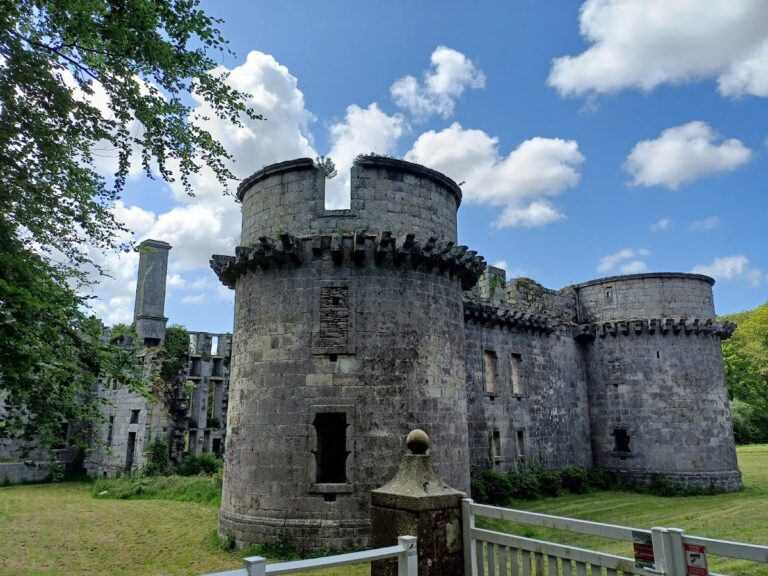
Château de Maillé preserves elements from its medieval stone phase, its sixteenth-century Renaissance enlargement, and later restoration. The surviving complex is associated with the mound of the earlier Château de Coëtseizploë, while the castle itself includes a medieval right wing, a Renaissance western façade, a stair tower, historic interior decoration, and the Kermeur chapel.
Medieval foundations
The mound of the former Château de Coëtseizploë remains associated with the site and preserves the physical setting of the earlier wooden fortress. The right wing was the first part of the stone castle to be built and dates from the fourteenth century.
Renaissance façade and chapel
The western façade belongs to the Renaissance phase added by Maurice de Carman and Jeanne de Goulaine. Its square pavilion rises through three stories and displays three superimposed rows of columns. From the lowest level upward, these use the Tuscan order, the simplest classical column style, followed by the Ionic order with scroll-like capitals and the Corinthian order with ornate foliage decoration.
The Kermeur chapel, built in 1555, forms part of the castle complex. A stair tower contains surviving masons’ marks. Its vault keystone originally carried the Kermavan arms combined with those of Lesquelen and Goulaine, arranged as a pendant. One room retains wall paintings and furniture dating from the sixteenth century.
Demolished wing and restored remainder
The northwestern wing became roofless and ruinous after the estate’s decline in the eighteenth century. It was demolished after Nicolas Ameline de Cadeville acquired the castle in 1789, while the surviving remainder was subsequently restored.