Palazzo Pica Alfieri: A Baroque Palace in L’Aquila


Site at a Glance
- Rating
- 4.7
- Popularity
- Very Low
- Country
- Italy
- Primary era
- Early Modern
- Eras represented
- Medieval, Early Modern
- Civilizations
- Kingdom of Naples
- Site type
- Domestic
- Remains
- Elite Residence
On this page10 sections
History
Palazzo Pica Alfieri is an eighteenth-century Baroque palace in L’Aquila, Italy, rebuilt after the earthquake of 1703 and regarded, with the adjacent Palazzo Quinzi, as one of the earliest examples of the city’s Baroque architecture. It stands on Piazza Santa Margherita along Via Roma, the route that follows the east–west principal street of L’Aquila’s Angevin urban plan.
Renaissance origins and aristocratic ownership
The palace occupies the site of the Palazzo del Conte di Montorio, a Renaissance building where Queen Joanna of Aragon stayed in 1493. The earlier palace later passed to Pompeo Colonna, an Italian nobleman and churchman, and became the official residence of the treasurer of Abruzzo Ultra, the historical administrative designation for the inland territory of Abruzzo. In that role, it hosted Andrea Ardinghelli and Margherita Strozzi.
While owned by Maffeo Barberini, a member of the Barberini family, the palace was purchased by Ludovico Alfieri in 1685 for 1,700 ducats. The building was almost completely destroyed by the 1703 earthquake, after which it was rebuilt in the form that survives today.
Baroque rebuilding and the Pica-Alfieri name
Francesco Fontana renewed the palace in several phases. The interior spaces were refurbished first, enabling the Alfieri family to return, while the façade was constructed afterward. In 1785, Eusebia Alfieri married Giannantonio Pica, heir to L’Aquila’s prominent Pica family, and the palace acquired the name Pica-Alfieri.
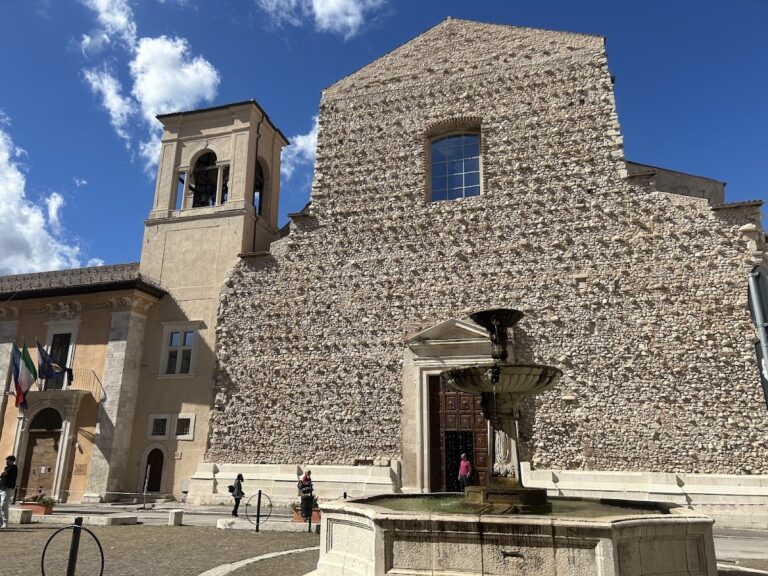
Piazza Santa Margherita and Piazza del Palazzo together formed L’Aquila’s political center until the eighteenth century. The palace faces the Palazzo della Congregazione dei Nobili, while the church of Santa Margherita and Palazzo Margherita also stand around the square. Palazzo Margherita had been the residence of Margaret of Austria, a sixteenth-century Habsburg governor of L’Aquila, and is now the seat of the municipality.
Earthquake damage and restoration
The 2009 earthquake caused extensive damage and left Palazzo Pica Alfieri unusable. Its furnishings and works of art were auctioned and sold in 2011. Reconstruction began on 15 September 2014 and culminated in the building’s reopening to the public on 29 September 2018. The palace is currently in use.
Remains
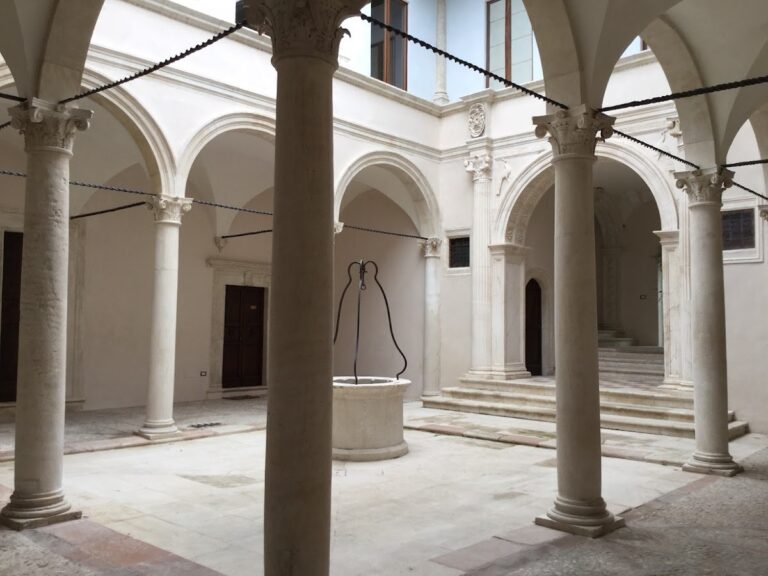
Palazzo Pica Alfieri is a quadrangular Baroque building with three free-standing sides and a fourth side separated from Palazzo Quinzi by a dividing wall. A large internal courtyard forms the central open space within the palace. Its position on Piazza Santa Margherita places the building within the historic civic setting associated with Via Roma and L’Aquila’s Angevin urban plan.
Exterior and courtyard
Principal façade
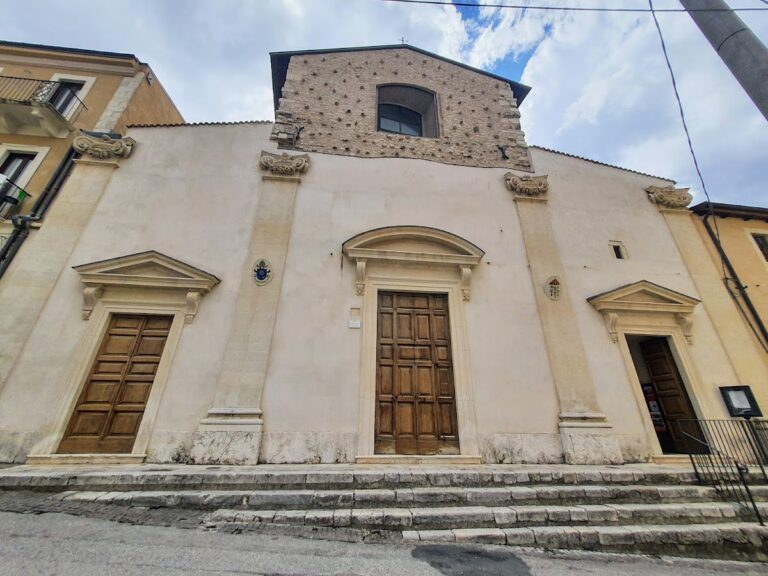
The principal façade, attributed to Pietropaolo Porani and dated 1726, is arranged in three sections. Two entrance portals occupy its lower level, with a balcony above them supported by four slender columns. The façade belongs to the rebuilding that gave the palace its present eighteenth-century Baroque character, a style known for theatrical composition, movement, strong spatial effects, and elaborate ornament.
Internal courtyard
The building contains a large internal courtyard within its quadrangular plan. The courtyard is enclosed by the palace’s three free-standing sides and by the separating wall adjoining Palazzo Quinzi.
Reception rooms and art collection
Historic interiors
The reception rooms retain eighteenth-century furnishings. They also include a picture gallery, a collection devoted to paintings, containing more than 50 works. The gallery includes paintings by Girolamo Cenatiempo, Pompeo Cesura, and Francesco Lavagna.
Nearby sites