Hof Bladelin: A Historic Urban Palace in Bruges


Site at a Glance
- Rating
- 4.3
- Popularity
- Very Low
- Country
- Belgium
- Primary era
- Medieval
- External website
- Open
- Eras represented
- Medieval, Early Modern, Modern
- Civilizations
- Belgian, County of Flanders
- Site type
- Domestic
- Remains
- Palace
On this page9 sections
History
Hof Bladelin is a fifteenth-century urban palace in Bruges, Belgium, built in 1435 for Pieter Bladelin. Its history connects the Burgundian court, Florentine banking, noble ownership, charitable work, and religious institutions. The palace later became part of a larger complex that included a chapel, a museum, and residences for older people.
Bladelin and the Burgundian foundation
Pieter Bladelin served as an adviser to Philip the Good, the Burgundian duke who ruled much of the Low Countries, and as treasurer of the Order of the Golden Fleece, a prestigious chivalric order founded by the Burgundian ruling house in the fifteenth century. In 1448, Bladelin and his wife, Margaretha van den Vagheviere, began founding Middelburg on reclaimed land northeast of Bruges. Bladelin built the town’s castle in the same year, moved there in 1451, and the settlement was completed about six years after the project began.
Bladelin also commissioned Rogier van der Weyden, one of the leading Netherlandish painters of the fifteenth century, to create an altarpiece for the church at Middelburg. The work is now known as the Bladelin Triptych.
Medici ownership and noble succession
From 1466, the Bruges residence housed a branch of the Florentine Medici, a powerful banking and political family. The palace became Medici property in 1472 and was managed as a banking branch by Tommaso Portinari. Portinari, who was also a patron of the arts, commissioned Hugo van der Goes to paint the Portinari Triptych. In 1497, the palace was sold to Jacobus III of Luxembourg, lord of Fiennes. In 1530, it passed to his sister, Françoise de Fiennes, the widow of Jean IV of Egmont.
Françoise’s son, Lamoral of Egmont, prince of Gavere, was beheaded in 1568 under the Duke of Alba. His possessions were confiscated, and in 1571 the City of Bruges converted the Hof of Fiennes into a charitable pawnshop where Spanish soldiers could redeem pledged goods. Lamoral’s son, Philip of Egmont, remained the owner of Hof Bladelin until his death in 1590.
Religious and charitable institutions
Jean de le Flye de la Gaugerie acquired the property in 1617 and entrusted it to Carmelite nuns, who purchased it in 1633. From 1681, ownership passed successively to Pierre de Southieu, Pieter du Chambge, and the de le Flye family. The latter family completed the complex with a fourth wing and retained it until 1787.
In 1787, Hof Bladelin became the property of Jean-Albert de Buisseret, governor of Flanders. He also owned the adjoining House of Miraumont on Sint-Jakobsstraat and left both properties to his cousin, Hendrik Ysenbrandt-Lybaert. From 1816, Ysenbrandt leased the Bladelin-Miraumont properties to his friend, the priest Leon de Foere, and sold them to him in 1829.
De Foere established a lace school, known as the Foersche schole, for impoverished girls whose parents received assistance from the Bureau of Charity. He also founded the convent congregation of Our Lady of the Assumption. After his death, the property passed through his brother, Doctor De Foere, to the monastic congregation. The congregation owned the complex for about a century and a half, first operating the lace school and later using the property as a retirement home.
Twentieth-century changes and present administration
During the second half of the twentieth century, the congregation merged with the Sisters of Our Lady of the Seven Sorrows, a West Flemish congregation whose mother house was at Ruiselede. The complex then included its chapel, a museum, and assisted-living residences. Bishop Emiel-Jozef De Smedt spent the last years of his life in a house on Naaldenstraat belonging to the Bladelin complex.
Hof Bladelin is managed by Vzw Gesticht de Foere, chaired by canon Patrick Degrieck. Between 2014 and 2018, KU Leuven was also involved in the association and organized educational and cultural activities at the complex. The palace’s historical rooms are used for conferences, lectures, and family events, while the chapel accommodates music concerts.
Remains
Courtyard and gatehouse
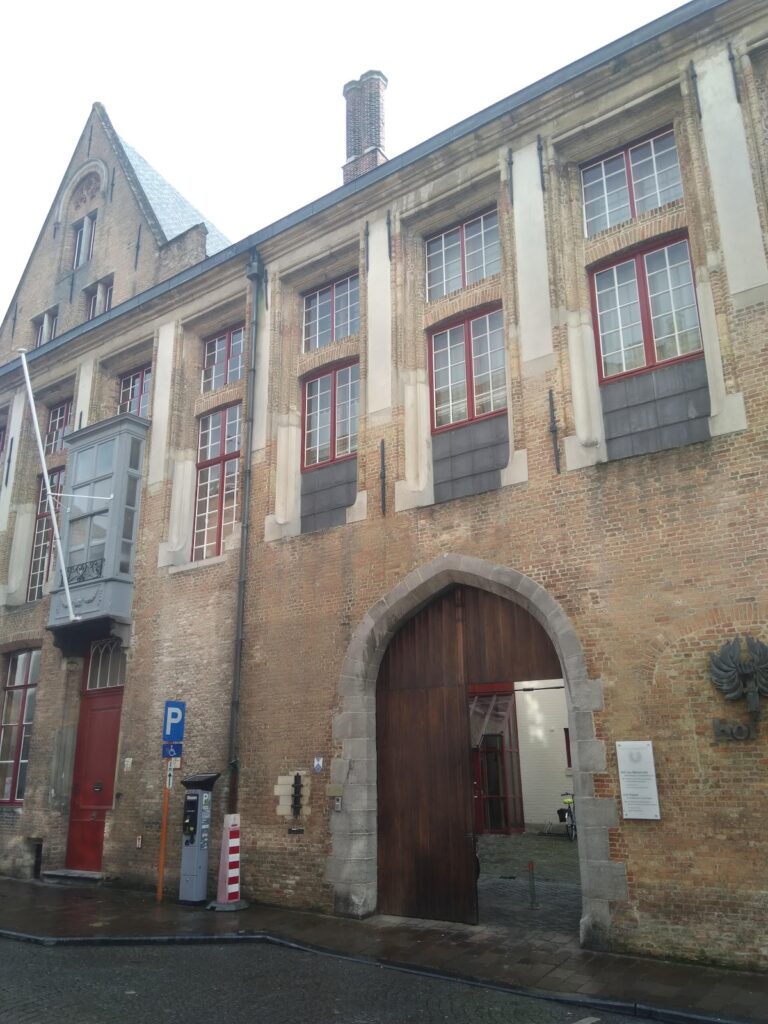
The entrance opens onto an enclosed, paved courtyard arranged with geometrically clipped boxwood hedges. Beside the main entrance rises a prominent Gothic tower. The entrance arcade rests on two carved corbels that carry the ribs. One corbel shows a woman and a dog, both symbols of fidelity. The other represents the story of Saint Alphege of Canterbury, who was abducted by the Normans in 1011. He refused to pay his ransom because doing so would have exhausted funds intended for the poor, and he was killed in 1012 after being pelted with animal bones during an orgy.
In 1469, Tommaso Portinari placed two medallions on the gatehouse facade to commemorate the marriage of Lorenzo de Medici and Clarice Orsini. Lorenzo was the leading Florentine ruler and patron of the arts associated with the Medici family in the later fifteenth century. The medallions are regarded as exceptionally important early examples of Renaissance art in Bruges. Renaissance art revived and transformed classical artistic forms that had begun in Italy and spread across Europe. The medallions were originally polychrome, with dark-brown heads against an azure-blue ground, and were surrounded by eight repetitions of the Medici emblem, a ring with three peacock feathers. The palace itself was originally ochre yellow.
Historical rooms and paintings
Two historical rooms contain beam-heads bearing the arms of Philip the Good and Isabella of Portugal. The walls of the Roman Hall are covered with sixteenth-century Mannerist paintings reproducing works from Raphael’s Vatican Rooms. Mannerism was a later sixteenth-century style known for deliberate artificiality, elongated forms, and complex compositions.
Hof Bladelin also contains The Adoration of the Shepherds, an oil painting on wood attributed to the Bruges painter Jacob van Oost, who was active mainly in the seventeenth century. The painting came from the monastery of the Apostolic Sisters of Bruges.
Chapel of Our Lady of the Assumption
The chapel of Our Lady of the Assumption was built in 1832 on part of the Naaldenmarkt to a design by the architect Franciscus Cools. Its late-Classical design was inspired by the Roman church of Saint Agnes Outside the Walls. The chapel is a brick building beneath a slate-gabled roof with a small roof turret. Its undecorated side walls contain semicircular windows reinforced with iron.
Inside, the three-aisled church extends for six bays and has superimposed columns finished to resemble marble, using the Doric and Ionic orders. A coffered barrel vault carries floral decoration, while a gallery with a brass balustrade was designed by Georges Dumery. In the apse, grisaille paintings by Joseph Paelinck, dated 1834, represent Charity, Faith, Hope, Love, and Religion. Grisaille is a painting technique that uses mainly gray tones to imitate sculpture or relief.
Two carved angels by Laurent Delvaux came from the court chapel of Charles of Lorraine. Above them stands an eighteenth-century statue of the Virgin Mary by Pieter Pepers. The organ gallery has small Corinthian columns and supports a Hooghuys organ. The stained-glass windows date from 1904 and were made by Jules Dobbelaere.
Nearby sites