Wodzicki Palace in Kościelniki: A Baroque and Classicist Estate in Kraków


Site at a Glance
- Rating
- 4.3
- Popularity
- Very Low
- Country
- Poland
- Primary era
- Early Modern
- External website
- Open
- Eras represented
- Early Modern
- Civilizations
- Polish–Lithuanian Commonwealth
- Site type
- Domestic
- Remains
- Palace
On this page11 sections
History
Wodzicki Palace in Kościelniki is a historic palace in Kraków, Poland, built for the Morstin family in the Baroque period and later remodeled in the Classicist style. Its history belongs to the former village of Kościelniki, now within Kraków’s District XVIII, and includes connections with Polish political, theatrical, and artistic life.
From estate to palace
The first owner of the estate was Stanisław Lubomirski, a voivode, or high-ranking territorial governor in the Polish-Lithuanian Commonwealth. The property later passed to the Kraków cathedral chapter, the governing body of clergy attached to the cathedral, and then to the Morstin family.
In 1708, Stefan Morstin commissioned a two-storey palace from Józef Piola. The Baroque building was placed at the center of an earlier defensive complex. In the late eighteenth century, Eliasz Wodzicki ordered its remodeling in the Classicist style, which drew on the forms and principles of ancient Greek and Roman architecture. The estate remained with the Wodzicki family from 1773 until the end of the Second World War.
Visitors and cultural associations
The palace was associated with several notable figures. Wojciech Bogusławski, a Polish actor, theatre director, and playwright, spent summer holidays there while visiting his grandmother. King Stanisław August Poniatowski, the last king of the Polish-Lithuanian Commonwealth, also came to Kościelniki to meet his sister, Izabella Poniatowska. Eliasz Wodzicki commemorated that meeting with a monument-fountain in the park.
Franciszek Ksawery Matejko, a music teacher and the father of the painter Jan Matejko, taught music at the palace. These associations place the residence within the social and cultural world of the Polish nobility before the political and military upheavals of the twentieth century.
War, decline, and changing ownership
After the fall of the Warsaw Uprising, the Wodzicki family established a hospital in the palace for refugees from Warsaw. The family left the Kościelniki estate at the end of January 1945. Red Army soldiers then occupied the palace for approximately six months, destroying the remaining furnishings and cutting down trees in the park.
After the Second World War, the palace gradually deteriorated, and the western outbuilding also fell into ruin. The estate was returned to the Wodzicki family in 1998, after which Zofia and Iwo Nowina Konopka became its owners. The palace and its plot were sold to a private individual in April 2020, while Iwo Nowina Konopka is listed as the current owner. The building is entered in Poland’s register of historic monuments under number A-676, dated 3 June 1985.
Remains
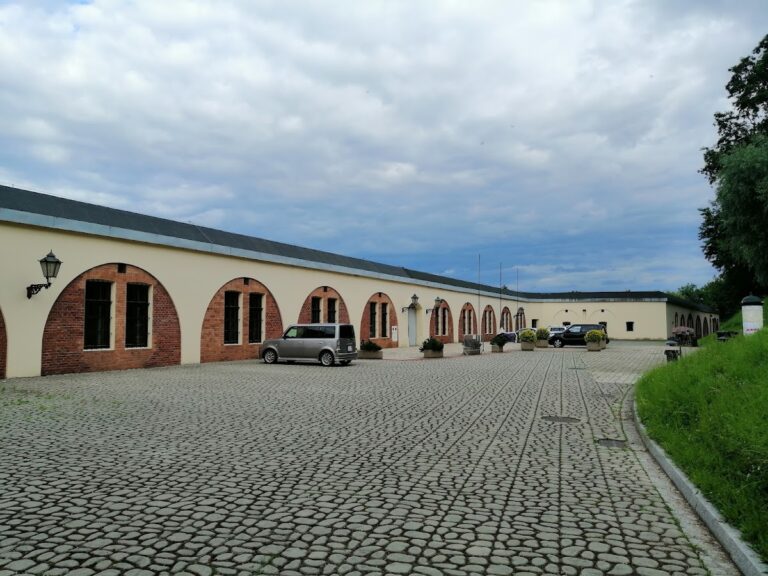
The surviving estate is organized around a two-storey palace with an H-shaped plan and a hipped roof. Its projecting side wings extend beyond the front facade to form corner pavilions. The building stands within grounds that once included formal gardens, water features, service buildings, and smaller structures associated with the residence.
Palace architecture
Central entrance
The main facade is centered on a roofed portico supported by four Ionic columns. Their capitals have the scroll-shaped forms characteristic of the Ionic order. A triangular pediment crowns the entrance and carries two heraldic emblems: the Wodzicki family’s Leliwa coat of arms on the left and the Pilawa coat of arms on the right, the latter associated with the Potocki family.
Western outbuilding
The western outbuilding formed part of the estate’s architectural complex. Like the palace, it deteriorated after the Second World War and is now ruined.
Gardens and monument-fountain
Terraced grounds
During the estate’s period of prosperity, terraced gardens surrounded the palace. Ponds and water channels shaped the grounds, while garden pavilions, an orangery, a chapel, and additional outbuildings served the wider residence. These elements formed the landscaped setting of the palace and its domestic and ceremonial life.
Commemorative fountain
The park’s monument-fountain stood four metres high and took the form of a stone vase with two bronze handles. Inscriptions on its sides referred to two royal encounters. One concerned Stanisław August Poniatowski’s meeting with Catherine II, empress of Russia, at Kaniów; the other commemorated his meeting with Izabella Poniatowska at Kościelniki. Fragments of the fountain survive, including pieces that retain parts of the inscriptions.
Nearby sites