Palazzo Ghini: An Aristocratic Palace in Cesena, Italy
Site at a Glance
- Rating
- 4.4
- Popularity
- Low
- Country
- Italy
- Primary era
- Early Modern
- Eras represented
- Early Modern
- Civilizations
- Papal States
- Site type
- Domestic
- Remains
- Elite Residence
On this page6 sections
History
Palazzo Ghini is an aristocratic palace in Cesena, Italy, commissioned by the Ghini family in 1680 in the late Baroque period. The site had earlier activity, with archaeological evidence of Roman buildings generally dated to the 3rd and 2nd centuries BC. Located in the historic center, the palace became the residence of the Ghini marquesses and is the best known of the family’s five palaces in Cesena.
The Ghini family and the palace commission
The Ghini family was a noble Italian family whose documented nobility in Siena reaches back to the early 13th century. Around 1600, its members were appointed marquesses of Romagna and recognized as patricians of Cesena and San Marino. The family also received the fief of Roccabernarda. Giovanni II Ghini acquired the palace site and other properties, and the family moved to Cesena in 1654.
The present palace was commissioned in 1680 by the brothers Giacomo Francesco and Alessandro Bruno Ghini. They entrusted the project to the Cesena architect Pier Mattia Angeloni. The building served as the residence of the Ghini marquesses for more than a century.
Ecclesiastical residence and later use
After an inheritance division, Monsignor Ghino Ghini obtained the entire property and reshaped it as a residence for ecclesiastical use. He donated the palace to the Jesuits, the Catholic Society of Jesus, who established their headquarters there from 1942 to 1962 and operated an apostolic school, a religious school associated with the formation of clergy or members of a religious order.
The palace later became the property of the Curia, the administrative body of a diocese or other ecclesiastical jurisdiction, and remains in use. Its history is also linked to Pope Pius VI and Pope Pius VII, successive Roman Catholic popes of the late 18th and early 19th centuries who were close relatives of the Ghini family. Their marble busts were presented to the palace as official personal gifts, and both popes posed for the works.
Remains
Exterior and plan
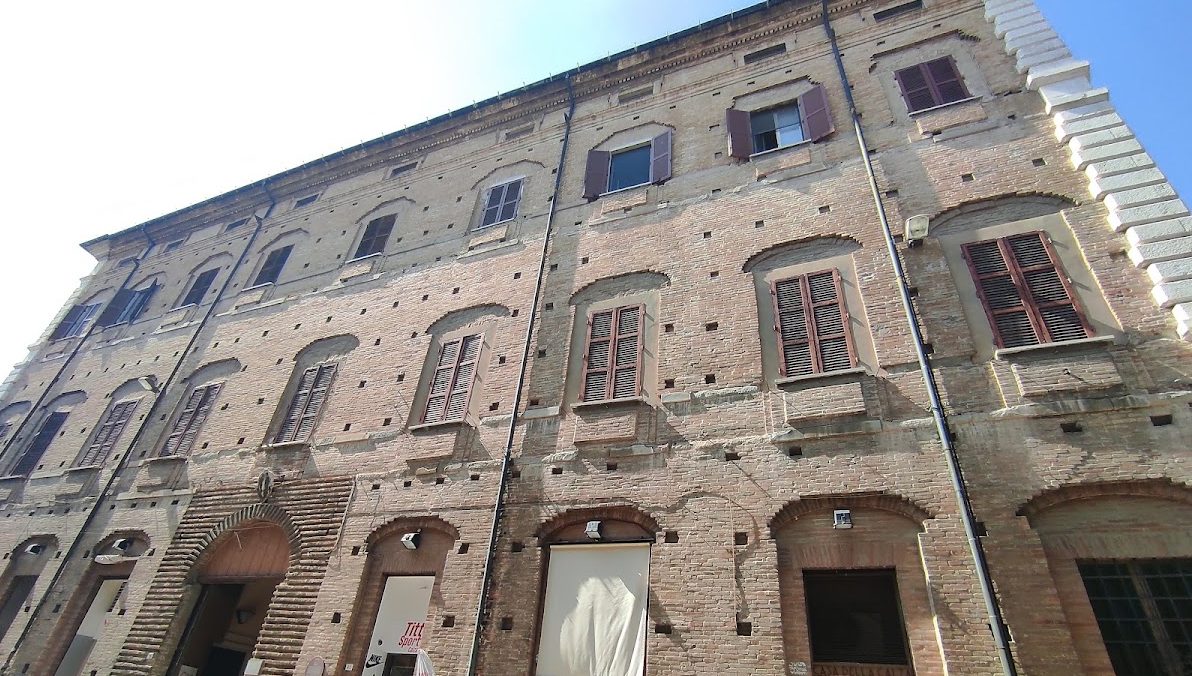
Palazzo Ghini stands on Corso Sozzi at the junction of the former Cervese road and Contrada San Zenone, near Corso Cavour and the station. It rises above the neighboring historic buildings and has a massive exterior. The original design called for a U-shaped plan, but construction produced only the ranges along Corso Sozzi and part of Via Uberti.
The Corso Sozzi facade retains unfinished stone detailing, while putlog holes, openings left in masonry for horizontal construction supports, indicate that parts of the work were never completed. Istrian stone faces the corners, where the building is decorated with the papal insignia of Pius VI.
Courtyard and ceremonial interiors
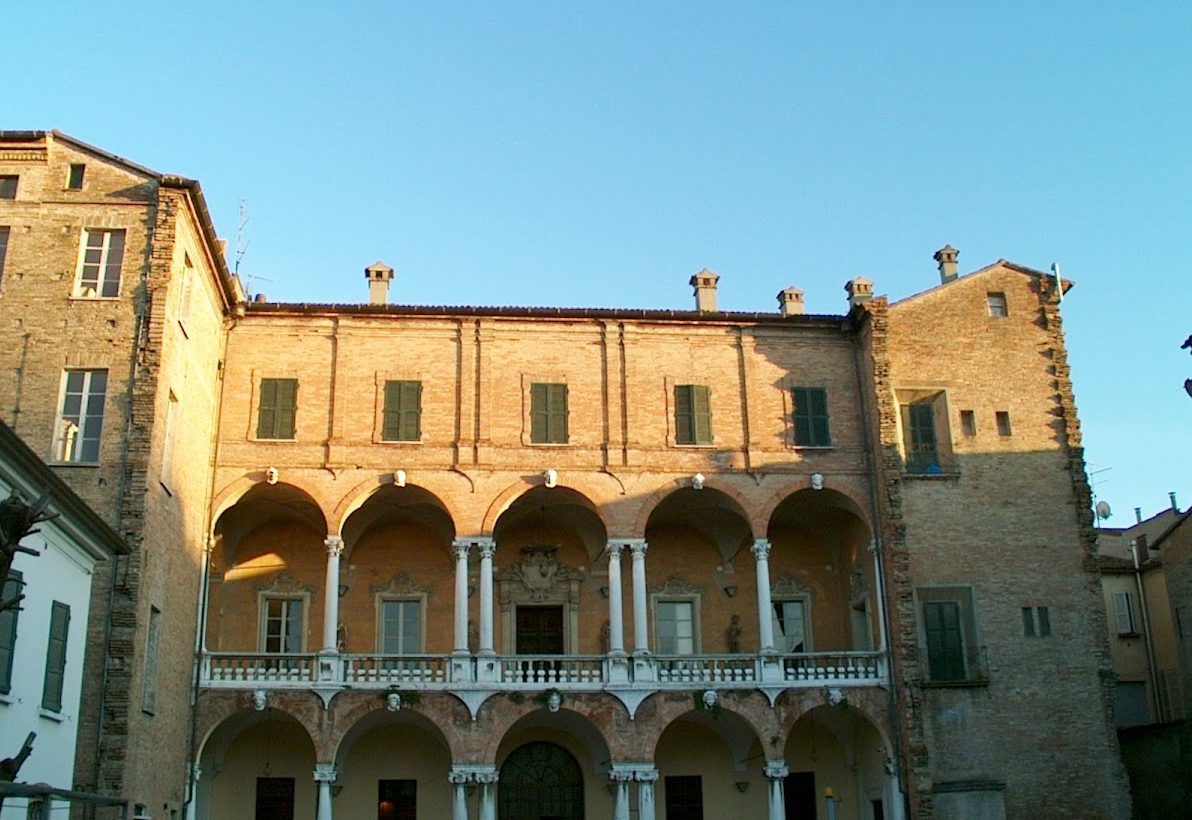
The courtyard facade contains a three-level loggia, a roofed architectural gallery or open-sided passage supported by columns. White-stone columns occupy the two lower levels, and the gallery provides a frontal view of the Malatestiana Library, Cesena’s historic civic library known for its Renaissance building.
A staircase leads to the loggia and its four statues by Francesco Calligari. The figures represent Minerva, Ceres, Glory, and Mars. From the loggia, the route continues to the great hall of honor, whose decoration includes a late Baroque cycle of historical and mythological frescoes by Giacomo Bolognini, painted between 1719 and 1721. The cycle originally contained 15 frescoes, of which 13 remain. The palace also preserves the marble busts of Pope Pius VI and Pope Pius VII.