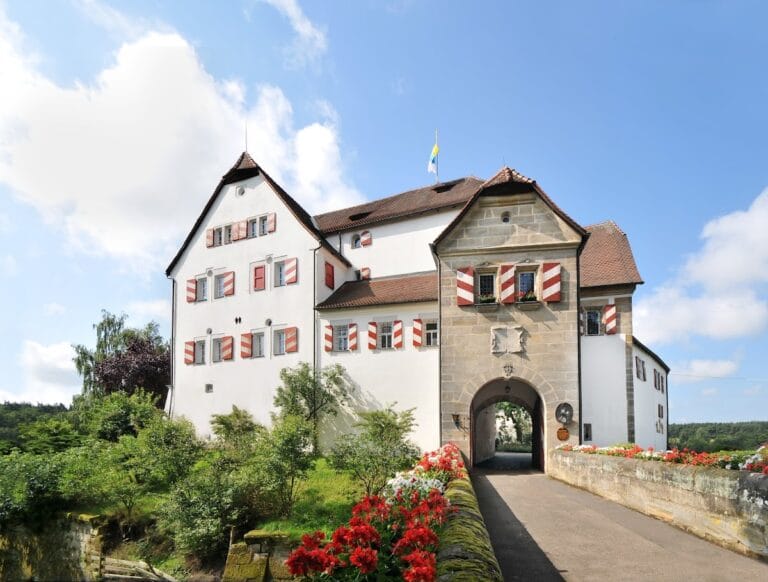
Schloss Grünsberg: A Medieval Castle and Baroque Palace in Germany


Site at a Glance
- Rating
- 4.3
- Popularity
- Low
- Country
- Germany
- Primary era
- Early Modern
- External website
- Open
- Eras represented
- Medieval, Early Modern
- Civilizations
- Holy Roman Empire
- Site type
- Domestic
- Remains
- Castle
On this page11 sections
History
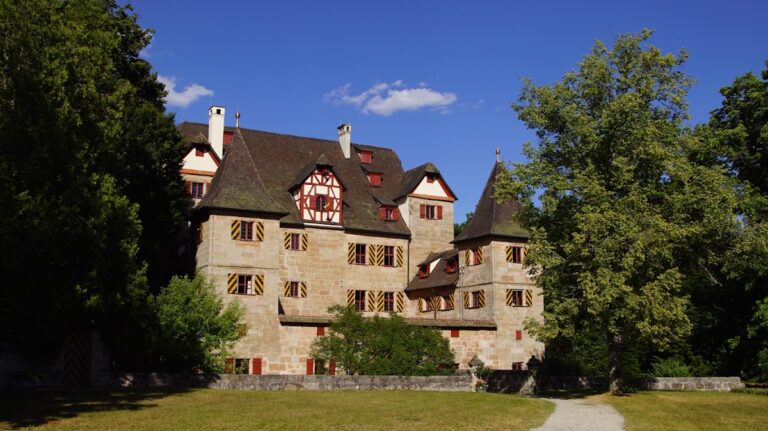
Schloss Grünsberg is a castle and palace complex in Germany near Altdorf, originating before 1231 as a medieval fortified seat on imperial property. Its later transformation into a palace between 1717 and 1723 preserved the basic form of the medieval fortress while adding Baroque buildings and interiors. The estate remained closely connected with the political and social world of Nuremberg, passing among ministerial, noble, and patrician families before becoming a charitable foundation in the early twenty-first century.
Imperial origins and the Rindsmaul fief
Grünsberg was probably established on behalf of the Empire, although the proposed defensive tower associated with the Hungarian invasions around 945 remains only a hypothesis. An imperial fief was property held from the emperor or Empire in return for service or obligations. The imperial ministerial Albertus Rindesmule de Nurnberch held the castle in this way and was using the name Rindesmule de Grundisperc by 1231. An imperial ministerial belonged to an official class that could hold military or administrative office, but whether Albertus took part in the castle’s construction is uncertain.
After the inheritance of the last Staufer, Konradin, the imperial fief passed to Ludwig the Strict of the Wittelsbach dynasty, while the Rindsmaul family retained possession. In 1311, Ludwig the Bavarian pledged the castle to the brothers Albrecht, Marquart, and Hartmann Rindsmaul for 350 pounds of Heller, a small medieval German monetary unit. Two hundred and fifty pounds had already been paid, and 100 pounds were to be spent on Grünsberg. In 1315, despite the Rindsmaul claims, Ludwig transferred the pledge to their brother-in-law, the knight Seyfried Schweppermann. His military assistance had contributed to Ludwig’s victory at the 1313 Battle of Gammelsdorf, a conflict in which Ludwig defeated forces supporting his rival. The Schweppermann family’s position as pledgeholders and heirs of the Rindsmauls was confirmed in 1375 by Count Palatine Ruprecht and his successors.
Wars and Nuremberg ownership
After the Schweppermann line died out, the Freudenberg family acquired Grünsberg in 1433. Nuremberg troops besieged and damaged the castle during the First Margrave War, a conflict between the imperial city of Nuremberg and the Margrave of Brandenburg-Ansbach. In 1481, the Truchseß von Pommersfelden family, who served the Wittelsbachs, acquired the estate.
Nuremberg forces burned the castle during the War of the Landshut Succession, a late medieval struggle over the inheritance of the Duchy of Bavaria-Landshut. In 1504, Grünsberg passed to the imperial city of Nuremberg, a city directly subject to the Holy Roman Emperor rather than to a territorial prince. The city leased the entire estate in 1506 to the Nuremberg merchant Wilhelm Rauscher. Rauscher later transferred it to his creditor Hans Durnhöfer and, after becoming insolvent, returned it to the city council in 1518.
Patrician families and rebuilding
The Nuremberg patrician Friedrich Behaim bought the estate for 3,000 gulden in 1529. Nuremberg patricians were members of the city’s hereditary governing elite, whose families combined political office, commerce, and landownership. Behaim was required to keep the castle open to the Nuremberg council and could sell or bequeath it only to Nuremberg citizens. His family undertook only partial renovations, and the castle was already regarded as a ruin before another fire damaged it during the Second Margrave War in 1552.
The Oertel family acquired Grünsberg in 1556 and rebuilt the castle. Repairs to the damage caused by both wars continued for several years, and the three-storey main residential building was completed in 1561. The estate subsequently continued to pass by inheritance. Sigmund Haller von Hallerstein inherited it through marriage in 1579. In 1672, his son-in-law Johann Paul II Paumgartner von Holnstein inherited Grünsberg, after which the family adopted the name Paumgartner von Holnstein und Grünsberg.
Baroque expansion and the Stromer inheritance
Between 1717 and 1723, Johann Paul III Paumgartner expanded the medieval castle into a palace complex. He retained the old castle’s basic form while adding historically inspired elements, stucco ceilings, a stair tower on the main building, a tower structure at the northeast corner, and the main castle gatehouse, completed in 1723. Additional buildings were erected in the outer bailey, the enclosed area containing subsidiary castle buildings.
Around 1730, Johann Paul Paumgartner’s widow, Sophie Paumgartner, born Nützel von Sündersbühl, married a member of the Haller family. Grünsberg therefore belonged to the Haller von Hallerstein family from 1730 to 1766. Sophie’s daughter from her second marriage, Eleonore Haller von Hallerstein, married Karl Christoph Stromer von Reichenbach in 1754. In 1766, Sophie transferred Grünsberg to her son-in-law in return for his assumption of her substantial debts. Since that year, the estate has belonged to the Stromer family, one of Nuremberg’s oldest and most prominent patrician families.
Conservation and foundation
Major renovations took place in 1909–1912 and 1919–1923. Damage in the castle forecourt from the Second World War had been provisionally repaired by 1954, and comprehensive conservation measures began in 1990. The last owner, Wolfgang Stromer von Reichenbach, provided in his will for the estate and palace to become a public charitable foundation under civil law. The Stromersche Kulturgut-, Denkmal- und Naturstiftung was established for this purpose in 2000, with the aim of preserving the monument and its inventory for future generations and making it accessible as far as possible. Rotraut Freifrau von Stromer-Baumbauer has administered the foundation and overseen conservation work since her father’s death.
The Bavarian State Office for Monument Protection designates Schloss Grünsberg as both an architectural monument and an archaeological monument. The foundation received the Bavarian Monument Preservation Medal in 2009 for the comprehensive renovation of Grünsberg Castle and the Silver Hemisphere in 2010, described as the most important national award of its kind. The estate also includes the Sophienquelle, gardens, a tithe barn, and woodland. The forest, together with the Rhaetian sandstone gorge known as Teufelskirche, entered the European Union’s FFH list of specially protected areas in 2004. FFH is the European Union system for protected areas established under the Habitats Directive.
Remains
Castle setting and medieval structure
Schloss Grünsberg stands in a depression on a hill spur that falls steeply toward the Schwarzach in a gorge-like formation. The surviving complex retains the basic form of the medieval fortress, even though it was enlarged as a palace in the eighteenth century. Its physical development can be read in the relationship between the medieval core, the sixteenth-century residential building, and the Baroque additions placed around it.
Residential buildings and fortified entrance
The three-storey main residential building, also called the main chamber building, was completed in 1561 during the rebuilding after the First and Second Margrave Wars. The expansion of 1717–1723 added important stucco ceilings and a stair tower to the main building. A tower structure was also added at the northeast corner. These works incorporated the older castle into a more extensive palace complex while preserving its underlying medieval form.
The main castle gatehouse was built in 1723. A gatehouse controls passage through a fortified entrance, and at Grünsberg it forms part of the Baroque reworking of the castle’s approach. Further buildings were added in the outer bailey, extending the complex beyond the principal residential structures.
Gardens, spring, and estate buildings
A Baroque garden was laid out outside the southern wall and connected with the straight avenue leading to the Sophienquelle. The garden is now severely damaged and closed off. The Himmelgarten, a Renaissance-Baroque garden originally arranged across seven terraces, was remodelled during the Baroque period. Its orangery no longer survives, and the garden is now used as an animal cemetery.
The Sophienquelle is a monumental Baroque spring installation created in 1724–1726 according to an Italian model in honour of Sophie Nützel von Sündersbühl. It is described as the largest enclosed Baroque spring complex north of the Alps. A Baroque tithe barn adjoins the Himmelgarten. A tithe barn stored dues traditionally paid in kind, often in the form of agricultural produce, and forms part of the wider estate associated with the palace.
Historic interiors and collections
The palace contains an inventory closely connected with the imperial city of Nuremberg and spanning the thirteenth to the twentieth century. Historical everyday objects and furniture, portraits, Nuremberg death shields, valuable glass goblets, and other objects illuminate patrician life across the centuries. Venetian moon-glass panes survive especially on the second floor of the palas, the principal residential and representative building of a medieval castle.
Among the objects is a construction model of the Rialto Bridge in Venice dating from the 1580s. It probably belonged to Wolf Jacob Stromer, the builder of Nuremberg’s Fleisch Bridge, although whether it was actually used in constructing that bridge remains disputed. The late-medieval portable altar of the city architect Endres Tucher contains several tiny reliquary pouches. An inscription on the altar states that it was consecrated by the archbishop of Acre.
Nearby sites