Haga Palace: A Neoclassical Royal Residence in Sweden


Site at a Glance
- Rating
- 4.1
- Popularity
- Low
- Country
- Sweden
- Primary era
- Modern
- External website
- Open
- Eras represented
- Modern
- Civilizations
- Swedish
- Site type
- Domestic
- Remains
- Palace
On this page7 sections
History
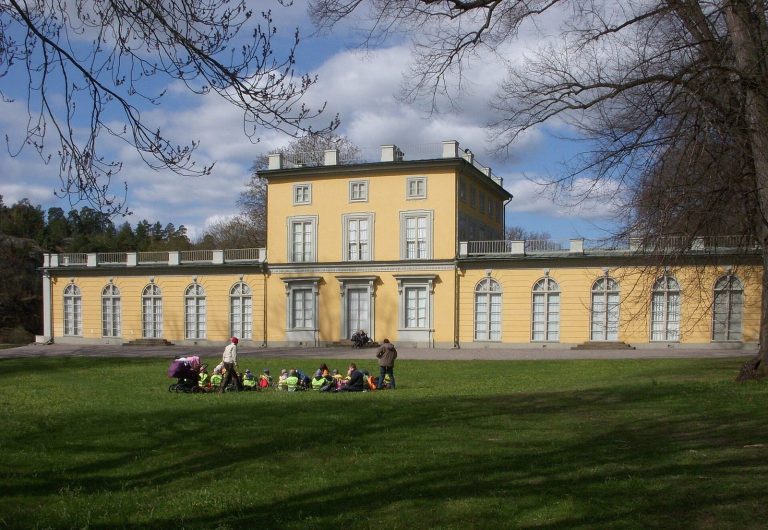
Haga Palace is a royal residence in Sweden, located in Haga Park in Solna. Built between 1802 and 1805 in the Neoclassical style, it was commissioned as a smaller residence for the royal children after plans for a monumental palace at Brunnsviken were abandoned.
Royal origins and nineteenth-century use
The decision to build Haga Palace followed the assassination of King Gustav III in 1792. His successor, Gustav IV Adolf, commissioned the architect Carl Christoffer Gjörwell in 1802 to design a new residence north of Gustav III’s Pavilion. Construction began in May that year and was completed in 1805. The building was also known as Haga slott and, in an earlier period, as the Queen’s Pavilion.
The residence saw relatively limited use until the 1820s, when the future King Oscar I and Crown Princess Josephine occupied it as a summer home. Their second son, Gustaf Bernadotte, was born at Haga. Following his death in 1852, a monument commemorating him was erected in the nearby park.
During the 1860s, Haga Palace was renovated for Prince August, Duke of Dalarna, the youngest son of Oscar I, and his wife, Princess Therese of Saxe-Altenburg. Therese remained there for 54 years, until her death in 1914, and gave the residence much of its domestic character. Prince Erik, a son of King Gustaf V, later used the palace temporarily until his death in 1918.
The Haga family
After an extensive renovation directed by the architect Ragnar Hjorth, Prince Gustaf Adolf, Duke of Västerbotten, and Princess Sibylla of Saxe-Coburg and Gotha moved into Haga Palace in 1932. Their four daughters, Margaretha, Birgitta, Désirée, and Christina, became known together as the Haga Princesses.
Carl XVI Gustaf was born at Haga Palace in 1946 and spent his childhood there with his sisters. His father, Prince Gustaf Adolf, died in the KLM DC-3 crash at Copenhagen Airport on 26 January 1947. Afterward, Sibylla and her children eventually stopped living at the palace full-time.
State use and return to the royal court
In 1966, King Gustaf VI Adolf transferred the right to use Haga Palace and its grounds to the Swedish government. The residence was intended to accommodate distinguished foreign visitors and heads of state, although it was used relatively infrequently.
On 23 April 2009, Prime Minister Fredrik Reinfeldt announced that the government would return control of the palace’s use to the royal court as a wedding gift for Crown Princess Victoria and Daniel Westling. The formal transfer took place on 1 October 2009. Victoria and Daniel moved into Haga Palace in November 2010, following their marriage on 19 June that year. Renovation of the residence began in 2011. The Swedish State remains its owner, while the Royal Court of Sweden occupies it as the home of Crown Princess Victoria, Prince Daniel, and their family.
Remains
The palace building
Haga Palace is a three-storey Neoclassical building containing 41 rooms. Its design presents the residence as a modern Italian-style villa and was modelled on the villa of ballet master Louis Gallodier at Hvilan in Drottningholm. Gjörwell designed the building after working at Haga from 1788 and studying under Louis Jean Desprez during work on Gustav III’s Pavilion and the unfinished palace at Brunnsviken. Gjörwell also designed the Echo Temple.
The exterior was largely complete by 1803. By December of that year, the scaffolding had been removed and the marble columns had been erected, while the interior work continued until late 1805. The building’s restrained classical character reflects Neoclassicism, an architectural style based on ancient Greek and Roman forms, symmetry, and classical columns.
Reused materials
Fourteen marble columns at Haga originated in Finland. During the reign of Sigismund III Vasa, they were taken to Poland and later returned to Sweden by Gustavus Adolphus. Nicodemus Tessin the Younger subsequently reused them in the German Church in Karlskrona. After that church was reconstructed following a major fire in 1790, the columns became available for use at Haga Palace.
Other elements also came from earlier royal building projects. The oak flooring was taken from Fredrikshov Palace, while stone originally acquired for Gustav III’s unfinished palace at Brunnsviken was incorporated into Haga Palace. In the surrounding park, a monument to Gustaf Bernadotte was erected after his death in 1852.