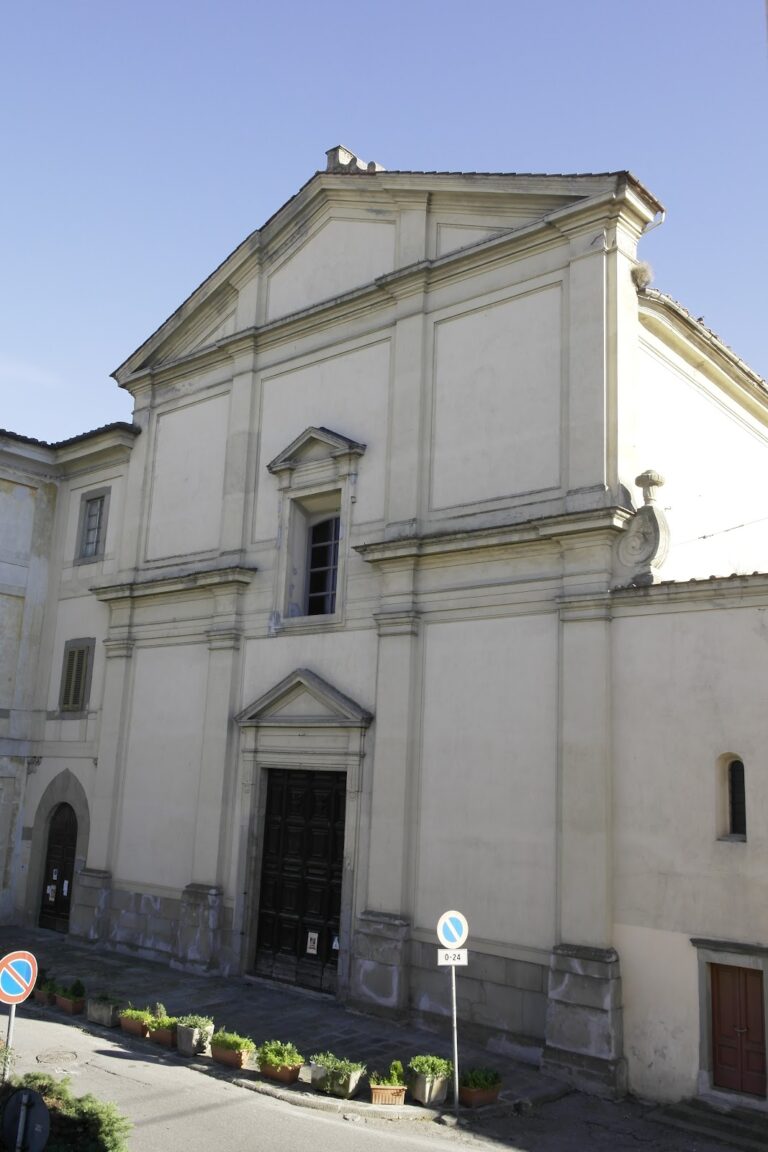
Palazzo Fabroni: A Historic Palace and Contemporary-Art Museum in Pistoia


Site at a Glance
- Rating
- 4.5
- Popularity
- Low
- Country
- Italy
- Primary era
- Medieval
- External website
- Open
- Eras represented
- Medieval, Early Modern, Modern
- Civilizations
- Grand Duchy of Tuscany, Italian, Republic of Florence
- Site type
- Domestic
- Remains
- Elite Residence
On this page14 sections
History
From the Dondori family to the Fabroni family
Palazzo Fabroni is a historic palace in Pistoia, Italy, whose origins lie in a medieval tower house. The earliest known reference appears in a 1353 inventory of the Spedale del Ceppo, a historic hospital institution in Pistoia, which lists a palace beside the chapel of Sant’Andrea, opposite the church. Around that time, the Pistoian Dondori family acquired the property and retained it for almost three centuries.
In 1620, the Dondori family sold the palace to the heirs of the Fabroni family. The Fabroni occupied the building until the early nineteenth century and probably undertook its complete restructuring during their tenure. After Carlo Fabroni died without male heirs, the property passed to his son-in-law, the Marquess Mazzarosa. Mazzarosa’s daughters sold it to the municipality in 1861 for 23,520 scudi.
Municipal and institutional uses
After its acquisition by the municipality, Palazzo Fabroni served changing public functions. From 1861 to 1927, it housed the offices of the subprefecture, a local government administration headed by a subprefect. Between 1928 and 1945, the Pistoian Federation of the National Fascist Party occupied the building. The party was Italy’s Fascist political organization under Benito Mussolini, and it was dissolved in 1943. After the Second World War, the palace became a middle school for approximately twenty years.
Transformation into an art museum
Following a lengthy restoration, Palazzo Fabroni was assigned in 1990 to serve as a center for contemporary visual arts. It is owned by the Municipality of Pistoia and now functions as the city’s contemporary-art museum. Its permanent collection began to take shape in the 1980s through bequests and donations from postwar artists, including Agenore Fabbri, Gualtiero Nativi, and Mario Nigro.
The holdings grew through further donations connected with solo and thematic exhibitions at the palace, including works by artists associated with Pop Art, Arte Povera, and Minimal Art. Arte Povera emerged in Italy during the 1960s and often employed humble or unconventional materials, while Minimal Art emphasized reduced forms and geometric order. The collection opened in 1997 through the union of municipal holdings, new acquisitions, and donations accumulated during the preceding years. It covers contemporary art from the postwar period to the present, with particular attention to artists connected with Pistoia and to artists who exhibited at the museum from 1990 onward.
Palazzo Fabroni belongs to the Metropolitan System for Contemporary Art of Florence, Prato, and Pistoia and to the Association of Italian Contemporary Art Museums. In autumn 2011, Aurelio Amendola enlarged the collection with eleven photographic portraits of artists made during his career. The donation placed portraits of several artists in dialogue with their works and established a separate group of portraits on the first floor.
Remains
Historic fabric and external architecture
Facade and entrance
The palace retains the substantial stone pillars and segmental arches of its tower-house phase on the ground floor. Its facade follows Florentine Mannerist architecture, a sixteenth-century style known for elongated forms, complex compositions, and varied adaptations of Renaissance conventions. Three levels of windows are distinguished by different pediments. The ground-floor windows have triangular pediments and iron grilles, those on the first floor have curved pediments, and those on the second floor have broken-arch pediments.
The central entrance portal was altered at the beginning of the twentieth century. Its upper section carries a curved, broken pediment containing the family coat of arms, whose design includes three hammers set on a diagonal band.
Interior and garden
Successive interior interventions changed the palace, while most of the load-bearing structures belonging to the former Dondori houses and the fourteenth-century palace were retained. The precise sequence of alterations cannot be reconstructed. The internal arrangement of rooms remains irregular rather than following the ordered rhythm of the facade. On the first floor, room layouts and wooden ceilings were repeatedly rebuilt.
A large central hall on the first floor was created at the end of the nineteenth century. It is now a double-height exhibition space, although its considerable height had formerly been divided into two levels. A walkway crosses the hall at second-floor level and exposes sections of masonry and terracotta windows that may belong to the earlier palace.
The residence originally possessed an extensive rear garden, giving it the character of a country villa within the city. A continuous portico now opens onto the garden, with a balcony above it, and a reduced version of this arrangement has been reproduced at second-floor level.
Contemporary art displays
Central hall and Pistoian artists
Claudio Parmiggiani’s monumental Scultura d’ombra occupies the walls of the central hall. The galleries surrounding it begin with works by the Pistoian artists Mario Nigro, Gualtiero Nativi, and Agenore Fabbri. Their practices included Abstract Art, which favors non-representational forms, and Informal Art, which emphasizes spontaneous forms and expressive material effects.
Fernando Melani’s room
One room is devoted entirely to Fernando Melani. It contains larger works and several special artistic projects that could not be adequately accommodated in his studio-house on Corso Gramsci. The works reflect his engagement with Abstract Art, Surrealism, Neoplasticism, Constructivism, Abstract Expressionism, Minimalism, and Arte Povera. Neoplasticism was a geometric abstract movement based on strict horizontal and vertical organization and primary colors.
Other collection galleries
Other rooms contain works by Roberto Barni, Bizhan Bassiri, Umberto Buscioni, Enrico Castellani, Giuseppe Chiari, Diego Esposito, Luciano Fabro, Alberto Garutti, Jannis Kounellis, Daniele Lombardi, Vittorio Messina, Nunzio, Claudio Parmiggiani, Alfredo Pirri, Renato Ranaldi, Gianni Ruffi, Daniel Spoerri, and Marco Tirelli. Together, these displays range from Arte Povera to Conceptual Art, Minimal Art, and Visual Poetry. Conceptual Art gives primary importance to ideas and processes, while Visual Poetry combines verbal language with visual composition.
Aurelio Amendola’s portraits
A separate first-floor room contains six of Aurelio Amendola’s donated portraits, depicting Alberto Burri, Enrico Castellani, Giorgio de Chirico, Jannis Kounellis, Marino Marini, and Andy Warhol. Five other portraits, showing Roberto Barni, Umberto Buscioni, Agenore Fabbri, Claudio Parmiggiani, and Gianni Ruffi, are displayed beside works by the corresponding artists.
Photography and installation
The concluding displays include photographs by Mario Carnicelli documenting his participation in Palmiro Togliatti’s funeral in August 1964. Togliatti was an Italian communist politician and longtime leader of the Italian Communist Party. The displays also include Underground no. 02, an installation created specifically for a museum room by the contemporary Italian artist Federico Gori.