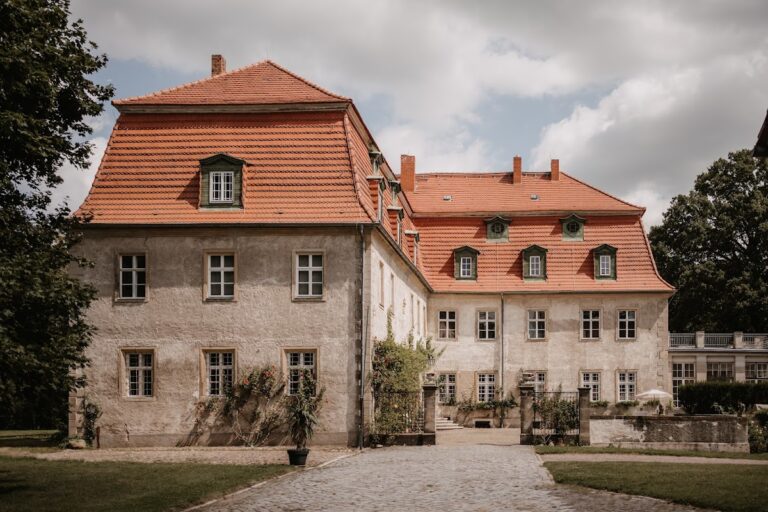
Schloss Grochwitz: A Baroque Palace and Knightly Estate in Germany


Site at a Glance
- Rating
- 4.5
- Popularity
- Low
- Country
- Germany
- Primary era
- Modern
- External website
- Open
- Eras represented
- Early Modern, Modern
- Civilizations
- Electorate of Saxony, Holy Roman Empire
- Site type
- Domestic
- Remains
- Elite Residence
On this page8 sections
History
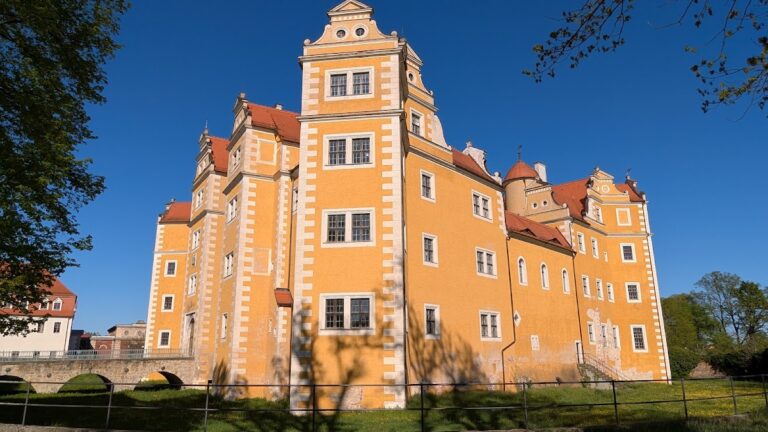
Schloss Grochwitz is a former palace and knightly estate in Herzberg (Elster), Germany. It developed from a manor associated with the village of Grochwitz into a Baroque palace during the 1730s, when Heinrich von Brühl commissioned its transformation and a palace park was laid out.
From village estate to noble manor
The Frauenhorst family became owners of Grochwitz in the late fifteenth century. Hans and Christoff von Frauenhorst operated a farm with five deserted hides, 19 farming holdings, and 14 cottager holdings. A hide was a historical unit of agricultural land, while a cottager was a smallholder with less land than a full peasant farmer. The farmers held twelve hereditary hides and paid dues recorded as 11 shock and 11 groschen. After extensive alterations, the farm was recognized as a knightly estate, a landed manor associated with the lower or provincial nobility.
Cuntz von Mila was recorded as the owner in 1550 and transferred the estate to Salomon von Mila in 1575. In 1589, it passed to the Pelikan family, who sold it to a member of the Wuthenau family. Benno Friedrich Brand von Lindau acquired Grochwitz from Albrecht von Wuthenau in 1625, but died that same year. The estate then passed to the Electoral Saxon court judge Daniel von Koseritz, who transferred it to Karl Gottlob von Römer at the end of the seventeenth century.
Brühl’s palace and wartime destruction
Heinrich von Brühl, a prominent minister and court official in the Electorate of Saxony and the Polish–Lithuanian Commonwealth, acquired Grochwitz in 1730. Under his ownership, the manor buildings were transformed into a palace in the 1730s, around 1736 according to a design by the architect Samuel Locke. The palace park was created at the same time.
The estate suffered severe damage during the Seven Years’ War, the major European conflict fought from 1756 to 1763. Frederick the Great, Frederick II of Prussia, occupied Grochwitz for four days from 20 October 1757, and his soldiers plundered the estate. A damage report dated 26 October estimated the losses at 34,503 thalers, a widely used silver currency in Central Europe. On 7 September 1758, Prussian soldiers set the palace on fire.
Financial pressure followed the wartime damage. Heinrich von Brühl was forced to sell the estate to Adolf Christian Wendler in 1761, and Wendler transferred it to Georg Gottlieb von Schenk in 1763. Another fire struck the palace in 1783.
The Barner and Palombini families
Christoph Wedig von Barner, an Electoral Saxon major who later became a general, owned Grochwitz from 1789. He died there in 1821. In June of that year, his second wife, Luise von Barner, daughter of Johann Heinrich Dombrowski, bequeathed the estate to her niece Antonie Caroline, who was married to Field Marshal Lieutenant Baron Joseph Friedrich von Palombini.
Grochwitz subsequently remained with the von Palombini family. Several of its heirs bore the first name Camillo. From 1900, Camillo Baron von Palombini served as district administrator of the Schweinitz district. Around 1922, the estate covered 239 hectares and was leased to Erich Kinder.
Baron Kraft von Palombini, the last representative of the aristocratic family, sold Grochwitz in 1938 to the farmer Hans-Friedrich Diesing of Trautensee near Breslau. After Diesing’s death, his family sold the property in 1940 to Otto Friedrich, a former mayor of Schöneiche near Berlin.
Postwar uses and restoration
After 23 April 1945, the Red Army used the palace briefly. It then became emergency accommodation for refugees. Land reform in the Soviet occupation zone expropriated Friedrich in 1945 and divided the estate’s 442 hectares.
From 1946, the building housed training for new teachers. Between 1948 and 1977, it served as the boarding school of Herzberg’s extended secondary school. After renovation, rooms were occupied from 1977 by various working groups directed by the Station for Young Naturalists and Technicians. The roof superstructure, the raised architectural element above a roof, and the clock were renewed in 1982.
An arson attack on 14 March 1992 destroyed the roof framework, while firefighting water damaged parts of the interior. The roof and small tower were rebuilt in 1994–95. Extensive renovation began after the property was sold in 2004. A private investor now operates Schloss Grochwitz as a hotel garni and event venue.
Remains
The palace
The surviving complex originated in the former manor buildings that were redesigned as a Baroque palace during the 1730s under Samuel Locke’s design. Repeated fires altered the building, and most of the fabric that remains dates from the nineteenth century. The roof framework and small tower were reconstructed after the arson fire of 1992, with the rebuilding completed in 1994–95.
The palace park
The palace park was laid out during the eighteenth-century transformation of the manor into a palace. It now contains the zoo operated by the city of Herzberg.
Nearby sites