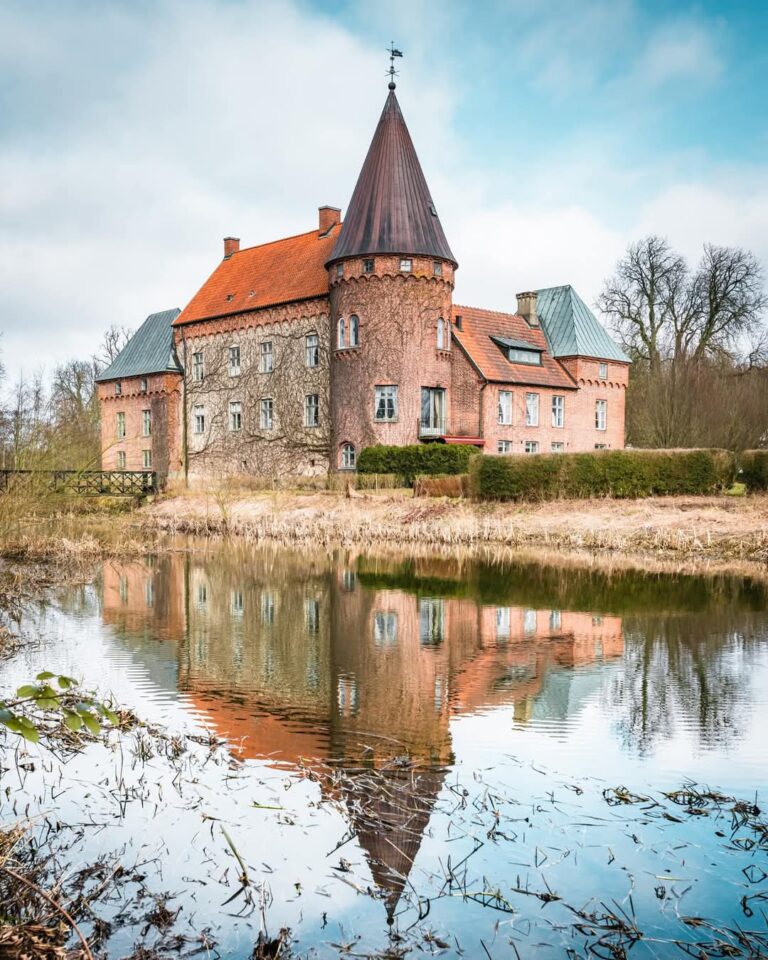
Hjularöd Castle: A Medieval-Style Water Castle in Sweden


Site at a Glance
- Rating
- 4.3
- Popularity
- Low
- Country
- Sweden
- Primary era
- Modern
- External website
- Open
- Eras represented
- Modern
- Civilizations
- Swedish
- Site type
- Domestic
- Remains
- Castle
On this page11 sections
History
Hjularöd Castle is a privately owned manor house in Sweden, built between 1894 and 1897 in the form of a restored medieval fortified castle. The present residence was commissioned by Chamberlain Hans Gustaf Toll, a senior court official, and designed by the Swedish architects Isak Gustaf Clason and Lars Israel Wahlman. Toll appears to have taken the restored Château de Pierrefonds in France as a model for the castle’s medieval appearance.
Medieval estate and Danish rule
Hjularöd was first mentioned in 1391, when Scania belonged to Denmark. In that year, a woman associated with Kirningstetten gave her farm to the Bosone convent. Stone foundations found during construction of the present castle point to earlier buildings on the estate.
The property remained under convent ownership until the secularization of church property transferred it to the Crown, meaning the ruling monarchy and its state authority. The convent and its surrounding lands were then reorganized as an administrative district.
Dresselberg and Akele ownership
In 1579, the Danish king granted Hjularöd to the noble Dresselberg brothers. Ten years later, William Nielsen Dresselberg built a manor on the site of the present castle. The defensive moat may also date from this period. The buildings were probably destroyed during the Danish-Swedish wars.
William Nielsen Dresselberg died without male heirs, and the family’s male line ended in 1620. His daughter Mette Dresselberg and her husband, Frederik Parsberg, later held the estate before selling it to Knud Gabriel Akele, a district judge of Halland. Akele owned Hjularöd for about 30 years and built a new main house that survived until the end of the seventeenth century.
Seventeenth- and eighteenth-century owners
Hjularöd returned to royal ownership in 1658 and was leased to Admiral Henrik Gerritsen, who had received the title Siöholm when he was knighted. He served as a squadron commander under the Swedish military leader Carl Gustaf Wrangel during the Battle of the Øresund. The estate later returned to the Akele family.
In 1662, members of that family sold Hjularöd to Colonel Fredrik von Buchwald, a member of the German noble Buchwald family. After acquiring nearby farms, he adopted the title Baron of Hjularöd in 1675. He also served as governor of Wismar until his death in 1693.
Two of von Buchwald’s sons died in battles during the Great Northern War, the conflict in northern and eastern Europe fought from 1700 to 1721. His youngest son, Georg von Buchwald, was killed at the Battle of Poltava in 1709. Hjularöd then passed to Fredrik’s daughter, Emerentia von Buchwald, who married Colonel Baron Reinhold von Löwen.
After Emerentia became widowed and outlived her unmarried sons, the estate passed to her two daughters. One died unmarried, leaving Charlotte von Löwen as sole owner. She was married to Colonel Bernt Wilhelm von Dellwig. Their son, Christian Georg von Dellwig, held Hjularöd for more than 40 years and erected a new residential building.
The present castle and later ownership
Christian Georg von Dellwig sold the estate in 1805 to Chamberlain Baron Carl Gustaf von Schwerin. His daughter, Brita Catharina, inherited it and later married Per Axel Tull. Their grandson, Chamberlain Hans Gustaf Toll, became the builder of the present castle after acquiring the estate from its previous owners.
Toll’s castle was constructed from 1894 to 1897 as a residence resembling a French medieval stronghold. In 1917, he sold the castle and surrounding lands to a consortium of private investors. The consortium divided the estate into separate parts and sold them individually. Members of the Bergengren family have owned the manor since 1926, and it has remained privately owned and closed to visitors since that year.
Hjularöd has also been used in Swedish film and television. Edvard Persson’s 1924 debut film, Studenterna på Tröstehult, was filmed there, with the castle presented under the name Tröstehult. Scenes for the television series Mysteriet på Greveholm were filmed at the castle in 1996, as were scenes for its 2012 continuation, Mysteriet på Greveholm: Grevens återkomst.
Remains
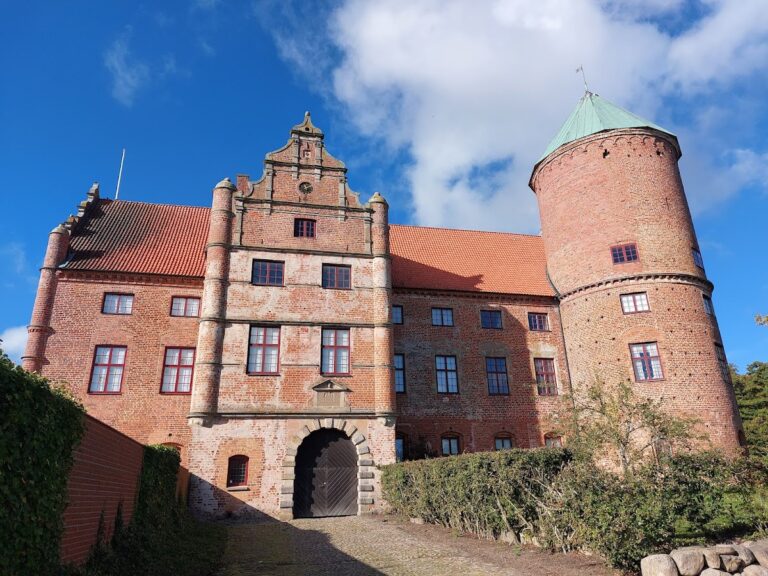
Hjularöd is arranged as a stone-and-brick manor house designed to look like a complete medieval fortified castle. A circular donjon, the principal fortified tower of a medieval castle, rises at the center of the complex. Massive walls with crenellations, or notched defensive parapets, partly enclose the outer area, while a water-filled moat surrounds the castle and gives it the character of a water castle.
Central tower and defensive enclosure
Circular donjon
The circular donjon forms the central vertical element of the fortress-like complex. Its position and fortified character support the medieval castle design that shaped the present residence, while the surrounding buildings and defenses create the impression of a unified stronghold.
Walls, moat, and bridges
The outer complex is partly enclosed by massive crenellated walls and bordered by the defensive moat. Three bridges provide access across the water, including two intended for pedestrians. Tall pointed arches, stepped gables, and high chimney stacks reinforce the castle-like composition.
Former southern gatehouse
A gatehouse, a fortified entrance building, formerly stood on the southern side of the complex. It was demolished during later reconstruction work, altering the arrangement of the approach to the castle.
Earlier foundations and courtyard
Stone foundations beneath or within the building area preserve evidence of structures that preceded the present castle. These remains connect the late nineteenth-century residence with the earlier estate first mentioned in 1391. The castle courtyard forms part of the surviving complex and was used as a filming location for scenes from Mysteriet på Greveholm.
Nearby sites