Palazzo Madama: Historic Palace and Seat of the Italian Senate


Site at a Glance
- Rating
- 4.3
- Popularity
- Low
- Country
- Italy
- Primary era
- Early Modern
- External website
- Open
- Eras represented
- Medieval, Early Modern, Modern
- Civilizations
- Italian, Papal States
- Site type
- Civic
- Remains
- Palace
On this page23 sections
History
Palazzo Madama is a historic palace in Rome, Italy, that now belongs to the Italian state and serves as the seat of the Senate of the Italian Republic. Its history began in the late fifteenth century, and its early sixteenth-century remodelling was closely tied to the Medici, the powerful Florentine banking and ruling family whose members became major patrons of Renaissance art and politics. The building later served the Papal States, became a public administrative centre, and was selected in 1871 as the home of the Senate of the Kingdom of Italy.
Medieval land and the first palace
The site formed part of land that had belonged for almost five centuries to the Benedictine monks of Farfa Abbey. This wider property included the area later occupied by Piazza Navona, while the square itself was originally known as Piazza Longobarda. In 1479 the monks transferred the land to the French monarch, who donated the portion between the Torre dei Crescenzi and the Baths of Alexander to his treasurer and the bishop of Chiusi, Sinulfo Ottieri di Castell’Ottieri. A palace was established on this plot.
In January 1503, Sinulfo left the property by testament to his brother Guidone, Count of Montorio. Guidone initially rented the palace and later transferred it to Giovanni de’ Medici. Giovanni, the son of Lorenzo the Magnificent, acquired the building in instalments in 1505 and commissioned Giuliano da Sangallo to carry out a major restoration.
The Medici residence in Rome
After the Medici were expelled from Florence, Giovanni de’ Medici, by then Pope Leo X, made the palace the family’s Roman residence. He also moved the remnants of the family’s Florentine library there, helping turn the building into a centre of humanist culture. Leo X temporarily sold the palace to his sister-in-law Alfonsina Orsini to address pressing debts, but recovered it through her inheritance in 1519.
Following Leo’s death in 1521, the palace passed to his cousin Giulio de’ Medici, who later became Pope Clement VII. It was associated with the Medici family’s second exile from Florence, which lasted from 1527 to 1530. Catherine de’ Medici spent only a few childhood years in the residence. In 1533 she formally renounced her paternal property in favour of her half-brother Alessandro, although she later contested the inheritance.
A settlement in 1560 recognised Catherine’s ownership while granting Margherita of Austria usufruct, the right to use and benefit from property belonging to another. Margherita was the daughter of Emperor Charles V and the widow of Duke Alessandro de’ Medici. After Alessandro’s death in 1537, she married Ottavio Farnese and lived in the palace for many years. Her residence gave the building its enduring name, Palazzo Madama. She left Rome in 1559 to become governor of the Netherlands.
After Margherita’s departure, several cardinals rented the residence. The palace eventually returned to Ferdinando I de’ Medici, who transferred it to Cardinal Francesco Maria Bourbon del Monte when he left Rome to become grand duke of Tuscany. Del Monte belonged to the pro-French faction in papal diplomacy. Although the building was poorly maintained during this period, he established a musical room and placed Caravaggio’s The Lute Player beside the artist’s The Musicians.
Academies and the House of Lorraine
In 1635 the Tuscan ambassador Niccolò Niccolini persuaded Carlo di Ferdinando de’ Medici to preserve the palace rather than sell it and to undertake further restoration. During the seventeenth century, the building housed the Florentine Academy in Rome, founded in 1673 by Grand Duke Cosimo III and directed by Ciro Ferri and Ercole Ferrata.
The Medici did not regularly occupy Palazzo Madama again until 1725, when Violante Beatrice of Bavaria, the sister-in-law of Grand Duke Gian Gastone, moved in. Under her residence the palace again became a setting for dances and festivities and also housed the Accademia dei Quirini. When Gian Gastone died in 1737, the Grand Duchy of Tuscany and Palazzo Madama passed from the Medici to the House of Lorraine.
Papal administration
In 1755 Pope Benedict XIV purchased the palace, making it a public building of the Papal States, the territories governed by the pope before the unification of Italy. Under papal administration it housed the criminal court offices of the Governor of Rome, a senior papal administrative office, and the police. For a period it was known as the “new Government Palace.” Its administrative function probably explains why the central office of the Roman Republic occupied the building in 1798 and 1799. That republic was a short-lived government established in Rome during the French Revolutionary era.
In 1849 Pope Pius IX transferred the Ministry of Finance and Public Debt and the Papal Post Office to Palazzo Madama. The administration of the Lotto was also installed there, and lottery-number drawings took place on the external loggia from 26 January 1850. Restoration accompanied this conversion, and the new offices were inaugurated in February 1853.
The Senate and the modern palace
In February 1871, the decision was taken to establish the Senate of the Kingdom of Italy in Palazzo Madama. Extensive adaptation followed, including the construction of a semicircular chamber in the former papal post-office courtyard. The Senate met in the palace for the first time on 28 November 1871.
The small sixth-century church of San Salvatore in Thermis stood in the street beside the palace. During the nineteenth century and the first decades of the twentieth, it was closed, expropriated, and demolished because the police feared that it could be used to attack the Senate. Some of its frescoes were incorporated into Palazzo Madama. At the end of the nineteenth century, the building also gained further artistic decoration, including the frescoes by Cesare Maccari. The Senate Library was installed in a building designed by Gaetano Koch in 1890.
During the first thirty years of the twentieth century, Palazzo Madama and neighbouring buildings underwent extensive adaptation. The Senate chamber was modernised, the elevations toward Via del Salvatore and Via della Dogana Vecchia were entirely rebuilt, and a connecting structure was constructed with Palazzo Carpegna. Palazzo Carpegna itself was rebuilt in an advanced position, while the former elevated passage linking it with the Sapienza was demolished.
The palace’s name is sometimes confused with that of the similarly named palace in Turin or with Catherine de’ Medici. The Roman name principally refers to Margherita of Austria, although Violante Beatrice of Bavaria was a later Roman “Madama.” The expression la madama, still used especially in Rome for the police, derives from the palace’s former papal administrative and police functions. The building continues to preserve evidence of its Medici, papal, royal, and republican history. In 2025, a Medici frieze showing the triumphal procession of Charles V after his coronation as Holy Roman Emperor by Pope Clement VII in Bologna in 1530 was restored and returned to the palace after 270 years.
Remains
Plan, facade, and entrance spaces
Palazzo Madama has an irregular plan resembling a pentagon, with sides of markedly different lengths. Its principal facade faces Corso del Rinascimento, between Piazza Navona and the Pantheon. The building’s present appearance combines the fifteenth- and sixteenth-century palace, a Baroque exterior, nineteenth-century Senate adaptations, and twentieth-century rebuilding.
Baroque facade
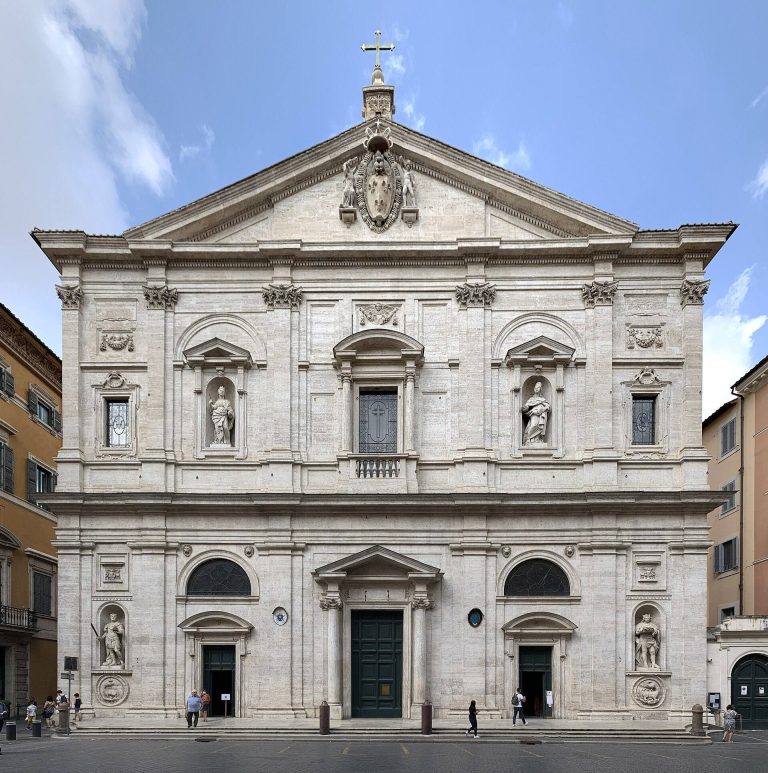
Paolo Maruscelli designed the principal Baroque facade, completed in 1642. It replaced an earlier asymmetrical pediment with a symmetrical composition marked by rusticated corners, a substantial cornice, and elaborate surrounds to the windows. More than one hundred leonine forms appear across the facade. The entrance portal includes the skin of the Nemean lion, the invulnerable beast killed by Hercules in Greek mythology. In the palace’s Medici imagery, the lion’s skin forms part of a mythological genealogy associated with the family’s claimed descent through Hercules, Omphale, and Tyrrhenus.
Cortile d’Onore
The principal entrance leads to the rectangular Cortile d’Onore. Its six portico columns belong to the structure associated with the period of Leo X. The courtyard’s present marble paving replaced the original travertine. At its centre is Emilio Greco’s bronze Grande figura accoccolata, made in 1971, while the Scala d’Onore rises beside the portico.
Secondary staircase
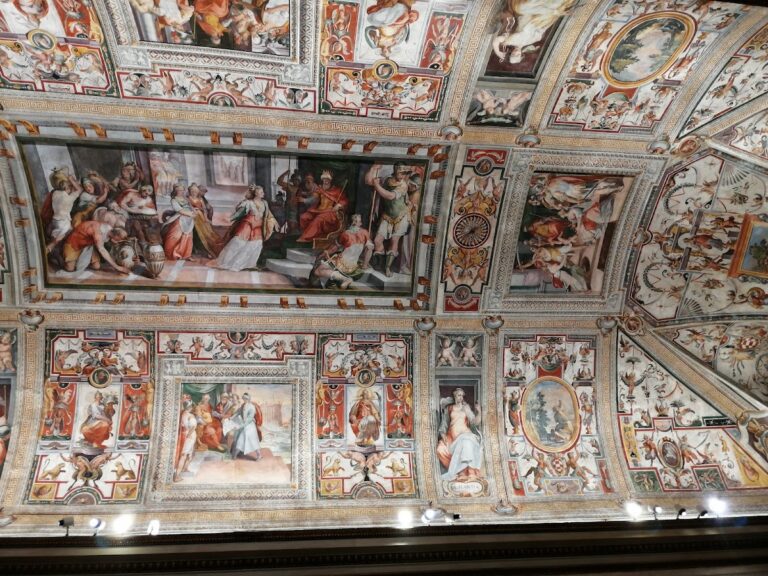
A second staircase is reached from the entrance near San Luigi dei Francesi. Its ceiling is a gilded wooden work of the sixteenth century, decorated with the Medici arms and representations of marine deities. The ceiling was installed above the staircase in 1931.
Under the direction of Romano Monanni, the interior was enriched with decorated ceilings and friezes. These later interventions form part of the layered interior in which Medici symbols, papal administrative adaptations, and the artistic programme of the Senate remain together.
Senate chamber and representative rooms
Legislative chamber
The legislative chamber is raised above the former papal courtyard. This arrangement followed the Tiber flood of 1870 and served as a precautionary measure. Its walls are upholstered in red; they were formerly blue, a colour associated with the heraldic colours of the House of Savoy.
Two rectangular plaques stand behind the position of the President of the Senate. One commemorates the proclamation of the Italian Republic after the 1946 referendum. The other bears Vittorio Emanuele II’s words commemorating Italian unification.
The domed ceiling is covered by the Velario, a painted textile ceiling decoration made in a neo-sixteenth-century revival of the grotesque technique. Grotesque decoration combines ornamental figures, foliage, and imaginative motifs derived from ancient Roman wall painting. The Velario contains medallions of four jurists, Gaetano Filangieri, Niccolò Machiavelli, Irnerius, and Aemilius Papinianus, together with four civic virtues, Justice, Law, Fortitude, and Concord. It also depicts four capitals of pre-unification states, Turin, Venice, Florence, and Naples. Fumanti, Nava, Bruschi, Mei, Barilli, and Gai produced the paintings.
The ceiling also contains Giovanni Paolo Panini’s fresco Allegory of the Chariot of the Sun, surrounded by allegorical figures, putti, floral garlands, and painted architectural illusions. The fresco was originally in the casino of Villa Patrizi, then moved to Palazzo Alberoni, and finally transferred to the Senate in 1928 after that building was demolished.
Sala Cavour
The Sala Cavour has a coffered ceiling, formed from recessed panels, with an oval painting of Bacchus and Ariadne by Giambattista Pittoni. The room is used by government members attending Senate sessions and is sometimes used for meetings of the Council of Ministers.
Sala Maccari
The Sala Maccari, also called the Yellow Room because of its yellow damask wall coverings, was decorated by Cesare Maccari after he won a Ministry of Public Education competition in 1880. The ceiling centres on a personification of triumphant Italy surrounded by four allegorical medallions representing industry, the armed forces, science, and the arts. The figures are nude boys and girls, while a frieze, a horizontal decorative band, joins the walls and ceiling with quotations from Machiavelli and Guicciardini.
Five scenes from the history of the ancient Roman Senate cover the walls. They show Appius Claudius Caecus urging resistance to the peace terms proposed by Pyrrhus’s ambassador Cineas; the senator Papirius Gallus remaining unmoved before the Senones, a Celtic people invading Rome in the early fourth century BC; the Samnites attempting to corrupt Curio Dentatus; Cicero denouncing Catiline; and Marcus Atilius Regulus advising resistance to Carthage despite having promised to return there during the First Punic War.
Buvette
The Buvette, a large refreshment room, has a vault decorated with light-coloured stucco friezes and figures from 1931. Stucco is a mouldable plaster used for architectural decoration. The room contains a sixteenth-century Medici tapestry from the Uffizi in Florence, a small fountain sculpture by Vincenzo Gemito, and Luciano Ventrone’s still lifes La Pausa and Il ritorno di Ulisse, both from 2002.
Representative salon
A large representative salon was created in the early 1930s by removing a partition wall. It has a modern-style coffered ceiling, six historical frescoes, and a seventeenth-century frieze. The part facing the Buvette contains putti and lions, while the opposite part contains female figures. Piero Guccione’s marine landscape Il nero e l’azzurro was installed there in August 2003.
Medici rooms and historic collections
Sala dello Struzzo
The Sala dello Struzzo has a gilded wooden coffered ceiling. A sixteenth-century ostrich appears in the ceiling design, yoked by a ribbon to a Medici shield added in the seventeenth century. The bird was probably selected for a French wordplay linking Autriche, meaning Austria, with autruche, meaning ostrich. Its heraldic associations may also have suggested speed, precedence, firmness, and strength.
Portraits of Margherita of Austria, her brother Philip II, and her son Alessandro Farnese are displayed in the room. Alessandro, who was born in Palazzo Madama, was the son of Margherita and Ottavio Farnese. The restored seventeenth-century Medici frieze showing Charles V’s triumphal procession returned to the room in 2025 after 270 years.
The room also contains a bust of President Enrico De Nicola and displays connected with the creation of the Italian Constitution. These include two modern artworks representing the delivery and signing of the Constitution, three unique copies of texts signed at Palazzo Giustiniani on 27 December 1947, and an unpublished Gazzetta Ufficiale bearing the handwritten signatures of De Nicola, Umberto Terracini, Alcide De Gasperi, and Grassi.
Seventeenth-century ceiling room
Another room has a seventeenth-century gilded wooden ceiling made with beams and compartments. Its frieze depicts episodes from the pontificate of Pope Pius IV, joining the architectural decoration to the history of the papal period.
Twentieth-century artworks
Works behind the Senate galleries
Behind the galleries of the Senate chamber, one room contains Corrado Cagli’s tapestry Narcissus and Giorgio de Chirico’s oil painting Nymphs beside a Stream, dating from about 1952 to 1955. Giuliano Vangi’s wooden statue Italia, a female figure with braids and ivory eyes, was also displayed in the palace before being transferred to Palazzo Giustiniani.
Modern views and landscape painting
The twentieth-century artistic programme includes Mauro Reggio’s views of the Theatre of Marcellus and the twin churches of Piazza del Popolo. It also includes Corrado Cagli’s painting of Mount Etna in eruption. Together with the later works in the representative rooms, these pieces form part of the palace’s continuing Senate collection.