Şeytan Castle: A Medieval Fortress in Türkiye


Site at a Glance
- Rating
- 4.7
- Popularity
- Low
- Country
- Turkey
- Primary era
- Medieval
- Eras represented
- Medieval
- Civilizations
- Georgian
- Site type
- Military
- Remains
- Castle
On this page6 sections
History
Şeytan Castle is a medieval fortress in Türkiye, near Yıldırımtepe in the Çıldır District of Ardahan Province. It stands in the historical region of Palakatsio, associated with the wider regions of Javakheti and Eruşeti. The site was used from the Hellenistic period, the era shaped by the spread of Greek culture after Alexander the Great, through the Ottoman period, with successive rulers repairing or altering the fortress.
Early and Medieval Use
Historical chronicles associated with Alp Arslan, the Seljuk sultan of the eleventh century, mention the fortress in 1064. Claims that Şeytan Castle was built during the Urartian period are not supported by historical sources. Later evidence points to an early medieval fortress, although an earlier fortification at the same location remains possible. The site belonged for long periods to the Kingdom of Georgia and to Samtskhe-Saatabago, a Georgian principality that governed parts of southwestern Georgia before Ottoman control.
Some interpretations identify the “Kacta Tsihe” named in Shota Rustaveli’s twelfth-century Georgian epic The Knight in the Panther’s Skin with Şeytan Castle rather than Alamut Castle. This proposed identification connects the fortress with one of the major works of medieval Georgian literature, but it remains an interpretation rather than a settled fact.
Ottoman Conquest and Later Name
During the Ottoman-Safavid War of 1578 to 1590, the fortress passed to the Ottomans. A chronicle covering Samtskhe-Saatabago between 1561 and 1587 states that its ruler, Manuchar II, reached an agreement with Lala Mustafa Pasha, an Ottoman commander and statesman active in the campaigns against Safavid Iran, and surrendered six fortresses, including Şeytan Castle.
Two eighteenth-century Georgian historical works describe the Ottoman campaign as beginning with sieges of Şeytan Castle and Mgeltsikhe. One gives 5 August 1578 as the date of Şeytan Castle’s fall and says that its defenders were killed. Ottoman historians from the same period or near it provide different opening dates and name other fortresses, leaving the exact role and sequence of Şeytan Castle in the campaign uncertain. The fortress nevertheless continued in use under Ottoman rule.
An Ottoman detailed register from 1595 lists the fortress under the Georgian-derived name Kacisiha. The name was later rendered in Turkish as Şeytan Kala or Şeytan Kalesi, meaning “Devil’s Castle.” A local legend links the name to the supposed sighting of a demon or evil spirit, and this belief reportedly survives as a local superstition. A trading area called Rabat existed near the fortress and later developed into an ordinary settlement. Ekvtime Takaishvili also reported that the castle contained a prison.
Remains
Hilltop Fortress
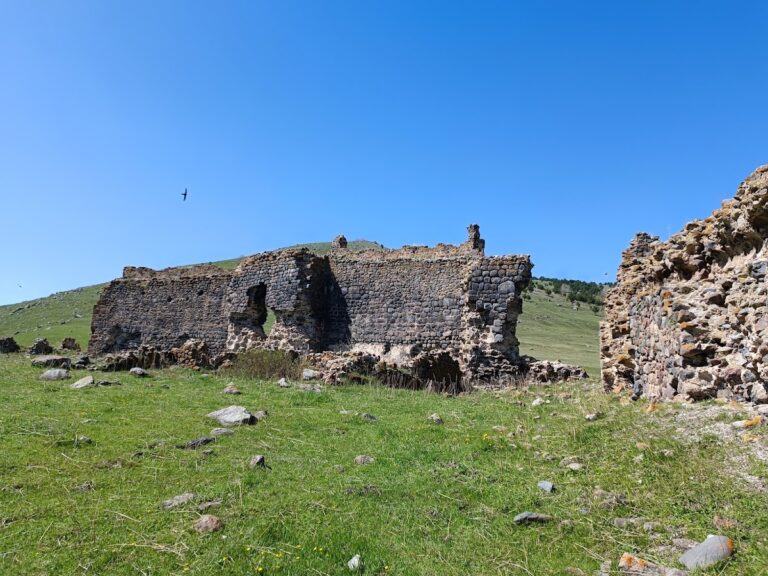
The fortress occupies a rocky hill on the right bank of a stream, about 1.3 to 1.5 kilometres from Yıldırımtepe, formerly known as Rabat. The hill rises to approximately 1,910 metres above sea level. Cliffs surround three sides, while access is possible from one direction. These natural rock faces strengthened the defensive position alongside the built walls and made the approach difficult. The castle has an asymmetrical plan measuring about 161 by 93 metres. Three towers formed part of the fortress, and one survives in relatively sound condition.
Water and Religious Features
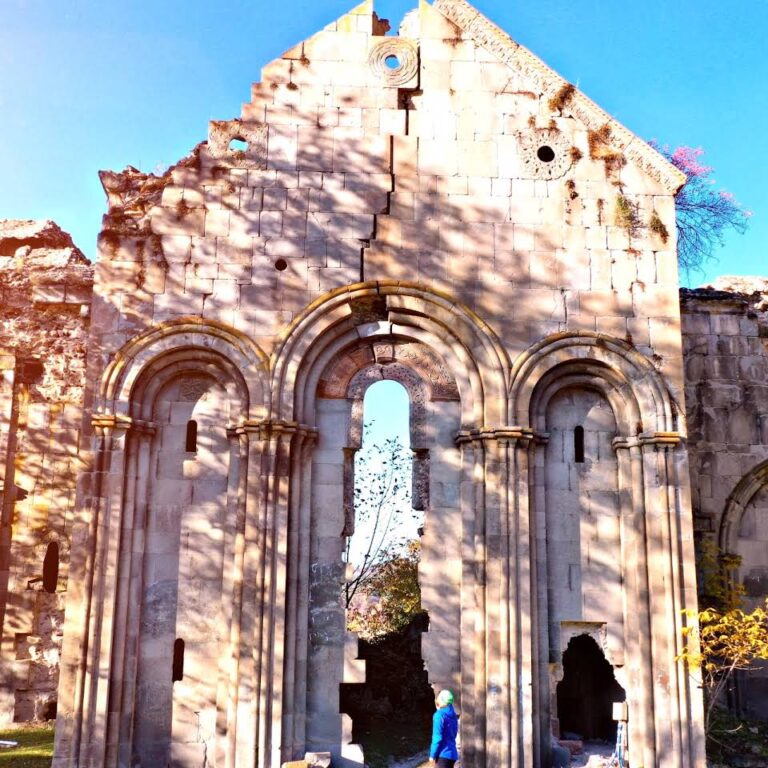
The surviving installations include cisterns, built reservoirs for collecting or storing water, together with the remains of a stairway descending toward the stream or water level. The fortress also contains a chapel. In its lower part stood a single-nave church built in the fourteenth century and dedicated to Saint Stephen. A single-nave church has one principal longitudinal worship space without parallel side aisles. The church survives as four walls, preserving the outline of this religious building within the wider fortress complex.
Nearby sites