Hünegg Castle: A Historicist Country Estate in Switzerland


Site at a Glance
- Rating
- 4.7
- Popularity
- Low
- Country
- Switzerland
- Primary era
- Modern
- External website
- Open
- Eras represented
- Modern
- Civilizations
- Swiss
- Site type
- Domestic
- Remains
- Castle
On this page5 sections
History
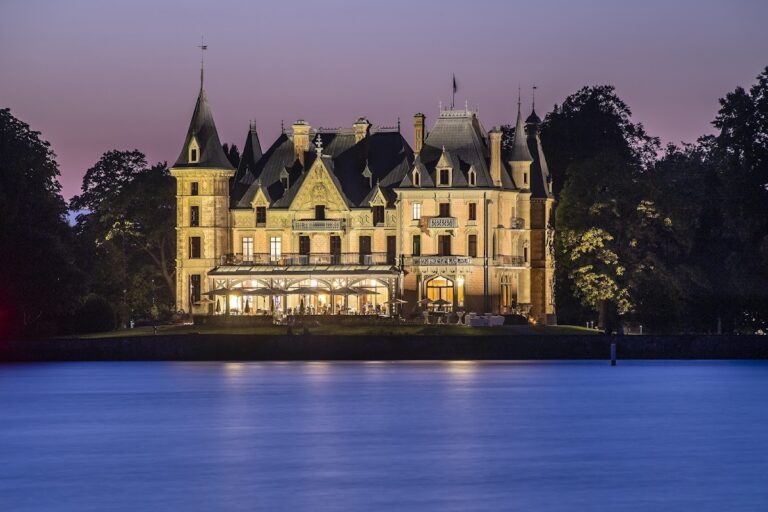
Hünegg Castle is a nineteenth-century country estate in Hilterfingen, Switzerland, built between 1861 and 1863 in the Historicist style for the Prussian Baron Albert Emil Otto von Parpart. Historicism revived and recombined forms from earlier architectural periods, and Hünegg’s design drew on Renaissance castles of the Loire. The estate stands beside Lake Thun and was designed by the German architect Heino Schmieden.
Construction and ownership
Von Parpart lived at Hünegg Castle for only several years before his death in 1869. His nephew inherited the estate in 1883, then sold the art collection and the castle itself in 1893 to Karl Lehmann, a commercial judge from Berlin.
After six years of Lehmann’s ownership, the property passed in 1899 to Gustav Lemke-Schuckert, an architect from Wiesbaden. Around 1900, Lemke-Schuckert slightly enlarged the building and had most of its interior refitted in the Art Nouveau style, an ornamental approach known for flowing lines, organic motifs, and integrated decoration.
Around the beginning of the Second World War, Hünegg Castle was sold to Oscar Haag of Küsnacht. The Canton of Bern acquired the property in 1958, bringing its period of private ownership to an end. Hünegg Castle is now recognized as a Swiss heritage site of national significance and is listed as a cultural property of national importance in the Canton of Bern.
Museum and public use
The castle houses a museum devoted to the domestic culture of Historicism and Art Nouveau. From summer 2018 until the end of 2022, it also accommodated the Swiss Gastronomy Museum after that institution moved from Schadau Castle in Thun. The castle and park have also hosted temporary exhibitions, including a mountain-railway exhibition held from May to October in 2012, 2013, and 2014. Through loans from approximately 130 individuals and 30 companies, the exhibition presented the pioneering history of Swiss mountain railways.
Remains
Hünegg Castle is a grand residential estate beside Lake Thun, surrounded by a park with notable old trees. Its exterior presents a nineteenth-century interpretation of Renaissance castle architecture, while the building’s slight enlargement around 1900 forms part of the surviving structure. The estate combines the castle with its landscaped grounds, preserving the setting of an elite private residence.
Domestic interiors
The interior contains costly selected materials and lavish furnishings arranged as preserved or recreated domestic rooms. Renaissance Revival interiors reuse architectural forms associated with the Renaissance, while the later Art Nouveau rooms introduce more flowing decorative design. Together, these interiors present the changing taste of the castle’s nineteenth-century owners and have been carefully maintained or recreated to convey the appearance of a residence recently vacated.
Nearby sites