Doudleby Castle: A Renaissance Hunting Residence in Czechia


Site at a Glance
- Rating
- 4.6
- Popularity
- Medium
- Country
- Czechia
- Primary era
- Early Modern
- External website
- Open
- Eras represented
- Early Modern
- Civilizations
- Holy Roman Empire, Kingdom of Bohemia
- Site type
- Domestic
- Remains
- Castle
On this page7 sections
History
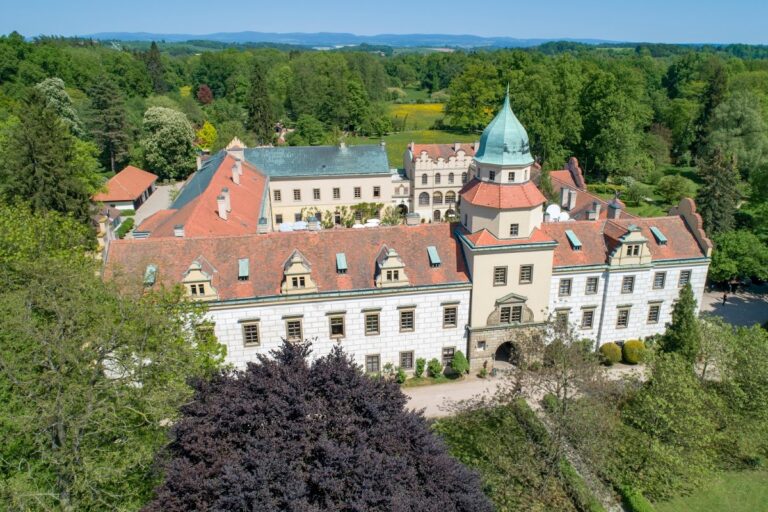
Doudleby Castle is a Renaissance castle in Doudleby nad Orlicí, Czechia, built by the Czech noble Bubna and Lititz family between 1585 and 1590. It probably replaced or incorporated an earlier fortress, which was first mentioned in 1545. The castle’s enclosed courtyard and later decorative phases reflect its development from a fortified residence into a refined aristocratic hunting lodge.
From fortress to Renaissance residence
Nikolaus the Elder of Bubna and Lititz commissioned the present four-wing castle at the end of the sixteenth century. The family lived at Senftenberg until the beginning of the nineteenth century, so Doudleby initially served mainly as a hunting residence rather than the family’s principal home.
A major transformation took place around 1630 under Heinrich Johann von Bubna. The interiors were substantially altered, and the wooden gallery that originally ran along the courtyard was replaced by a stone passageway. Further Baroque remodelling followed between 1670 and 1690 under Franz Adam, Count von Bubna. Baroque architecture, which favoured elaborate decoration and dramatic spatial effects, gave the Renaissance building a more richly embellished interior.
Baroque decoration and aristocratic occupation
Baroque frescoes were added after 1650, and a chapel dedicated to the Holy Family was built in 1700. In Christian devotion, the Holy Family refers to Jesus, Mary, and Joseph. These changes strengthened the castle’s religious and representational character within the Bubna family residence.
During the first quarter of the nineteenth century, the diplomat Ferdinand von Bubna and Littitz lived at Doudleby. He served for a time as governor-general of Piedmont, Savoy, and Nice, bringing an important diplomatic figure into the castle’s history.
Decline, restitution, and renewal
Restoration work was undertaken in 1886 and again during the 1960s. The abolition of nobility and noble titles in December 1918 harmed the castle’s maintenance. Its decline began during the German occupation and became more severe during the Soviet period. After the Second World War, the Bubna family was expropriated.
Following the political transition, the Czech Republic restituted the castle to the family’s descendants. Demolition was discussed after 1991, but the discovery of historic frescoes beneath later ceiling plaster renewed interest in the building. The castle was subsequently restored and opened to the public, with a military museum and an exhibition of Vamberk lace established in its rooms. Doudleby Castle is protected as a Czech cultural monument, a state designation for places recognised as part of the country’s cultural heritage.
Remains
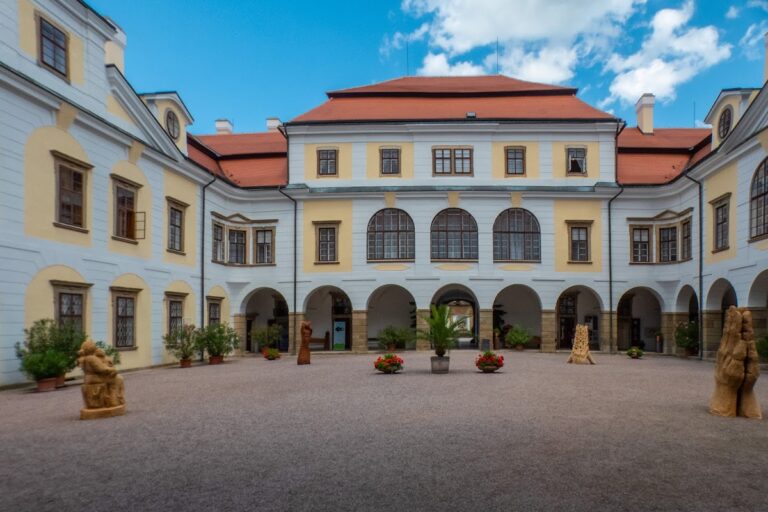
Doudleby Castle is a four-wing Renaissance building arranged around an enclosed interior courtyard. This plan retains a defensive character associated with the site’s earlier fortress history, while the arcades, sgraffito, paintings, and later Baroque additions express its development as an aristocratic residence. The complex stands within a park in the town of Doudleby nad Orlicí.
Courtyard and entrance
Open arcades supported by Tuscan columns run along the ground floor of the courtyard. Tuscan columns are a simplified classical type with plain shafts and restrained capitals. The arcades originally carried a wooden gallery, which was replaced by a stone passageway in 1630. A stone entrance portal from the same period leads into the complex, and a niche above it contains an image of the Madonna and Child.
Exterior decoration and interiors
The exterior walls are richly covered with sgraffito, a technique that reveals contrasting plaster layers by scratching or cutting through the surface. The projecting central section has a semicircular gable bearing a coat of arms with the initials F-A-G-V-B, associated with Franz Adam, Count von Bubna.
Inside, paintings from the early Baroque period include historic frescoes found beneath later ceiling plaster. The Holy Family chapel forms part of the castle complex and dates from 1700. A statue of John of Nepomuk stands near the castle on its west side. John of Nepomuk was a fourteenth-century Bohemian saint traditionally associated with bridges, waterways, and the seal of confession.
Nearby sites