Palazzo Roverella: A Renaissance Palace and Gallery in Rovigo


Site at a Glance
- Rating
- 4.5
- Popularity
- Medium
- Country
- Italy
- Primary era
- Medieval
- External website
- Open
- Eras represented
- Medieval
- Civilizations
- Venetian
- Site type
- Domestic
- Remains
- Elite Residence
On this page9 sections
History
Palazzo Roverella is a Renaissance palace in Rovigo, Italy, commissioned in 1474 by Cardinal Bartolomeo Roverella as an imposing residence for his family. Facing Piazza Vittorio Emanuele II, the building reflects the prestige of the Roverella family, which had settled in Ferrara but originated in a place of the same name between Rovigo and Lendinara. Its architect is unknown, although the design has traditionally been associated with the ideas of the young Biagio Rossetti, a Renaissance architect and urban designer linked to Ferrara.
Foundation and Alteration
Construction was interrupted by Cardinal Roverella’s death in 1477. From the late sixteenth century, inappropriate uses brought repeated interior changes, many of them inadequate. These alterations contributed to the palace’s deterioration and gradually distanced its interior from the character of its original principal residence.
Restoration and Collections
Work on the facade began at the end of the Second World War, while the rest of the palace received no substantial attention until 1985, after further deterioration had affected several parts of the building. Interior renovation began in 2000 through the Municipality of Rovigo and the Cassa di Risparmio di Padova e Rovigo Foundation. The work brought the palace closer to its original residential appearance while adapting it for gallery and exhibition use.
The building became the venue for the picture galleries of the Accademia dei Concordi, Rovigo’s civic cultural and scholarly institution, and the diocesan seminary, an institution for the education and formation of clergy. It now functions as the city’s art and archaeology gallery and also hosts exhibitions, particularly those devoted to modern art of the nineteenth and twentieth centuries.
The Accademia dei Concordi was established around 1580 through the initiative of Count Gaspare Campo. Its painting collection began to develop in the mid-eighteenth century, when prominent Venetian painters were commissioned to portray distinguished people from Rovigo and patrons from the Veneto. In 1833, Count Giovanni Francesco Casilini’s bequest of almost 200 works of fifteenth- and sixteenth-century Venetian art established the Accademia’s picture gallery.
Private donations continued to enlarge the holdings. In 1878, half of the Silvestri counts’ collection went to the Accademia, while the other half passed to the Diocesan Seminary of Rovigo. Albano Gobbetti made another major bequest in 1901. In 1982, the seminary’s picture gallery, containing about 200 works, was entrusted to the Accademia dei Concordi, reunifying the Silvestri collection. The resulting gallery is chiefly devoted to Venetian art from the fifteenth to the eighteenth century.
Remains
Palace Exterior
Arcaded Facade
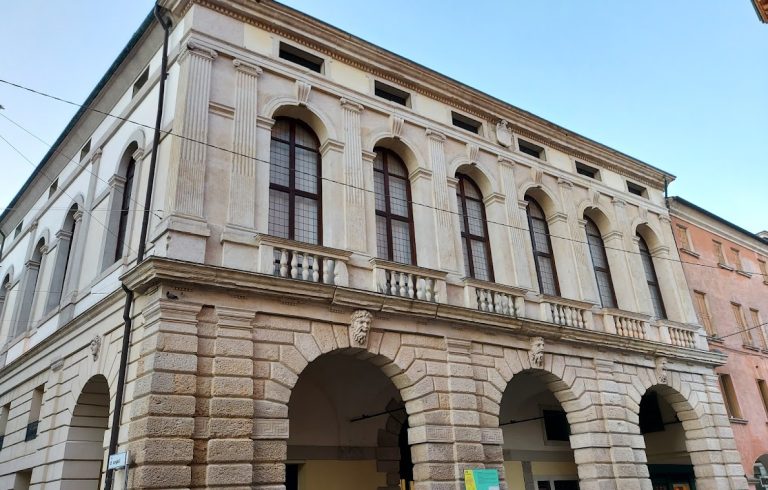
Palazzo Roverella is a monumental Renaissance building with a high arcaded facade. Three tiers of openings vary in form and size, and the levels are supported by robust marble columns. Red brick combined with white marble creates a pronounced polychrome effect. Restoration recovered the facade’s visual unity and harmony, preserving the exterior expression of the palace’s original purpose as a grand family residence.
Collections and Interior Functions
Picture Gallery
The picture gallery is dominated by Venetian art from the fifteenth to the eighteenth century. Its works include The Coronation of the Virgin by Nicolò di Pietro, Madonna and Child between Saint Jerome and Saint Helena by Palma Vecchio, Madonna and Child by Giovanni Bellini, Portrait of Antonio Riccobono by Giovanni Battista Tiepolo, and Seascape with Broken Bridge by Luca Carlevarijs.
Other paintings include Saint Lucy and Scenes from Her Life by Quirizio da Murano, Christ Carrying the Cross by Giovanni Bellini, Madonna and Child by Pasqualino Veneto, and Saint Cajetan of Thiene by Giovanni Battista Piazzetta. Portraits include Portrait of a Young Man by Andrea Previtali, Portrait of Cardinal Bartolomeo Roverella by Giovanni Battista Pittoni, Portrait of Giulio Contarini da Mula from 1759 by Alessandro Longhi, Portrait of Giovanni Tommaso Minadois by Giuseppe Nogari, Portrait of Doge Alvise Pisani by Bartolomeo Nazzari, and Portrait of Count Gasparo Campo by Giovanni Battista Piazzetta. The collection also contains Sacred Conversation by Girolamo da Santacroce, Madonna and Child by Nicolo Rondinelli, and The Circumcision by Marco Bello.
Archaeology Collection
The archaeology section brings together Egyptian, Greek, Etruscan, and Roman artifacts. The Egyptian holdings include the mummies of a woman and an infant, known as Meryt and Baby, as well as ushabti, small Egyptian funerary figurines intended to serve the deceased in the afterlife, and other associated objects. Vases and votive statuettes, objects offered in connection with a religious vow, entered the collection through private donations.
Nearby sites