Palais Bénédictine: A Historic Liqueur Distillery and Museum in Fécamp


Site at a Glance
- Rating
- 4.5
- Popularity
- Medium
- Country
- France
- Primary era
- Modern
- External website
- Open
- Eras represented
- Modern
- Civilizations
- French
- Site type
- Economic
- Remains
- Production Complex
On this page8 sections
History
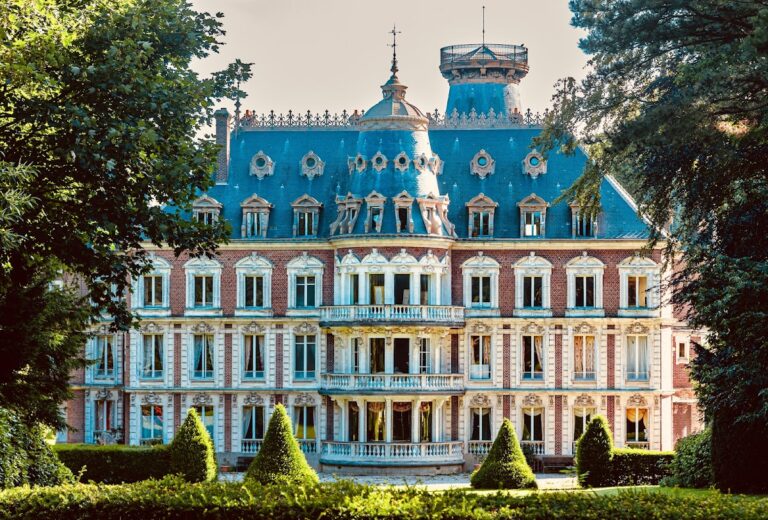
The Palais Bénédictine in Fécamp, France, is a late-nineteenth-century liqueur distillery and museum built for Alexandre-Prosper Le Grand, the entrepreneur who invented and commercially developed Bénédictine liqueur. Construction began in 1882, and the building was inaugurated in 1888. Designed as a hybrid of art and industry, it also associated Le Grand’s product with Fécamp’s monastic tradition. Its combination of functions and elaborate historicism earned it the nickname “industrial Versailles.”
Construction and rebuilding
Le Grand commissioned Camille Albert to design the palace, while Ernest Baron directed its construction using local materials and techniques. Ferdinand Marrou created the ironwork and roof finials. A major fire devastated the building on 12 January 1892, and it was subsequently rebuilt in the form that survives today.
Industry, collections, and later development
The palace brought together the making and storage of Bénédictine with a museum devoted to medieval and early art. It has no institutional connection with Fécamp Abbey, although many objects in the museum and part of its library came from the former abbey. A contemporary-art exhibition space was added in 1988. Other rooms explain the history of Bénédictine and present approximately 600 counterfeit examples of the liqueur.
Remains
The Palais Bénédictine is an eclectic nineteenth-century building that combines Neo-Gothic and Neo-Renaissance forms, both revival styles reinterpreting earlier medieval and Renaissance architecture. Its design also refers to the emerging Art Nouveau. The surviving palace brings together industrial rooms, museum galleries, historic interiors, stained glass, ironwork, and spaces for contemporary art.
Distillery and cellars
The distillery and cellars occupy the lower part of the palace and are used to produce and store Bénédictine. Above them, the spice room presents the plants and spices used in the liqueur. The precise recipe remains secret, while 27 plants and spices are identified as ingredients. This arrangement links the visible display of raw materials with the production spaces below.
Museum collections and abbey material
The museum contains Gothic- and Renaissance-period furniture, old ironwork, religious objects, enamels, ivories, coins, locks, paintings, and other works of medieval and early art. Material associated with the former Fécamp Abbey includes manuscripts and incunabula, books printed in Europe before approximately 1501, along with sixteenth-century champlevé enamels, a technique using recessed areas cut into metal and filled with enamel, reliquaries, carved ivories, and ancient ironwork. Part of the library came from the abbey, while a separate ironwork collection was acquired from a château in the Loire Valley.
Many paintings are chiefly executed on wood. They were formerly attributed to particular French, Italian, German, and Flemish artists, but those attributions are regarded as somewhat arbitrary, with most of the works instead associated with workshops or artistic schools.
Historic halls and stained glass
The central Abbots’ Hall contains a stained-glass window showing the monks of Fécamp receiving Francis I, the French king who reigned from 1515 to 1547, in 1534. Statues of abbots associated with important moments in the history of Fécamp Abbey also stand in the hall. Elsewhere, a large stained-glass window presents Alexandre-Prosper Le Grand as the celebrated renewer of the liqueur that brought him his fortune.
Contemporary-art space
The ground floor includes a contemporary-art exhibition hall created in 1988. The space is accompanied by a bar, a veranda, and a shop, forming a later addition to the palace’s combined industrial, museum, and exhibition functions.