Ruins Engenstein: A Medieval Fortified House in Switzerland


Site at a Glance
- Rating
- 5
- Popularity
- Very Low
- Country
- Switzerland
- Primary era
- Medieval
- Eras represented
- Medieval
- Civilizations
- Holy Roman Empire
- Site type
- Military
- Remains
- Castle
On this page7 sections
History
Foundation and Schaler use
Ruins Engenstein is a small medieval hilltop castle ruin in Switzerland, probably built by the Basel-based Schaler family during the first quarter of the thirteenth century, around 1200 to 1225. It stood on the family’s allodial property, land held as hereditary private property rather than as a feudal fief. Before nearby Schalberg Castle was completed, Engenstein probably served as a manor house and residence for the Schalers.
Archaeological finds indicate that the site was used most intensively during the second half of the thirteenth century. Its importance probably declined sharply after Schalberg Castle was built, although a small number of finds associated with the fourteenth century point to continued use on a reduced scale.
Thierstein ownership and rediscovery
After the Schaler line died out in the fourteenth century, Engenstein and Schalberg passed to the Counts of Thierstein as an episcopal fief. The Counts of Thierstein were a medieval comital dynasty in the Basel region, while an episcopal fief was land or a lordship held from a bishop in return for feudal obligations.
Engenstein remained unknown in later centuries because documentary sources did not mention it. The Swiss historian and castle researcher Walther Merz discovered the site shortly after the turn of the nineteenth and twentieth centuries.
Excavation and conservation
A private working group excavated Engenstein between 1963 and 1970. The ruin was excavated and conserved in 1975, and the finds are exhibited at the local museum in Aesch.
Remains
Rocky outcrop and fortified house
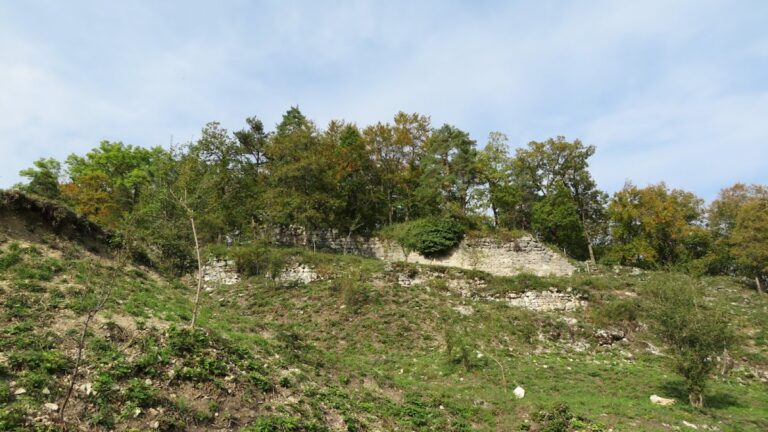
Engenstein stands at approximately 430 metres above sea level on a small rocky outcrop between the remains of Münchsberg Castle and the former Schalberg Castle. Münchsberg is about 280 metres away in a straight line, while Schalberg lies just under 100 metres away, with direct visual contact between the sites. The outcrop provided very little building space, probably allowing only a fortified house rather than a substantial castle. The rock summit was artificially levelled, creating the confined area on which the structure stood. The name Engenstein, meaning “narrow rock,” may have been inspired by this restricted setting.
Cellar and approach
A cellar was cut into the rock at the eastern side of the levelled summit. Its staircase, carved directly from the stone, remains walkable, and clearly visible beam sockets in the cellar wall show where a timber ceiling was supported. The original approach climbed steeply from the west along the rocky ridge and was probably narrow enough to be used only on foot. The outcrop is now reached by a metal ladder, while the surviving remains remain in ruinous condition.
Nearby sites