Tandragee Castle: A Reconstructed Estate Residence in Northern Ireland

Site at a Glance
- Rating
- 5
- Popularity
- Very Low
- Country
- United Kingdom
- Primary era
- Early Modern
- Eras represented
- Early Modern
- Civilizations
- English
- Site type
- Domestic
- Remains
- Castle
On this page8 sections
History
Tandragee Castle is a historic castle in the United Kingdom, on the site of an earlier O’Hanlon stronghold in Tandragee, Northern Ireland. Its present form dates from a reconstruction completed in 1837, after the earlier castle had stood in ruins for approximately two centuries.
Plantation and the O’Hanlon Stronghold
During the Plantation of Ulster, the early-seventeenth-century English and Scottish colonization of land confiscated from Gaelic Irish powers, Tandragee Castle became the property of Sir Oliver St John, 1st Viscount Grandison. As Lord Deputy, the English Crown’s chief representative and governor in Ireland, he rebuilt the earlier stronghold associated with the O’Hanlon clan, a Gaelic Irish family connected with the Tandragee area.
The castle’s ownership passed to Sir John St John, 1st Baronet, in 1630, and to Henry St John of Tandragee in 1648. During the Irish Rebellion of 1641, an uprising against English government and settler control, the O’Hanlons attempted to recover their lands and castle. Fighting destroyed Tandragee Castle and left it in ruins until its nineteenth-century reconstruction.
The Estate and Manchester Residence
After the St John period, ownership passed through Robert Sparrow and Robert Bernard Sparrow. Lady Olivia Sparrow held the estate in 1805. From 1822, it belonged to Millicent Sparrow and George Montagu, 6th Duke of Manchester. Their marriage brought the Tandragee estate into the Manchester family, and the duke commissioned the castle’s reconstruction in 1837 as the family’s Irish residence.
The succession continued through William Montagu, 7th Duke of Manchester, from 1855; George Montagu, 8th Duke of Manchester, from 1882; and William Montagu, 9th Duke of Manchester, from 1890. Alexander Montagu, 10th Duke of Manchester, held the property from the 1940s. Born at Tandragee, he left the castle in 1928 and returned to it when the Second World War began.
Wartime and Later Use
In 1943, Alexander Montagu leased Tandragee Castle to the United States Army for wartime use. General George S. Patton, a senior United States Army commander best known for his role during the Second World War, reportedly visited while inspecting troops in Northern Ireland and was guest of honour at a dance held at the castle.
Alexander Montagu sold the castle and estate in the 1950s to Thomas Hutchinson, a Tandragee businessman and founder of Tayto. The building later became associated with the Tayto potato-crisp business. Tandragee Castle is a registered Grade B1 heritage building.
Remains
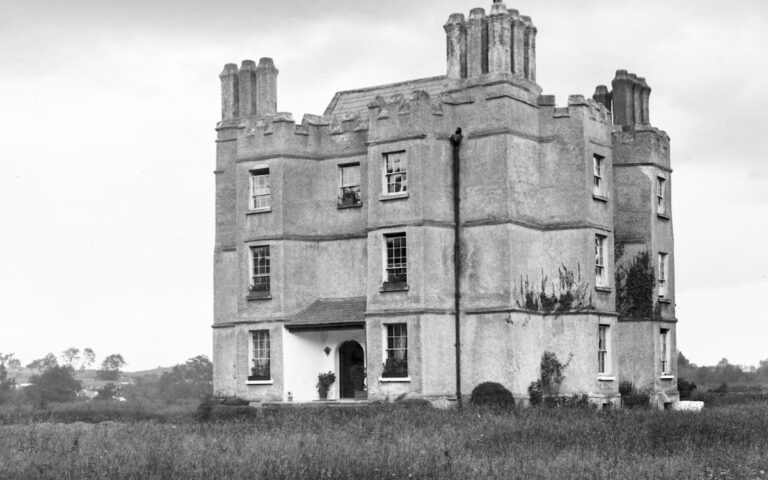
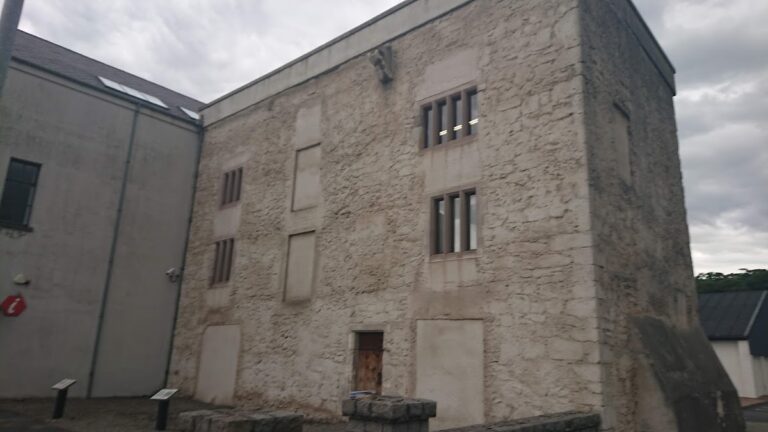
Tandragee Castle stands on the site of earlier defensive structures, including the former O’Hanlon stronghold. The surviving building is the result of the 1837 reconstruction, while the surrounding estate includes a demesne park and a golf course. The castle currently contains offices serving the Tayto potato-crisp factory.
Castle and Estate Grounds
Reconstructed Castle
The present castle is the building reconstructed in 1837 for the Manchester family’s Irish residence. Its current use is administrative, with offices serving the Tayto factory. The earlier defensive history of the site is represented by its position over the former O’Hanlon stronghold and the castle rebuilt there during the Plantation period.
Demesne Park
The estate retains a demesne park, or landscaped estate grounds, that incorporates a golf course. This park forms part of the grounds associated with Tandragee Castle and its later estate use.