Ruine Turmhölzle (Fernegg): A Medieval Castle Ruin in Germany


Site at a Glance
- Rating
- 4.5
- Popularity
- Very Low
- Country
- Germany
- Primary era
- Medieval
- External website
- Open
- Eras represented
- Medieval
- Civilizations
- Holy Roman Empire
- Site type
- Military
- Remains
- Castle
On this page8 sections
History
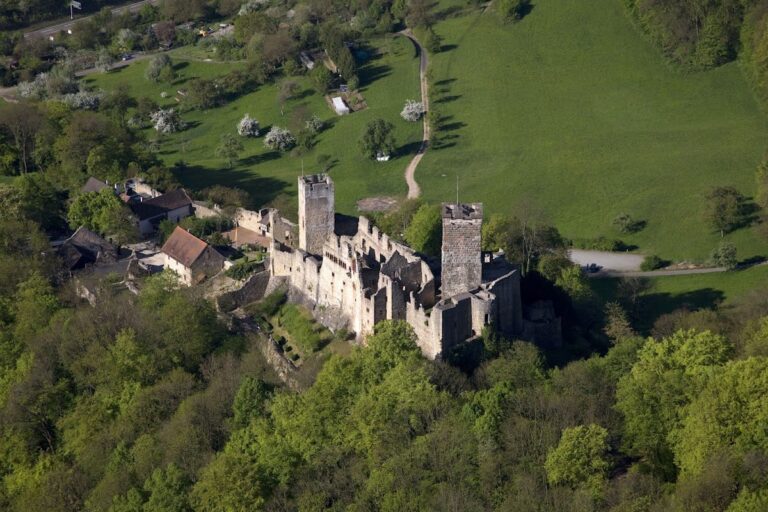
Ruine Turmhölzle is a medieval castle ruin in Germany, near Schopfheim in Baden-Württemberg, whose masonry suggests construction during the twelfth century in the high Middle Ages. The castle is also associated with the name Fernegg, probably its historical name, while Turmhölzle arose only later. Positioned above Raitbach, it probably helped secure the territorial lordship of St. Blasien Abbey, a Benedictine monastery in the southern Black Forest.
Fernegg and St. Blasien Abbey
The castle’s early history remains uncertain, but fifteenth-century property registers listing St. Blasien Abbey’s possessions in Raitbach refer to the castle area as Fernegg. A 1360 property register may preserve an earlier reference through its mention of a farm called “under the Egge.” These records connect the site with the abbey’s landed interests and support the identification of Fernegg as the castle’s original name.
The castle was probably held as a fief from St. Blasien Abbey by ministeriales, medieval service nobles who carried out administrative and military duties for a higher lord. In this arrangement, the castle formed part of the abbey’s territorial organization. Its later name, Turmhölzle, reflects a subsequent change in local usage rather than the medieval name preserved in the property registers.
Excavation
In the summer of 1981, school groups carried out a large-scale excavation of the ruin under the direction of the archaeologists Thomas Keilhack and Gerhard Wesselkamp of Eimeldingen. The work brought archaeological attention to the remains and contributed to the understanding of the castle’s surviving structures.
Remains
Site layout and defenses
The ruin occupies a 620-metre-high, spur-like projection of the Hohen Möhr, a mountain in the southern Black Forest, east of Raitbach. The spur extends west-southwest and drops steeply on three sides into surrounding stream valleys. An elongated, oval castle area follows this defensive ground. A ditch encircled the site, accompanied by an outer rampart that is now partly heavily flattened. Two further ditches protected the rising eastern side, where the natural slope provided less protection.
Core castle
Keep and curtain wall
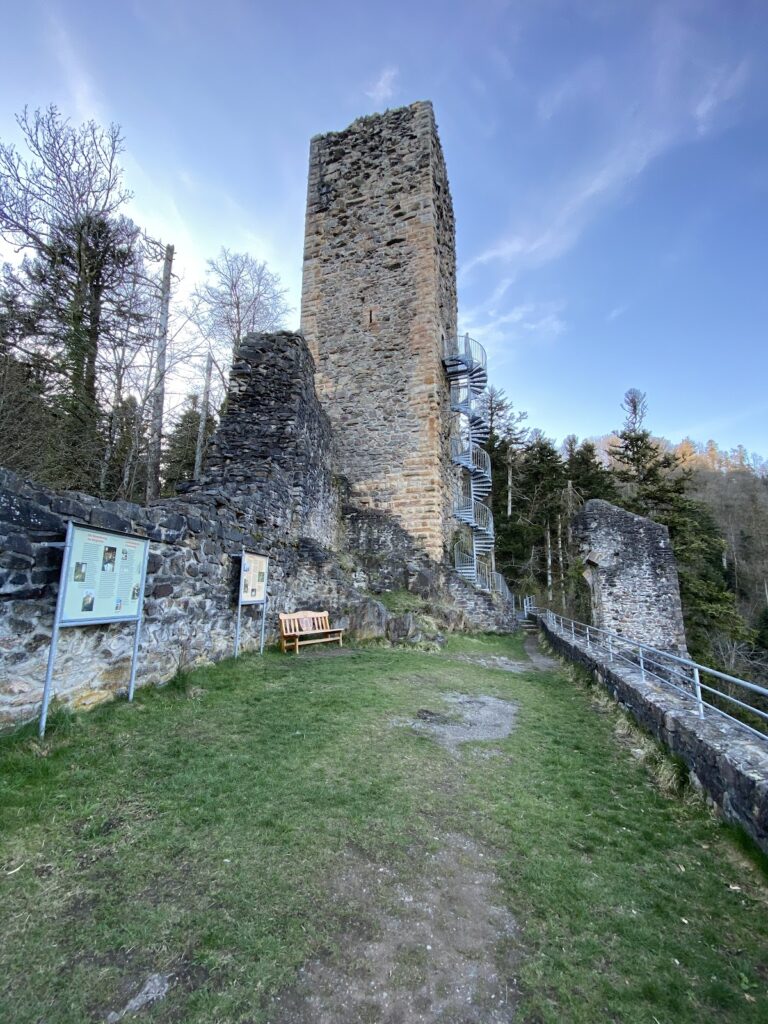
The core castle contained a curtain wall, the enclosing defensive wall of a castle, together with a square keep. The keep, the principal fortified tower used mainly for defense and lookout, had walls approximately 2.5 metres thick. Its masonry consisted of smooth ashlar blocks, meaning carefully cut stone blocks without projecting bossing. Parts of the keep and additional wall remains survive in the ruin.
Western building wing
A larger building wing extended west of the keep and was attached both to the keep and to the curtain wall. Joints in the masonry show that this wing was built in several construction phases. The surviving remains therefore preserve evidence of alterations to the castle’s core over time.
Nearby sites