Salvatierra Castle: An Andalusi Frontier Fortress in Spain


Site at a Glance
- Rating
- 4.8
- Popularity
- Very Low
- Country
- Spain
- Primary era
- Medieval
- Eras represented
- Medieval
- Civilizations
- Crown of Castile, Crusader, Order of Calatrava
- Site type
- Military
- Remains
- Castle
On this page11 sections
History
Salvatierra Castle is an Andalusi-origin fortress in Spain near Calzada de Calatrava, in southern Ciudad Real. Its origins and construction date remain uncertain, but it is generally understood as an Islamic fortification positioned on a natural route across the Sierra Morena between the Central Plateau and the Guadalquivir depression. Its location gave it a role in controlling movement through a contested frontier.
An Andalusi Frontier Fortress
During the late eleventh and early twelfth centuries, Salvatierra stood within the conflict zone between the Christian kingdoms and the Andalusi territories. Its earlier purpose may have included controlling the Berber population of La Mancha during rebellions and the political instability of the taifa period, when Muslim Iberia was divided among competing smaller states. The precise beginnings of the fortress remain unresolved.
As the Christian-Muslim frontier moved south toward the Guadiana valley in the mid-twelfth century, Salvatierra became an advanced Christian position. The Order of Calatrava, a Christian military order founded in 1158 to defend and govern frontier territories, probably controlled the castle by 1170. In that year, its master García and his supporters withdrew there during an internal struggle over the order’s leadership.
The Order of Salvatierra
The castle’s importance grew after the Christian defeat at the Battle of Alarcos in 1195. This major Christian-Almohad battle led to a broad Christian withdrawal, including the loss of Calatrava la Vieja, the order’s principal center. The Order of Calatrava was left territorially reduced and close to collapse.
In 1198, Master Martín Pérez de Siones led 400 knights and 700 infantry from Zorita de los Canes through Manzanares and captured Salvatierra, reportedly through the treachery of a Muslim. The Calatravans then strengthened and repopulated the fortress, transferring their convent and headquarters there. The order consequently became known as the Order of Salvatierra. The episode gave the castle a later reputation as a “castle of salvation.” For some, its survival represented a divine achievement, while for others it remained a humiliation.
Under Christian occupation, Salvatierra served as an important frontier outpost and a place of psychological warfare. Its fortifications and the presence of a church bell tower were viewed as provocations by the surrounding Muslim population. Muezzins, officials who call Muslims to prayer, reportedly summoned the faithful from the surrounding territories.
The Almohad Siege and Christian Recovery
In 1211, while preparations were under way for the Battle of Las Navas de Tolosa, the Almohad caliph Al-Nasir crossed the Sierra Morena with a large army and placed it on the plain of Salvatierra. The Almohads were a North African Berber dynasty that ruled much of the western Islamic world, including Muslim Iberia, during the twelfth and early thirteenth centuries.
Traditional accounts describe Ruy Díaz de Yanguas, a professed member of the Order of Calatrava, leading a sortie by 300 Christian defenders while maintaining their formation. A selected group covered the retreat. The siege lasted 51 days. The settlement on the hillside and the surrounding defenses fell first, while the castle continued to resist until siege engines battered it with stones and arrows.
Master Martín Pérez de Siones sent envoys to Alfonso VIII, the king of Castile, requesting reinforcements or permission to surrender. Unable to relieve the fortress, the king authorized its capitulation. Ruy Díaz de Yanguas and the remaining defenders escaped by night, and Salvatierra returned to Muslim control.
The Christian army advancing toward Las Navas de Tolosa camped around Salvatierra in 1212 but did not attack, judging its capture too costly. After the Christian victory in that battle, Salvatierra was definitively recovered between 1213 and 1215. The castle continued functioning until the fourteenth century, even after the Order of Calatrava moved its permanent headquarters to Calatrava la Nueva.
Ownership and Heritage Protection
Salvatierra Castle is privately owned because it lies within the former Encomienda of the Sacristanía Mayor. It is protected as an Asset of Cultural Interest under Spain’s general declaration of 22 April 1949 and the Historical Heritage Law of 1985. In 2019, it was added to the Red List of heritage at risk.
Remains
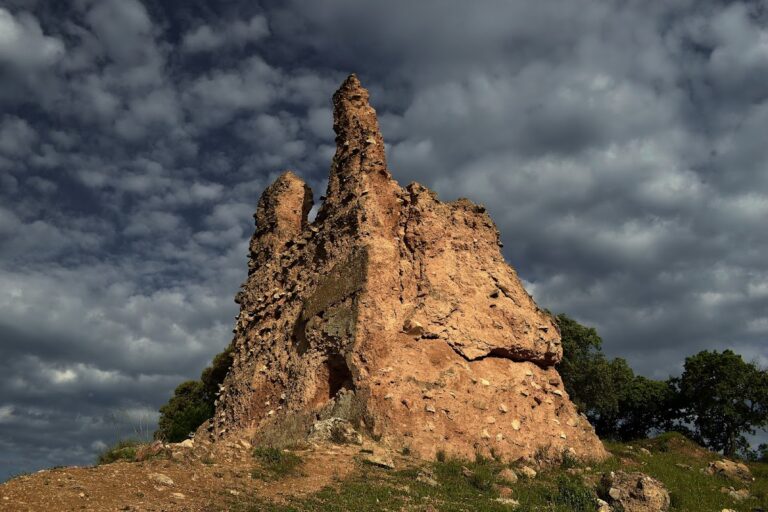
Salvatierra Castle occupies a small hillock at the foot of volcanic Mount Atalaya, near Calzada de Calatrava and opposite the castle-convent of Calatrava la Nueva. The CR-504 road runs between the two fortresses, while the castle’s position near a route across the Sierra Morena helps explain its strategic setting. The surviving complex is ruined but retains a substantial defensive enclosure, strengthened by the steep southeastern slope of the hill.
Defensive Enclosure
Keep and Curtain Walls
The tower keep remains the most prominent element of the fortress. It is built of masonry, with large corner blocks made from volcanic ashlar, or carefully cut stone, whose reddish color contrasts with the rest of the structure. Several sections of curtain wall and defensive towers also survive, forming the principal enclosure. Their construction combines Christian lime-and-stone concrete with tabiya, an Islamic rammed-earth method in which earth or a related aggregate is compacted within wooden formwork to create solid walls.
Settlement and Interior Spaces
Hillside Settlement
On the slope facing Calatrava lies the area formerly occupied by the settlement around the castle. This hillside town appears to have been abandoned during the twelfth century, before the principal fortress itself ceased to function. Its position outside the central defensive enclosure reflects the broader organization of the stronghold and its associated population.
Vaults, Chambers, and Cisterns
Several complete vaults survive within the monument, belonging to military and storage spaces. Underground chambers and masonry-built cisterns form part of the complex, showing how the fortress incorporated enclosed and below-ground facilities. Near the foot of the keep, the beginning of a dome survives from a space whose function remains uncertain. Together, the walls, towers, keep, and internal structures convey the considerable scale and strength of the former fortress despite its ruined condition.