Torri dei Salvucci: Twin Medieval Towers in San Gimignano


Site at a Glance
- Rating
- 4.9
- Popularity
- Very Low
- Country
- Italy
- Primary era
- Medieval
- External website
- Open
- Eras represented
- Medieval
- Civilizations
- Holy Roman Empire
- Site type
- Domestic
- Remains
- Elite Residence
On this page7 sections
History
The Torri dei Salvucci are twin medieval towers in San Gimignano, Italy, built in the thirteenth century as tower houses, a building type that could combine fortified residence with a visible display of family wealth and political power. They originally belonged to the de Mangeri family before passing to the Salvucci, one of the city’s leading Guelph families. In medieval Italy, Guelphs generally supported the papacy, while Ghibellines generally supported the Holy Roman Emperor. The towers’ imposing form was intended to express the Salvucci family’s supremacy within San Gimignano.
From the de Mangeri to the Salvucci
Through agreements and marriages, the towers passed to the Salvucci in 1257. The family had grown wealthy through commerce and moneylending, and they incorporated the towers into a larger complex that included the Salvucci palace and another nearby Salvucci tower. This concentration of buildings gave physical form to the family’s influence in the city.
The Salvucci were bitter rivals of the Ardinghelli, a Ghibelline family whose towers and palace stood on the opposite side of the square. Their rivalry was part of the wider factional struggles that often shaped the politics, architecture, and armed conflicts of medieval Italian communes.
Height, conflict, and collapse
A separate Salvucci tower was built in 1248. It was later reduced in height, probably because it rose above the 51-metre Torre Rognosa, despite a prohibition issued in 1255 against surpassing that tower. The Salvucci initially disregarded the restriction, reflecting the intensity of competition between powerful families.
In 1439, the 1248 tower collapsed. The disaster destroyed the Salvucci palace and partially damaged the nearby Torre Useppi, which was later lowered for structural reasons. Continuing struggles and reprisals between the Salvucci and Ardinghelli contributed to the decline of San Gimignano’s communal autonomy during the mid-fourteenth century and to its eventual submission to Florence.
Remains
The twin towers
The two surviving towers stand in Piazza delle Erbe beside Piazza Duomo, forming a closely paired composition. Each has a square plan, with very few openings and occasional small rectangular windows. At street level, extremely narrow doorways are topped by either horizontal stone architraves or pointed arches. Their tall, restrained surfaces preserve the defensive and representational character of medieval tower-house construction.
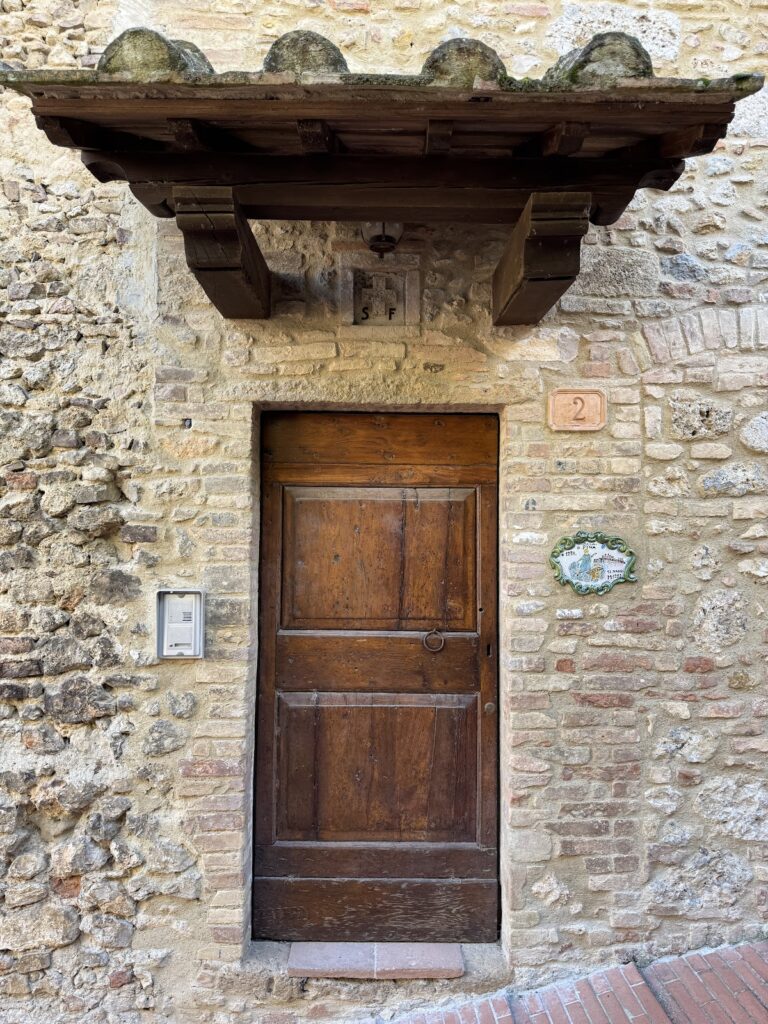
The original de Mangeri family emblem remains carved on the stone corbels above the street. This surviving detail preserves a physical link with the towers’ earlier ownership, before their transfer to the Salvucci in the thirteenth century.
The Salvucci architectural complex
The towers were connected with the Salvucci palace and another neighboring Salvucci tower, creating a single architectural complex. The palace was destroyed in the collapse of the separate 1248 tower in 1439, while the twin towers remain in use. Their surviving arrangement therefore preserves part of a larger family compound whose form was shaped by medieval rivalry and consolidation.
Torre Salvucci Maggiore
The taller tower, Torre Salvucci Maggiore, rises 48 metres and contains 10 floors. Its interior is arranged as a multi-level historic residence. It is the only one of San Gimignano’s 14 surviving towers of this type currently used as a residence, giving the building a continuing domestic function alongside its medieval fabric.