Santa Fina Chapel: An Early Renaissance Chapel in San Gimignano


Site at a Glance
- Rating
- 3.5
- Popularity
- Very Low
- Country
- Italy
- Primary era
- Medieval
- External website
- Open
- Eras represented
- Medieval
- Civilizations
- Republic of Florence
- Site type
- Religious
- Remains
- Chapel
On this page9 sections
History
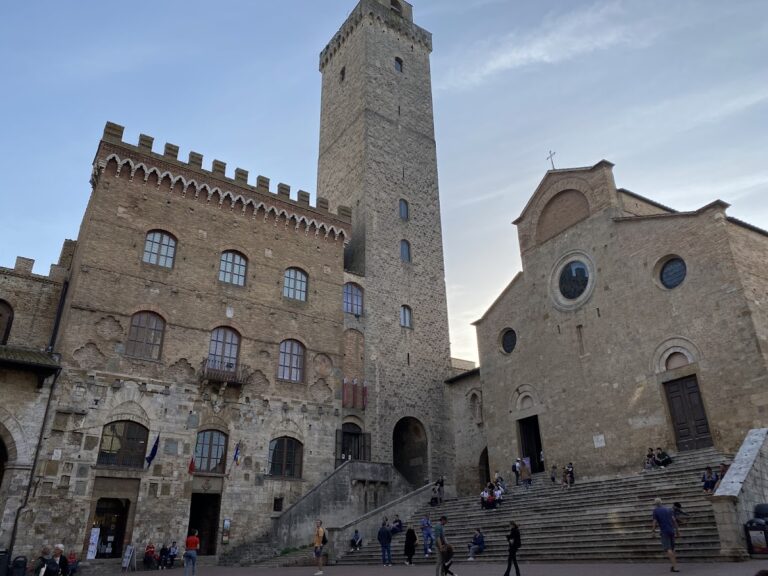
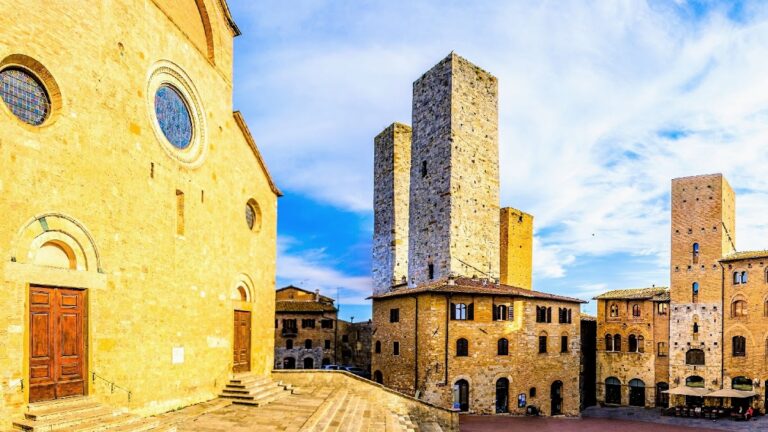
Santa Fina Chapel is an Early Renaissance chapel in San Gimignano, Italy, built to house the relics of Saint Fina, the town’s protector and patron saint. The chapel became an important expression of Florentine Renaissance architecture, painting, and sculpture within the Collegiate Church of Santa Maria Assunta.
Saint Fina and the growth of her cult
Fina dei Ciardi died on 12 March 1253. Her veneration developed quickly in San Gimignano, and her original burial place was a small cloister beside the cemetery. In 1325, the commune approved an altar inside the church for her relics, bodily remains preserved for religious veneration.
Stories about Fina’s life shaped the chapel’s later imagery. After her mother died, Fina adopted severe religious self-denial. She became paraplegic and spent about five years lying on a wooden board, cared for by two women, Beldia and Bonaventura. According to her hagiography, a saint’s life that includes religious traditions and miracle narratives, Saint Gregory the Great appeared to her and announced that she would soon die and attain eternal life. Gregory was a sixth-century pope and theologian whom Christian tradition regards as one of the major Doctors of the Church.
According to the legend, Fina died at the age of fifteen on 12 March 1253. Violets appeared around her wooden board, while the bells of San Gimignano rang without human action. During the funeral, her nurse Beldia was healed of paralysis when Fina touched her, and a blind boy recovered his sight after touching the saint’s feet. These traditions became the central subjects of the chapel’s painted decoration.
Planning and completion
In 1457, San Gimignano decided to create a “beautiful and honourable” chapel for Saint Fina. Work advanced slowly until Giuliano da Maiano was summoned from Florence in 1468 to provide a suitable design. Giuliano and his brother Benedetto da Maiano shaped the project. Giuliano, an architect and sculptor of the Florentine Renaissance, designed the chapel, while Benedetto produced its altar-tomb and reliefs. Giuliano received 11 lire and 6 soldi for his design, and the chapel was completed in 1472.
The side-wall frescoes were made by Domenico Ghirlandaio in connection with Benedetto da Maiano’s sculptural work. The tomb bears an epitaph referring to 1475, while the frescoes were painted during the 1470s. They form Ghirlandaio’s first known major commission and already show features associated with his mature practice, including detailed architectural settings and individualized contemporary figures.
Consecration and public veneration
The Bishop of Pistoia consecrated the chapel on 4 October 1488. A papal bull issued by Pope Sixtus IV in October 1481 authorized the public cult and veneration of Saint Fina, and Pope Paul III confirmed that authorization in 1538. These decisions formalized the public religious practice that had grown around the saint in San Gimignano.
The chapel’s overall decorative program joined sculpture, fresco, architectural framing, and devotional imagery. Ghirlandaio’s compositions brought religious narratives together with contemporary interiors, local architecture, and portraits of people from his own time. The elaborate architectural framing used here became an important feature of his later work, and the chapel’s overall scheme was later employed in his frescoes for the Sassetti Chapel in Florence.
Remains
Chapel structure and interior fittings
The chapel occupies one bay in the right aisle of the Collegiate Church, specifically the seventh niche. Three walls define the space, and each wall opens through an arched recess. The arches carry an entablature, the horizontal architectural zone above them, decorated with a polychrome terracotta frieze of seraphim, a high order of angels commonly shown with wings. Above the entablature are lunettes, semicircular wall or ceiling areas, incorporating circular windows.
Carved and inlaid wooden stalls by Antonio da Colle line the side walls. A marble balustrade enclosed the chapel in 1661, adding a later element to the Renaissance interior.
Altar, tomb, and devotional image
The altar and monumental tomb were made by Benedetto da Maiano in 1475. Their reliefs show episodes from Saint Fina’s life, while the saint’s relics lie beneath the altar. Above it stands a tabernacle containing a portrait of Fina painted on leather by the Sienese artist Manno di Bandino in the early fourteenth century.
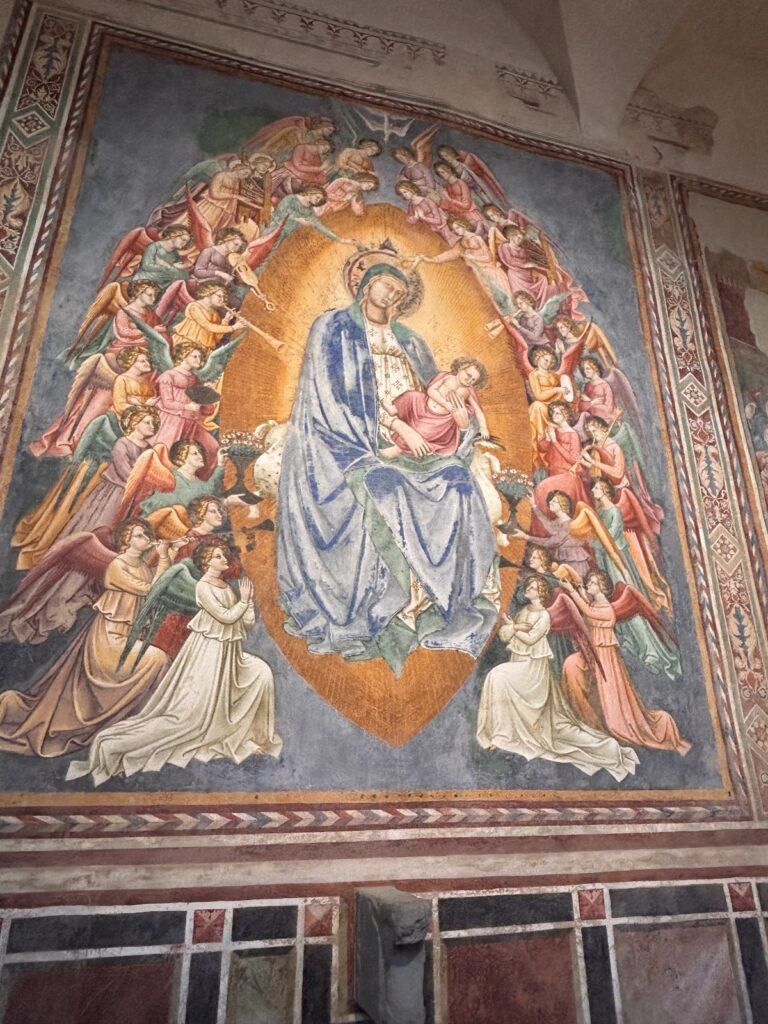
An urn above the tabernacle held Fina’s bones until 1738. The upper lunette contains a Madonna and Child between two angels. Together, the altar, tomb, image, and relics form the chapel’s principal devotional focus.
Right-wall fresco
The right-wall fresco depicts Saint Gregory the Great announcing Fina’s approaching death. Gregory appears inside a mandorla, an almond-shaped aureole, surrounded by red-winged seraphim. Fina lies in prayer on a bare wooden board, attended by Beldia and Bonaventura, while two angels carry her soul heavenward within an aureole.
The scene takes place in a bright domestic or monastic interior. Whitewashed walls, a coffered ceiling, and geometric perspective frame a door and window that open toward a garden with rose bushes and a distant citadel. A small rat beneath the bench refers to the legend that Fina was eaten alive by rats and worms.
Several objects add symbolic meanings to the scene. The pomegranate refers to royalty, fertility, resurrection, and the unity of the Church. The apple refers to original sin, while the wine refers to the Eucharist. A finely worked platter may relate to Ghirlandaio’s family connection with goldsmithing and to his own training in that art.
A wall plaque carries a gold-lettered Latin inscription presenting Gregory’s announcement that Fina will rise to heaven on his feast day and live eternally with her bridegroom. Above the painted architrave, two angels transport the soul of the praying saint.
Left-wall fresco and upper decoration
The left-wall fresco represents Fina’s funeral. She lies on a bier covered with richly decorated brocade, her head resting on a pillow. The scene is framed by a Renaissance exedra around the altar, with precious marble panels, fluted pillars, composite capitals, a richly ornamented entablature, and a blue semi-dome.
Beldia kneels behind Fina as the saint touches her hands, representing the healing of Beldia’s paralysis. A crying blind boy touches Fina’s feet, recalling the restoration of his sight. In the background, an angel near a tower suggests the miraculous ringing of San Gimignano’s bells, and the Torre Grossa can be identified among the town’s towers.
The funeral scene includes Ghirlandaio’s first true-life portraits of contemporary figures. The citizens shown probably include the chapel’s donors. Several wear contemporary clothing and display individualized gestures and expressions, bringing the sacred event into a recognizable Renaissance setting.
Sebastiano Mainardi painted the prophets in the chapel’s four pendentives, curved triangular sections that support a dome or vault. His works also fill the lunettes with Saints Ambrose, Nicholas, Jerome, Gimignano, and Augustine, while the vault contains the Four Evangelists. Mainardi was Ghirlandaio’s brother-in-law, master, and artistic associate.