Castello di Musso: A Medieval Fortress Guarding Lake Como


Site at a Glance
- Rating
- 3.9
- Popularity
- Very Low
- Country
- Italy
- Primary era
- Medieval
- Eras represented
- Medieval, Early Modern
- Civilizations
- Duchy of Milan, Spanish
- Site type
- Military
- Remains
- Castle
On this page14 sections
History
Castello di Musso is a medieval fortress in Italy, positioned between Dongo and Musso above Lake Como. Built to guard the lake and the ancient Via Regina, it also controlled routes from Valtellina and Valchiavenna toward the Po Valley. Its military role continued into the eighteenth century, while the surviving ruins reflect centuries of expansion, destruction, and material reuse.
Medieval foundations and Visconti rule
The rocky site may have been fortified in pre-Roman times, but the first certain historical record dates to 1350. At that time, the castle and its small settlement belonged to the Malacrida family, a Guelph family from Como. The Malacrida had moved to Dongo after buying the property at auction from the municipality of Como.
In 1406, Giovanni Malacrida received Musso and Poschiavo as a feudal fief, meaning land or jurisdiction granted by a ruler in return for loyalty and service, from Duke Giovanni Maria Visconti. The grant was confirmed by Filippo Maria Visconti in 1422 and by Francesco Sforza in 1450. The Visconti and Sforza were ruling dynasties of Milan, and their decisions shaped both ownership of the territory and the castle’s defenses. During this period, the fortifications were strengthened, particularly with Visconti support.
Sforza intervention and Trivulzio’s fortress
In 1472, the Sforza removed the fief from the Malacrida family. The family had taken possession of the mountainous area above the fortress and enlarged the defenses against the orders of the dukes of Milan. Galeazzo Maria Sforza then entrusted the fortress and its possessions to the Cotignola family, which held them until 1493.
Biagio Malacrida regained the fief in 1493 after Ludovico il Moro, the Milanese ruler, pardoned him. The continuing threat from the Grisons, forces belonging to the Three Leagues, an Alpine political federation corresponding broadly to the later Swiss canton of Graubünden, led Biagio to seek the protection of Gian Giacomo Trivulzio in 1507. Trivulzio was a prominent Italian condottiero, or professional military commander, and a marshal allied with France.
The Grisons attacked the castle during this period and almost completely destroyed it. Biagio Malacrida then ceded the whole fief to Trivulzio. The new lord enlarged the fortress with walls designed to withstand contemporary artillery, whose increasing use required thicker and stronger defenses. He also received the right to mint coins, established a mint inside the fortress, commissioned the adjacent port, and rebuilt the upper fortress.
After Trivulzio died in 1518, the fief passed first to Gerolamo Squinzano and then to Sebastiano da Novara. Their tenure preceded the seizure of the castle by Gian Giacomo Medici, known as the Medeghino.
The Medeghino and the destruction of 1532
In 1522, the Medeghino seized Castello di Musso after fleeing Milan following a murder. For about ten years, he used the fortress as the headquarters of his operations and mercenaries, as well as a secure port for raids conducted on the lake. From Musso, he directed the occupation of the Tre Pievi, a historical territory in the northern part of Lake Como, together with Gravedona, Dongo, and Chiavenna. These areas had long been controlled by the Three Leagues of the Grisons.
Under the Medeghino, the fortress reached its greatest extent and became the center of his small state on Lake Como. Its defenses controlled the movement of goods and armed forces between Switzerland and the Po Valley. Attacks from the Grisons through Val Mesolcina became increasingly frequent, and Medici surrendered the fortress to Duke Francesco II Sforza in 1532. The Grisons demolished it in March of that year. In return, the Medeghino received the marquisate of Melegnano.
Later military use and changing ownership
Under Spanish rule, the Malacrida returned to Musso in 1532 and rebuilt only part of the castle walls. The Bossi family purchased the castle in 1617 and retained it until 1838. During the War of the Mantuan Succession in 1636, part of the fortress was rebuilt to support Fort Fuentes against French forces approaching from the north. In 1701, the remaining defenses were used by the Austrians against the Spanish during the struggles over succession to the Duchy of Milan. These episodes marked the last major military phases in the fortress’s long defensive history.
Gardens, study, and material loss
From 1858 until his death in 1883, Giovanni Manzi, a local notable and engineer, created the Giardino del Merlo in the lower part of the fortified area below the Church of Sant’Eufemia. He introduced exotic plants from around the world, giving the lower grounds a new botanical purpose after their military importance had declined.
The future Saint Luigi Guanella, then parish priest at Pianello del Lario, investigated the history of Castello di Musso and wrote a series of articles for the local newspaper L’Ordine. The articles were later collected in a publication. The physical remains were reduced by the demolitions of successive military conflicts and by the exploitation of the Musso marble quarries. This marble had been used for valuable building and decorative stone since Roman times.
Remains
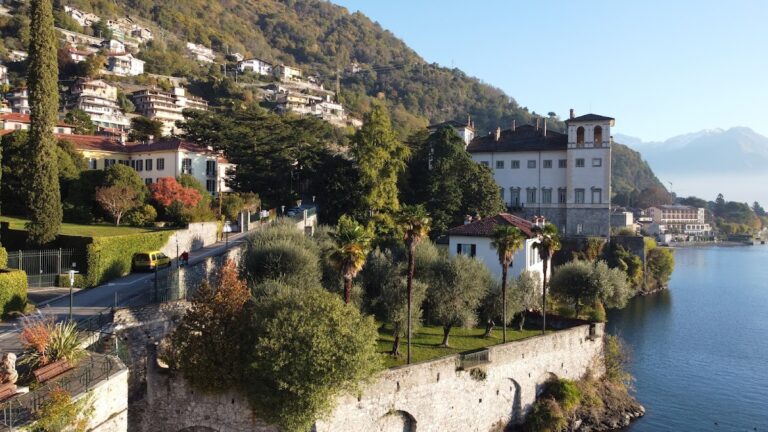
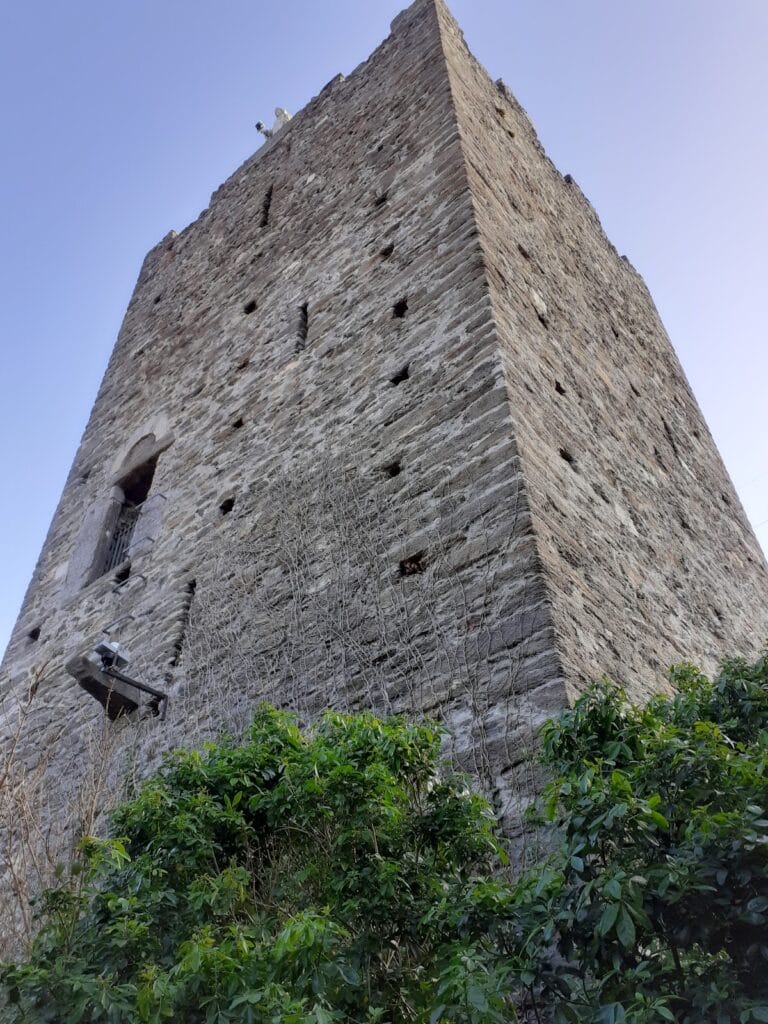
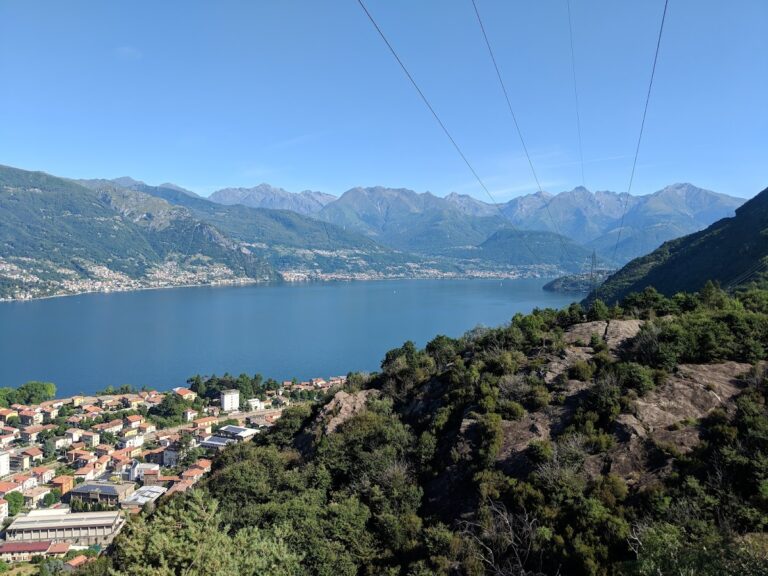
The former fortress occupied a rocky spur about 300 metres above sea level between Dongo and Musso. It rose steeply above Lake Como and overlooked the ancient Via Regina. Much of the perimeter walling survives, although the great fortress as a whole is represented by only a small part of its former extent. The surviving fabric belongs to medieval and early-modern phases that extended from the thirteenth to the sixteenth century, when the defenses were repeatedly strengthened, enlarged, partly rebuilt, and demolished.
Fortress defenses and military installations
Walls and triple circuit
During the Medeghino’s occupation, the fortress was arranged in three circuits of walls on the rocky spur above the lake. A ditch between the walls and the mountain was filled with sharpened wooden stakes to discourage assaults. These defenses formed the main structure of the expanded stronghold, whose position linked the lake approaches with the routes leading toward the Alpine valleys and the Po Valley.
Trivulzio’s additions
Trivulzio’s rebuilding introduced walls adapted to artillery warfare, a mint for producing coins, a port connected with the fortified settlement, and a rebuilt upper fortress. The later remains reflect only part of this complex, since the Grisons demolished the fortress in 1532 and subsequent rebuilding restored only sections of the walls. Marble extraction from the nearby quarries further reduced the surviving fabric.
Church and earlier sacred evidence
Church of Sant’Eufemia
The Church of Sant’Eufemia stands within the fortified area. It was built over an earlier early-medieval chapel, which may itself have replaced a pagan place of worship. The church therefore occupies a position where the religious use of the site continued through several historical phases within the former defensive enclosure.
Altar of Diana
At the foot of the cliff, work to widen the road below uncovered a sacrificial altar dedicated to Diana in the early twentieth century. Diana was a Roman goddess associated especially with nature, hunting, and the wilderness. The altar, a permanent stone installation for ritual offerings, may indicate an earlier cult site beneath the later chapel, although that interpretation remains possible rather than certain.
Giardino del Merlo
The lower area beneath Sant’Eufemia contains the Giardino del Merlo, the botanical garden laid out by Giovanni Manzi from 1858. Its plantings included palms such as Trachycarpus fortunei, Chamaerops humilis, and Brahea armata, together with oak, laurel, common box, Opuntia engelmannii, euphorbias, rue, bitter orange, Cycas revoluta, Idesia polycarpa, camphor, magnolia, chinaberry, banana, papyrus, olive, privet, camellia, azalea, passionflower, viburnum, crape myrtle, American agave, eucalyptus, cedar, oleander, cherry laurel, bamboo, yucca, and stone pine. The garden occupies the lower part of the fortified area and forms a later layer in the site’s physical history.
Nearby sites