Château de Chissey-en-Morvan: A Feudal Castle in France


Site at a Glance
- Rating
- 3.4
- Popularity
- Very Low
- Country
- France
- Primary era
- Medieval
- External website
- Open
- Eras represented
- Medieval, Early Modern
- Civilizations
- Duchy of Burgundy
- Site type
- Military
- Remains
- Castle
On this page16 sections
History
Château de Chissey-en-Morvan is a medieval castle in France, in the commune of Chissey-en-Morvan, Saône-et-Loire, beside the Ternin. Its development extended from the thirteenth to the eighteenth century around a twelfth-century tower, and its history reflects the overlapping authority of the bishop of Autun and the Duchy of Burgundy.
Medieval lordship
In the thirteenth century, the seigneurie was held by Hugues de Châtillon-en-Bazois, also known as Hugues de Roussillon, a noble knight who took part in the Crusades. The earliest surviving tower was incorporated into the castle at the end of the thirteenth century. In 1307 or earlier, Odet de Roussillon, called Odet de Chissey, succeeded his uncle Guillaume de Crux.
A fief was a landed holding granted within a system of feudal dependence. In 1374, Hérard de Roussillon, known as Hérard de Chissey, renewed his tenure from Geoffroi David, bishop of Autun. The fief included the fort, moats, pond, orchard, mill, and one-sixth of the parish tithes. Around 1385, Hugues de Ternan, also called Hugues de Chissey, renewed the tenure and married Philiberte de Paisey, lady of Maison-Ithier.
The castle was held in full jurisdiction from the bishopric of Autun, while its dependencies owed allegiance to the Duchy of Burgundy, a secular principality. The lord of Chissey exercised one-third of the justice of the borough. The remaining shares belonged to the bishop of Autun and the lord of Château de la Motte-Chissey. The castle’s jurisdiction covered the manor and the hamlets of Fontaine and La Verpillière, with boundaries defined in 1608 largely by the river and its associated streams.
Conflicts over authority
The competing claims of the bishop and the duke produced direct confrontations. In 1369, after the lord failed to make an aveu, a formal acknowledgment of a superior lord’s authority and rights over a fief, Bishop Geoffroi David sent his bailiff, Parizet Le Pergeot, to Chissey. The bailiff symbolically placed the castle under episcopal authority by fixing a marker to its gate.
In 1385, Philip II of Burgundy, known as Philip the Bold, sent his procurator Pierre Blet to carry out a similar act for the duchy. Guillaume Costain, a priest and castellan of Lucenay, removed the ducal marker. The bailiff of Autun then declared the seizure invalid and without prejudice to the bishop’s rights.
Andoche de Chissey held the fief in 1401. In 1397, he and his brother Hugues had been accused of removing stones from the seigneurial residence of Vaucheseuil. The bishop summoned them and seized their revenues. Andoche renewed his aveu in 1411 with his relative Jean de Chaulgy, but in 1415 he was condemned for forcing episcopal subjects to perform guard duty around his manor and to contribute to repairs to the moats. He died without issue.
The Chaulgy and Montmoyen families
Michaut de Chaulgy, known as “the Brave,” renewed his tenure on 6 November 1447. He served as chamberlain to Philip III the Good and Charles the Bold, was the second-ranking knight at the Parlement of Beaune, and held responsibility for forest rights in Auxois. In 1477, representing the house of Roussillon, he petitioned Louis XI to recover the barony of Roussillon. He died that year.
In 1503, Louis, Claude, and Georges de Chaulgy jointly acknowledged the fortified house and castle, its moats, and its mill. Around 1530, Jacques de Chaulgy, Claude’s son, was lord of Chissey and Anost. He built the castle at Anost and, with the consent of his wife, Claude de Crécy, sold Chissey in 1558 to Claude Régnier de Montmoyen. Claude Régnier died in 1591, leaving the property to his son Odinet.
Odinet de Montmoyen became governor of Autun in 1582 and defended the town against Marshal d’Aumont. He probably ordered repairs at Chissey and in 1583 attempted to require most parish inhabitants to perform guard duty at the castle. In 1588, he unsuccessfully challenged the superior authority of Bishop Pierre IV Saulnier. On 17 July, the bishop, the bailiff of Autun, and neighbouring lords came to Chissey with the land register and title deeds to assert episcopal rights.
Later seigneurial ownership
Odinet’s daughters inherited the estate. Chrétienne de Chissey married Jean de Senailly-Damas, baron of Villers, while Marie de Chissey married Nicolas de Sercey, lord of Le Jeu. Chrétienne rendered an aveu in 1637 and acquired Jean de Marrey’s share of Vaulsery on 19 April 1666, becoming its sole lady. In 1668, she founded three weekly masses in the chapel, supported by an annual rent of 66 livres. These comprised a Requiem mass on Monday, a mass of the Blessed Sacrament on Thursday, and a mass of the Virgin on Saturday. She died in 1685 and left Chissey and her other lands to her nieces.
Marie-Françoise de Sercey renewed her tenure of the fief in 1685 and married Claude-Joseph de Fussey. She died in 1744 and was buried in the choir of the parish church. Her son François de Fussey renewed the tenure in 1745 by right of his wife, Marie Nuguet, and updated the written land register in 1767. Nicolas-Antoine-François-Xavier de Fussey had the limits of his jurisdiction fixed on the side of Buy in 1777. He emigrated during the French Revolution and died in exile.
The estate also became involved in a dispute over the Montagnerot fief. Armed men belonging to Antoine Nuguet, lord of Esbaugis, occupied the castle for fifteen days, and the resulting lawsuit was still continuing in 1684. During earlier periods of unrest, dependants of the estate were required to provide watch and guard duty at the castle.
Revolution and nineteenth-century history
Around 1793, the castle was sold and adjudicated for 14,724 livres to Alexandre Henri Hubinet, a major in the Hussars who commanded the soldiers of the Camp des Latois, and Joseph-Alexandre Brochot, a forest inspector. The property was converted into a farm.
Napoleon spent the night of 16 March 1815 at the castle while returning from Elba. He stopped to contact the men of the Camp des Latois and then continued to the Pierre Écrite post station, where he decorated Abbé Rasse. The framework of the large square tower was repaired in 1868. The privately owned castle has been protected as a monument historique, a French legal heritage designation for buildings or sites of historical or architectural importance, since 12 June 1997.
Remains
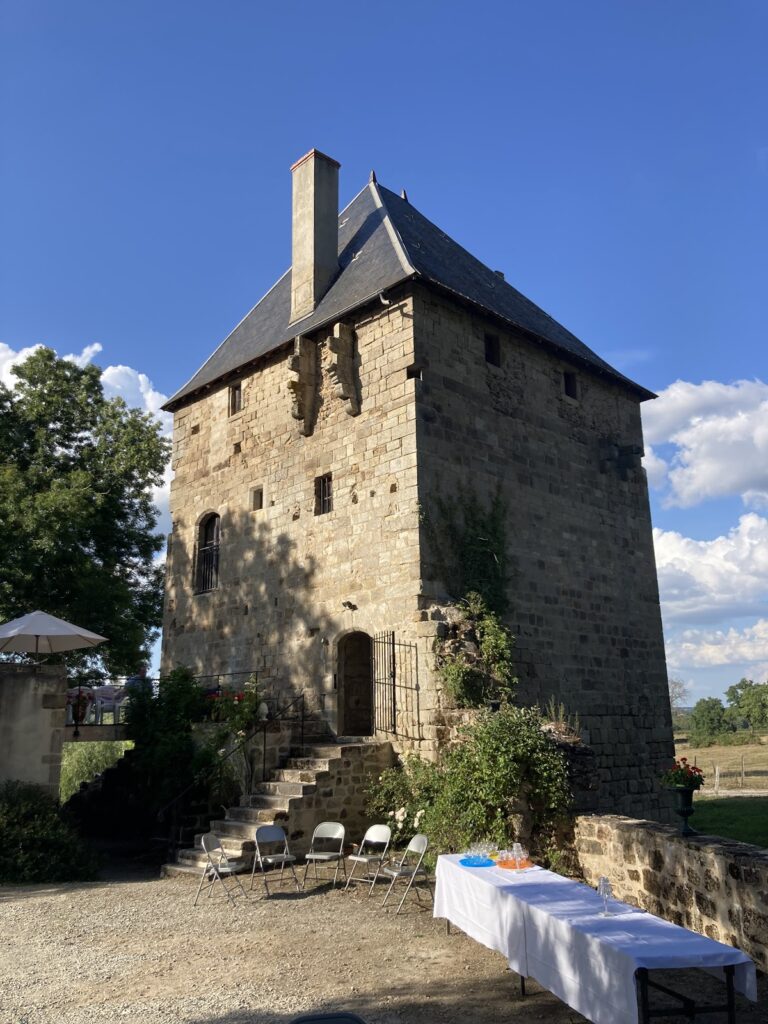
Château de Chissey-en-Morvan stands slightly apart from the village beside the Ternin. The surviving complex is arranged around an inner courtyard and retains three round towers, a massive square tower, and two residential buildings set at right angles. Its defensive system formerly included a broad, deep moat supplied by the river, followed by an earth embankment. The moats have since been filled in, while the associated fief also included a pond, orchard, and mill.
Early tower and residential buildings
Twelfth-century tower
The oldest surviving element is a three-storey tower built in the twelfth century. It is now truncated and stands at the north-east corner of the complex. At the end of the thirteenth century, it was incorporated into the expanding castle, preserving an earlier defensive structure within the later arrangement.
Principal residence
The principal residential building occupies the rear of the inner courtyard. It contained a vaulted cellar, a mezzanine, and an upper storey with a gallery overlooking the courtyard. Together with the second residential building set at a right angle, it formed the domestic core of the surviving complex.
Square tower
The massive square tower belongs to the castle’s surviving defensive group. It was remodelled in the eighteenth century, and its framework was repaired in 1868. The fief’s medieval and early modern records associated the towered castle with the moats, pond, orchard, and mill.
Defensive and service buildings
South curtain wall and entrance
On the south side, opposite the residential building, a curtain wall, meaning a defensive wall joining towers, was divided into two sections by a drawbridge. The drawbridge was reached across a fixed bridge and flanked by two loopholes, narrow openings for observation or defensive fire. Machicolations, projecting structures with openings through which objects could be dropped, and further loopholes made access difficult.
Service building and corner towers
The service building stood on the right when entering the courtyard. It contained a large kitchen, chapel, barn, and stables. Four corner towers formerly completed this defensive arrangement, each equipped with two loopholes. The south-west tower has disappeared, and the castle once extended westward through a keep and another tower that no longer survive.
Chapel
The chapel formed part of the service building and included a small opening in its side wall. This allowed the seigneur to hear Mass from beside his fireplace. Chrétienne de Chissey later endowed the chapel with three weekly masses in 1668, linking the surviving religious space with the devotional life of the estate.
Heraldic features
The arms associated with Hugues de Ternant were blue, bearing three black-masoned embattled towers. The quartered coat of Michaut de Chaulgy combined the arms of Chaulgy and Roussillon, preserving the connection between the castle’s later lords and the earlier Roussillon lineage.