Haus Crange: A Medieval Water Castle in Herne, Germany
Site at a Glance
- Rating
- 4.8
- Popularity
- Very Low
- Country
- Germany
- Primary era
- Medieval
- External website
- Open
- Eras represented
- Medieval, Early Modern
- Civilizations
- Duchy of Cleves, Holy Roman Empire
- Site type
- Military
- Remains
- Castle
On this page7 sections
History
Haus Crange is a water castle in Herne, Germany, built around 1440 by Duke Adolf II of Cleves on an island in the low-lying Emscher area. A water castle was a fortified residence surrounded by water, using a moat or naturally wet ground for defense. The complex belonged to the late medieval period and was reached by a wooden drawbridge.
Foundation and the von Eickel family
Before 1441, Adolf II established the castle as a lordly residence in the Emscher landscape. Probably on 10 August 1441, the feast day of Saint Lawrence, he enfeoffed Derick van Eykel with the house known as “ten Krangh.” Derick was Drost of the Bochum office in the County of Mark. A Drost was a high-ranking official who represented a lord in administering and judging a territorial office, while the County of Mark was a medieval territory in Westphalia. The name “Krang” meant “river bend.”
The von Eickel family retained Haus Crange until 1637, when inheritance transferred the property to the von Rump family. In 1761, a fire destroyed the building. It was renewed that same year, with rooms redesigned in the Neoclassical style above a Gothic vaulted cellar. Gothic was a medieval architectural style, while Neoclassicism drew on forms associated with ancient Greek and Roman architecture.
Changing ownership and decline
The owners moved out in 1812, after which Haus Crange was leased. Ownership later passed by inheritance to the Counts of Landsberg-Velen. The estate was sold to the Harpener Mining Company in 1884, to the Canal Construction Company in 1905, and later to Essener Steinkohle AG. In 1962, the industrialist Robert Heitkamp acquired it.
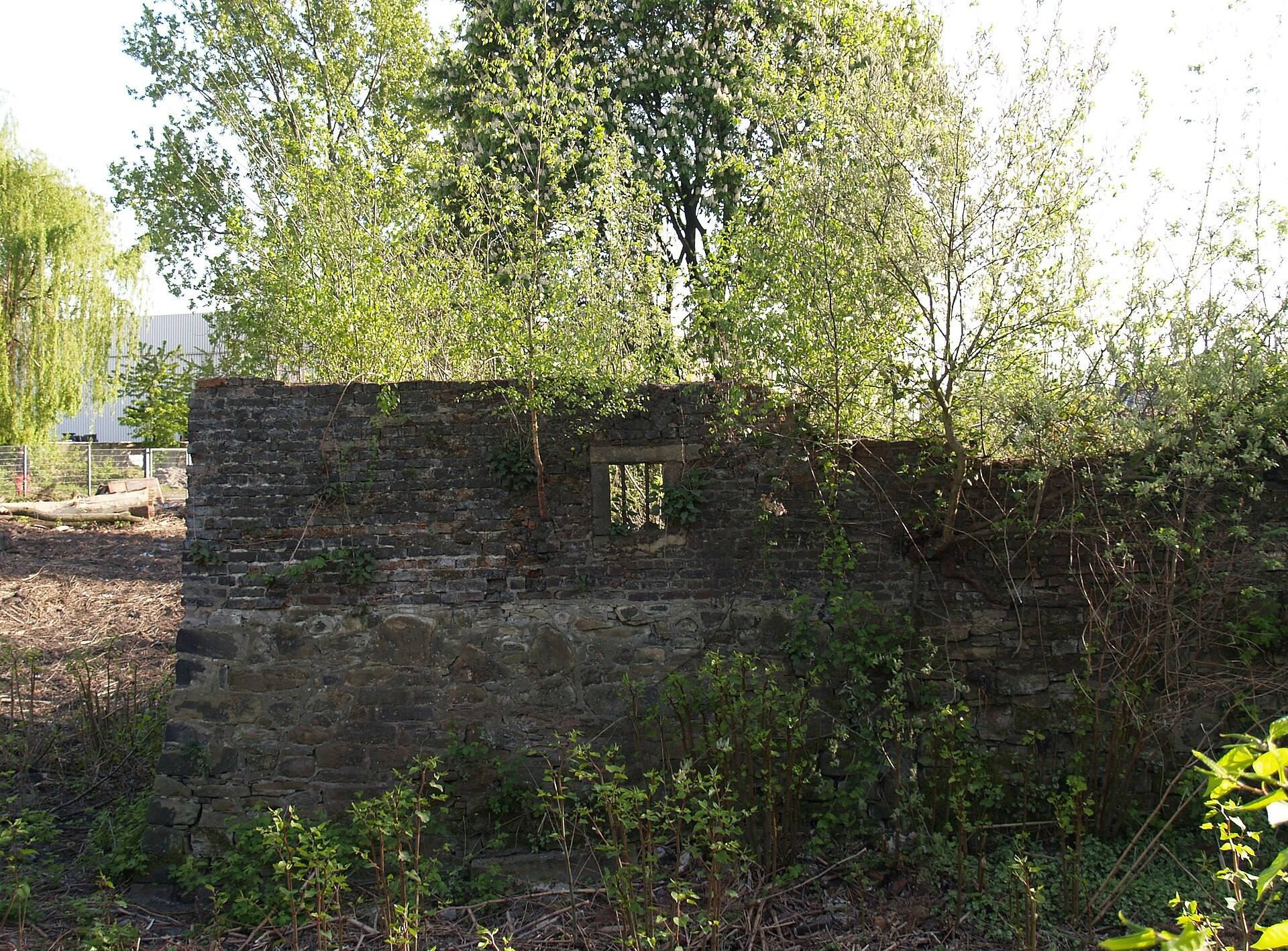
Haus Crange deteriorated increasingly during the twentieth century. The site received heritage protection in 1984, and the Haus Crange Support Association was founded in 1991 to help save the building. The City of Herne acquired it in 1992. Restoration, rebuilding, and extension plans were developed, and temporary measures were undertaken, but by around 2000 the building had largely fallen into ruin. After ten years of repair work, the surviving remains were preserved as a well-maintained ruin.
Saint Lawrence Chapel and the Crange Fair
A chapel connected with Haus Crange stood north of the castle. The Saint Lawrence Chapel was consecrated in 1449 and demolished in 1873. Its triptych, a three-part artwork often made with hinged panels, was produced by the Soest School of painting, a regional tradition of medieval panel painting associated with Soest. The triptych is now at Ahausen Castle.
The nearby Crange Fair developed from a horse market held on Saint Lawrence’s Day. Since the sixteenth century, wild horses from the Emscherbruch had been sold there, linking the annual market to the religious calendar and the surrounding landscape.
Remains
Castle foundations
Haus Crange was arranged as a water castle on an island in the low-lying Emscher area. Corner towers formed part of the fortified residence, whose entrance was reached by a wooden drawbridge. The 1761 renewal incorporated a Gothic vaulted cellar beneath rooms given Neoclassical interiors. The surviving remains consist of the castle’s foundation walls, preserved after repair work as a maintained ruin. A circular path with information panels surrounds the remains.
Saint Lawrence Chapel
The Saint Lawrence Chapel stood to the north of Haus Crange and was consecrated in 1449. Its triptych survives at Ahausen Castle and belongs to the Soest School of painting. The chapel’s former position and its association with the castle form part of the site’s medieval religious history.