Penhow Castle: A Fortified Manor and Country House in Wales


Site at a Glance
- Rating
- 4.4
- Popularity
- Very Low
- Country
- United Kingdom
- Primary era
- Medieval
- External website
- Open
- Eras represented
- Medieval, Early Modern
- Civilizations
- English, Norman
- Site type
- Domestic
- Remains
- Castle
On this page10 sections
History
Penhow Castle is a historic castle in the United Kingdom, whose earliest fortified manor was built by the Anglo-Norman de St Maur family in the early 12th century. Sir Roger de St Maur had constructed the fortified manor by 1129, after the estate was seized from Caradog ap Gruffydd, a high-ranking Welsh ruler associated with Gwent, during the expansion of Norman power into Wales.
From Norman manor to fortified castle
The manor of Penhow had been held by Caradog ap Gruffydd at the time of the Norman invasion of Wales. The estate then came into the possession of the Seymour family, whose earlier name was de St Maur. Their tenure established the castle’s earliest surviving phase, although the building was extended and reconstructed in almost every century after its origins.
Further fortification and enlargement took place in the 15th and 17th centuries. These changes formed part of a long development rather than a single rebuilding campaign, with the castle repeatedly adapted to changing requirements.
Ownership and later transformation
The manor passed to the Somersets in the 16th century. In 1674, the Lewis family of St Pierre purchased it. During the 17th and 18th centuries, large-scale remodelling changed the character of the building, refashioning the fortified residence as a more comfortable country house.
Viscount Rhondda, an industrialist and conservator of ancient buildings in Wales, bought Penhow Castle in 1914. By the middle of the 20th century it had fallen into considerable disrepair. Film director Stephen Weeks later bought and restored the castle, living there and opening it to the public during his tenure. It was sold again in 2002 and returned to use as a private home.
Penhow Castle is frequently claimed to be the oldest continuously inhabited castle in Wales. It is a Grade II* listed building, a designation used in England and Wales for buildings of particular importance that receive a higher level of protection than Grade II structures.
Remains
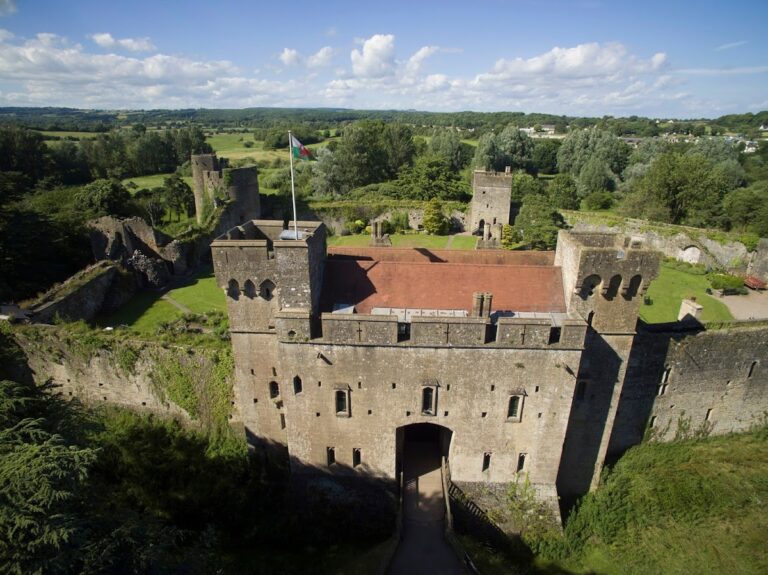
Penhow Castle is a small castellated building constructed from local Old Red Sandstone rubble, using irregular roughly prepared stones from a reddish sedimentary rock formation. Its surviving form combines an early fortified element, a later medieval hall range, and extensive changes that made the building suitable as a country house.
Main castle
West tower
The west tower is the oldest part of Penhow Castle. It dates from the period when the Seymour family, formerly known as de St Maur, held the estate and represents the castle’s early fortified phase.
Hall range and interiors
A later two-storeyed hall range was added in the 14th or 15th century. The castle was then extensively remodelled in the 17th and 18th centuries, when its medieval fortified character was adapted to domestic use. The interiors include exceptionally fine decoration from the Restoration period, the architectural and decorative era that followed the restoration of the English monarchy in 1660.
Agricultural buildings
Two groups of ancillary agricultural buildings stand to the south-west and south of the castle. Together they include barns, byres used for housing cattle, and a stable block intended primarily for horses.
South-west group
The nearer group contains a barn and an L-shaped byre range. A separate barn to the south-west is listed in its own right, as is the associated byre range.
Southern group
The farther group contains an additional barn, another byre, and a stable block at the far south-west. The five-bay barn with its attached byre and the stable block are separately listed agricultural buildings, preserving the range of working structures associated with the castle.