Château de Gray: A Fortified Castle and Museum Complex in France


Site at a Glance
- Rating
- 4
- Popularity
- Very Low
- Country
- France
- Primary era
- Early Modern
- Eras represented
- Medieval, Early Modern
- Civilizations
- French, Holy Roman Empire
- Site type
- Domestic
- Remains
- Palace
On this page11 sections
History
Château de Gray is a former fortified castle in Gray, France, whose origins are attributed to the eleventh century, possibly on the site of a ninth-century Carolingian castrum. It initially belonged to the palatine counts of Burgundy, hereditary rulers of the County of Burgundy, and served a military purpose. The castle later became the seat of the governors of Franche-Comté until 1668.
A fortress of the County of Burgundy
The castle formed part of the network of fortresses established in the County of Burgundy after the territory entered the Holy Roman Empire in 1032 to 1034. This was a long-lasting political association of territories in central Europe, within whose western sphere the County of Burgundy lay during the medieval period. The fortress occupied a strategic position above Gray’s lower town and commercial river port on the Saône.
The castle was destroyed in 1192 and again in 1227, when Count Palatine Othon II of Burgundy ordered its destruction. Count Hugues de Besançon rebuilt it in 1248, and a Sainte-Élisabeth chapel was added in 1266. Gray’s commercial activity expanded greatly during the thirteenth century under Count Othon IV of Burgundy and his wife, Mahaut of Artois. The fortified town and its port on the Saône supported this development.
The castle and town were burned in 1324. Queen Jeanne of France, Countess of Burgundy, and her son-in-law, Duke Eudes IV of Burgundy, arranged their reconstruction around 1333. Jeanne later occupied the castle during her widowhood after the death of her husband, King Philip V of France.
Wars, destruction, and restoration
On 6 August 1477, forces of Louis XI looted, destroyed, and burned the castle during the French annexation of the Burgundian state. The annexation followed the succession crisis after the death of Charles the Bold. Charles I of Amboise attacked the castle again in 1480 on Louis XI’s behalf.
Restoration took place at the end of the fifteenth century and continued during the sixteenth century under Emperor Charles V, his provost Gauthiot d’Ancier, and Charles V’s Spanish Habsburg successors. The castle was later ruined and annexed by Louis XIV during the French reconquest of Franche-Comté in the Ten Years’ War, a conflict fought from 1634 to 1644. Gray’s fortifications were also besieged in 1674 during Louis XIV’s campaign in the Dutch War.
From aristocratic residence to museum
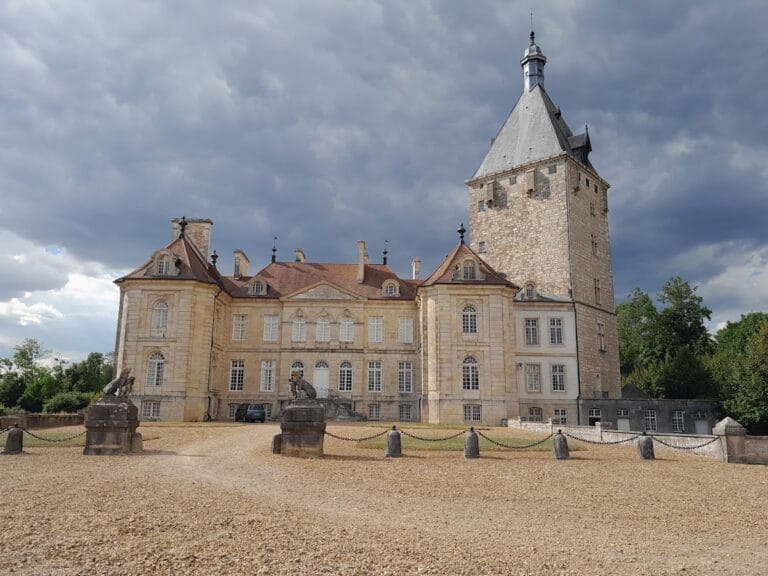
Count Louis Fabry de Moncault purchased the property in 1698 and built a residential palace within the former castle enclosure between 1699 and 1732. The grounds were reorganized as a formal French garden, with geometrically planned paths and symmetrical planting, as well as a kitchen garden, greenhouses, and a large aviary.
From 1777 to 1783, the property belonged to Louis, Count of Provence, the future King Louis XVIII. He adapted it as a residence for distinguished guests. The Countess of Autrey received prominent political, intellectual, and literary visitors there.
During the French Revolution, the property was sold in 1796 as a national asset, meaning property confiscated and offered for sale by the state after aristocratic or institutional ownership had been abolished. Delangre acquired it first, and Alexandre Martin de Gray, an imperial baron and mayor of Gray, purchased it later that year for use as his residence. The royal chapel was demolished between 1796 and 1817. Louis Revon acquired the property in 1866.
The city of Gray bought the property in 1901 and established the Musée Baron-Martin there in 1903 on the initiative of Senator-Mayor Maurice Signard. The museum was reorganized in 1954 and received a local archaeology section in 1973. The municipality remains the owner, and the palace houses a collection of more than 475 works, including art, furniture, objects, paintings, and sculptures. Some donations came from Edmond Pigalle, a grandson of Alexandre Martin de Gray. Historic-monument protection covers the fortified entrance tower from 1916, the vaulted cellars from 1988, and the enclosure walls from 1991.
Remains
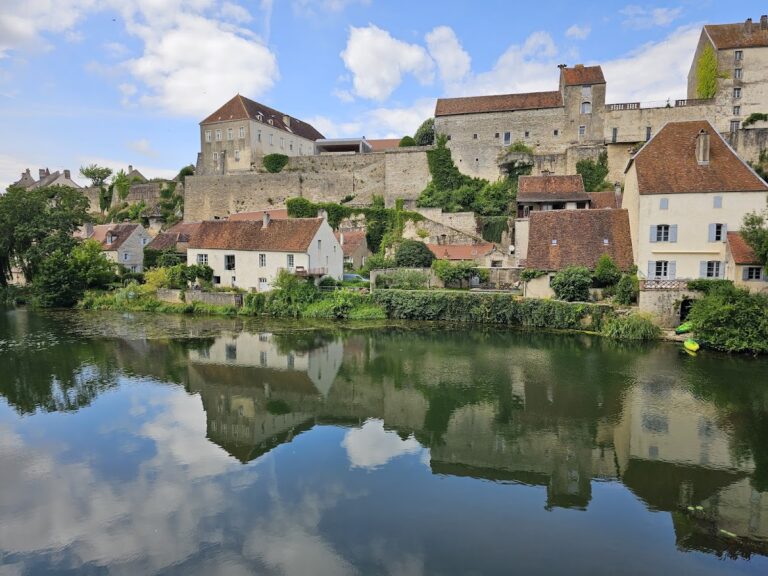
Château de Gray occupies the historic upper town above the local plain, the fortified lower town, and the Saône river port. The surviving site combines parts of the thirteenth-century fortress with the residential palace built inside its former enclosure between 1699 and 1732. A park, formal French garden, kitchen garden, greenhouses, and large aviary occupy parts of the former castle grounds.
Medieval fortress remains
Parvis tower
The principal surviving medieval structure is the fortified entrance tower known as the Parvis tower. It dates from the thirteenth century and represents part of the defensive castle that once occupied the upper town. The tower received historic-monument protection in 1916.
Enclosure walls and vaulted cellars
Thirteenth-century enclosure walls survive with the Parvis tower as part of the medieval defensive perimeter. The site also contains vaulted medieval cellars. These cellars were opened for the museum’s local archaeology section in 1973 and provide an underground element of the former fortress complex. A cannon dating from 1856 is associated with the site’s fortifications.
Palace and grounds
Residential palace
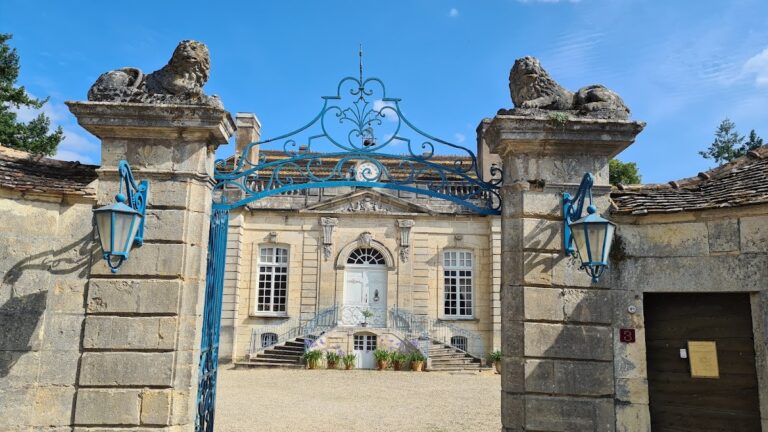
The principal later building is the palace constructed within the former castle enclosure by Louis Fabry de Moncault between 1699 and 1732. It now contains the Musée Baron-Martin, whose collections include works of art, furniture, objects, paintings, and sculptures.
Formal gardens and park
The former castle grounds were reorganized as a formal French garden, with planned geometric arrangements, together with a kitchen garden, greenhouses, and a large aviary. A park also occupies land on the site of the earlier fortress, linking the later residential landscape to the medieval enclosure.
Nearby sites