Esztergom Castle: A Medieval Royal Residence and Ottoman Frontier Fortress


Site at a Glance
- Rating
- 4.6
- Popularity
- Very Low
- Country
- Hungary
- Primary era
- Medieval
- Eras represented
- Classical, Medieval, Early Modern
- Civilizations
- Hungarian, Roman
- Site type
- Military
- Remains
- Castle
On this page9 sections
History
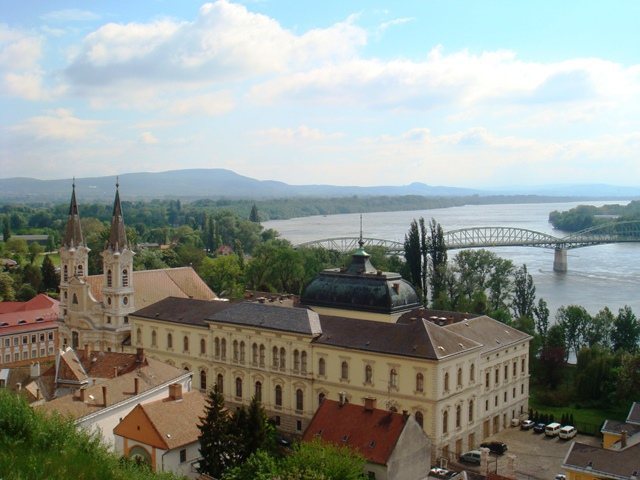
Esztergom Castle is a medieval Hungarian fortress in Esztergom, Hungary, developed on the site of the Roman fort of Solva from the late tenth and eleventh centuries. Standing above the Danube, it became a royal residence, an administrative and religious center, and later an Ottoman frontier stronghold.
Royal and archiepiscopal origins
Grand Prince Géza is said to have established a palace and church at the former Roman fort in the late tenth century. The earliest palace buildings and southern fortifications are attributed to the period of his son, King Stephen I. During the eleventh century, the Cathedral of Saint Adalbert and other buildings of the Archdiocese of Esztergom were established on the central plateau.
Rebuilt and enlarged over several phases, the complex served for about 250 years as one of the principal residences of the kings of Hungary. Until the Mongol invasion of 1241, Esztergom was the administrative and religious center of the Hungarian Kingdom. After King Béla IV moved the capital to Buda in 1256, the castle was left to the clergy, and the former archiepiscopal complex later became a museum.
Habsburg and Ottoman conflict
During the conflicts between the Habsburgs and the Ottomans in 1526–1531, Esztergom changed hands repeatedly. Ottoman forces captured it, Ferdinand of Habsburg recovered it, and the castle was retaken during the Ottoman advance toward Vienna before Habsburg forces recovered it again. The Ottoman conquest followed in 1543.
In August 1543, Sultan Süleyman I’s army captured the castle after a siege of about twelve days. The surrounding district became a sanjak, an Ottoman provincial district administered by a local governor, and was attached to the Buda Eyalet, the larger Ottoman province. Esztergom served as one of the empire’s northwestern frontier strongholds from 1543 to 1595 and again from 1605 to 1683.
A large force of German, Polish, and Venetian troops besieged the castle in 1594–1595. A relatively small Ottoman garrison under Sokolluzade Lala Mehmed Pasha defended it, but surrendered on 2 September 1595 after relief failed to arrive and hunger and thirst took hold. The defense was witnessed and recorded by the Ottoman historian Ibrahim Peçevi, and it inspired the song known as the “Esztergom Castle Folk Song.”
The Ottomans besieged Esztergom again in 1605. Sokolluzade Lala Mehmed Pasha, then a grand vizier, captured the castle after a siege of about one month, beginning another 78 years of Ottoman control. After the Ottoman defeat at the second siege of Vienna in 1683, the Holy League, a coalition of European powers formed to oppose the Ottoman Empire, helped drive Ottoman forces from Hungary. Esztergom Castle definitively left Ottoman rule on 1 November 1683.
Modern preservation and use
Esztergom Castle has been included on Hungary’s UNESCO World Heritage tentative list since 1993. Its modern uses include the Castle Museum of Esztergom, the Esztergom Castle Theatre, and a wax museum.
Remains
Fortifications and plateau
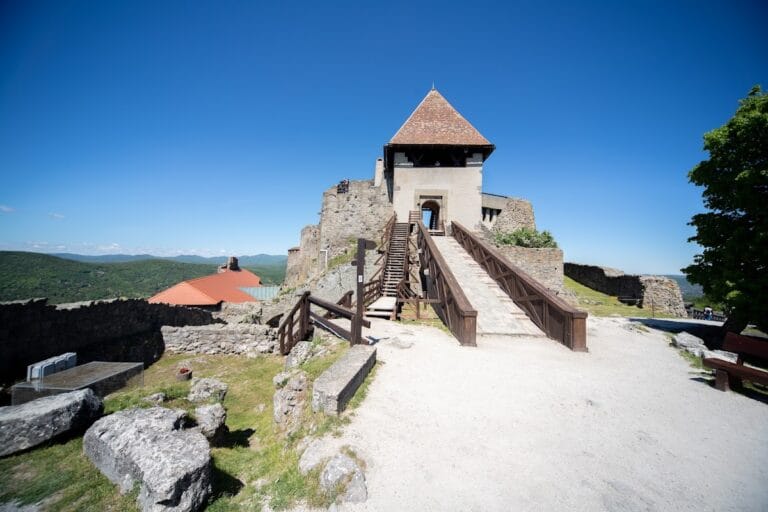
Esztergom Castle occupies a formerly triangular mountain plateau above the Danube. Medieval and early-modern fortifications survive along the western, northeastern, and southern sides, together with outer gate installations and the northern rondel.
Central plateau and palace complex
Cathedral and archiepiscopal buildings
The central plateau contains the site of the eleventh-century Cathedral of Saint Adalbert and the associated buildings of the Archdiocese of Esztergom. This group formed the religious and institutional core of the medieval castle.
Southern palace
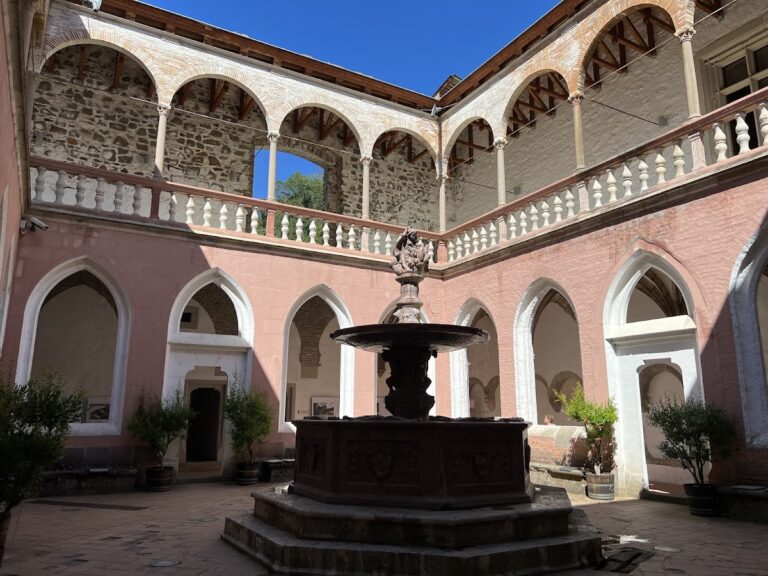
The southern palace complex preserves the lower part of the residential tower, the palace chapel, rooms with late Romanesque and early Gothic architectural elements, the remains of the great hall, and the remains of the northern residential building. Important parts of the late Gothic and Renaissance extensions also survive. Major sections of the southern palace buildings were restored in 1938, around 1970, and again in 2000, preserving substantial portions of the surviving palace fabric.