Fortress of Porto Santo Stefano: A Spanish Coastal Fortification in Italy
Site at a Glance
- Rating
- 4.2
- Popularity
- Very Low
- Country
- Italy
- Primary era
- Early Modern
- External website
- Open
- Eras represented
- Early Modern, Modern
- Civilizations
- Italian, Spanish
- Site type
- Military
- Remains
- Fort
On this page10 sections
History
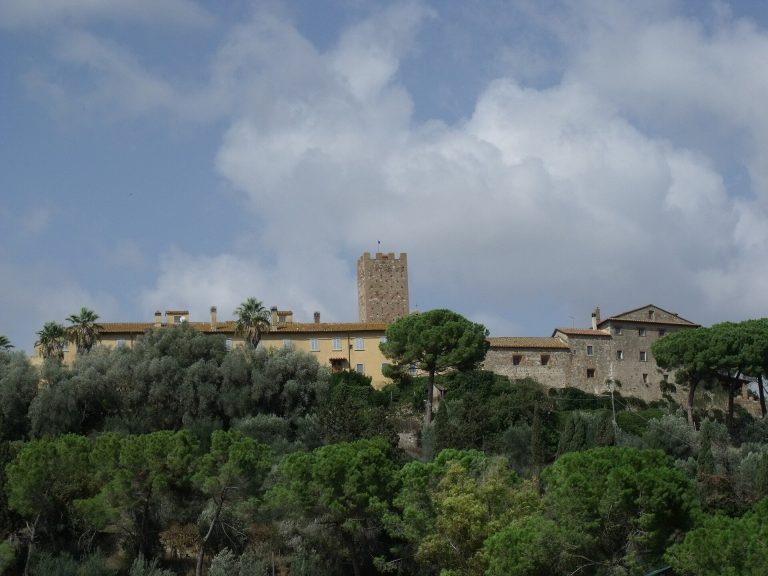
The Fortress of Porto Santo Stefano is a Spanish coastal fortification in Italy, built between the late sixteenth and early seventeenth centuries after Porto Santo Stefano became part of the State of the Presidi, a Spanish-controlled territory whose forts protected strategic ports and maritime routes. It replaced an earlier Sienese tower and served for centuries as a defensive and observation post overlooking the port.
From the Sienese tower to the Spanish fortress
The construction site had previously held the fifteenth-century Tower of Santo Stefano, built by Siena. Spanish authorities considered the tower inadequate for the more effective coastal-defense system then being developed and ordered its demolition. Some of its building materials were reused in the new fortress.
Work progressed slowly and was completed in 1636. The complex was later improved according to a project by Pedro Álvarez, a military engineer specializing in the planning and improvement of defensive fortifications. For several centuries, the fortress combined defensive duties with observation of the coast, and it resisted and repelled attacks and maritime raids on several occasions.
Napoleonic defenses and military use
At the beginning of the nineteenth century, French forces strengthened the defenses because British ships might attack during the Napoleonic period. After the territory entered the Grand Duchy of Tuscany, the Lorraine rulers repaired the paving. These interventions formed part of the fortress’s continued adaptation to changing military circumstances.
Following Italian unification, the building retained a military role and served as a strategic garrison during the First World War. Heavy bombing of Porto Santo Stefano during the Second World War led to the construction of two buildings on the highest terrace for temporary municipal offices. After the offices moved to the new town hall, the premises were used by the Porto Santo Stefano Nautical Technical Institute for laboratories and several classrooms.
Restoration and museum use
Restoration campaigns in the second half of the twentieth century renewed the complex. In 1990, architect Nicoletta Maioli, commissioned by the heritage authority responsible for the provinces of Siena and Grosseto, restored the underground spaces and converted them into temporary museum areas. Since 1997, the fortress has functioned as a museum complex devoted to exhibitions about the local territory.
The permanent exhibitions Memorie sommerse and Maestri d’ascia were created with the aim that they might eventually form part of a maritime museum for Porto Santo Stefano. Both belong to the provincial Musei di Maremma network. Together, they connect the fortress’s coastal military history with the archaeology of Mediterranean shipping and the long boatbuilding tradition of the Argentario.
Remains
Fortress layout and defenses
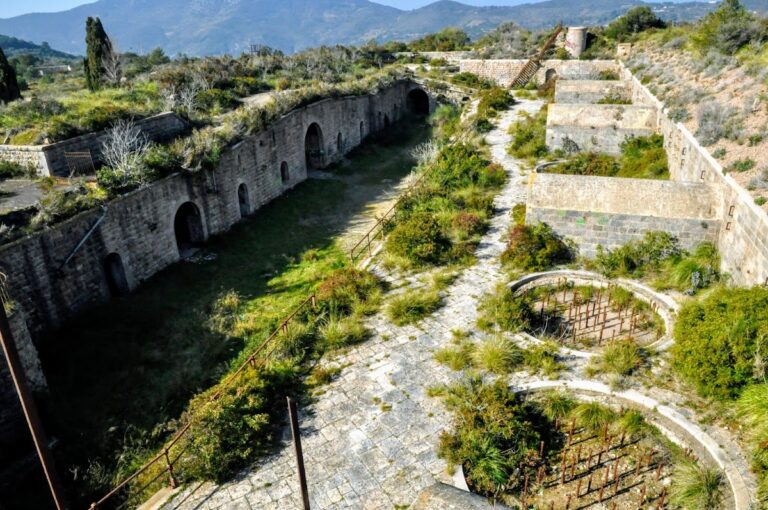
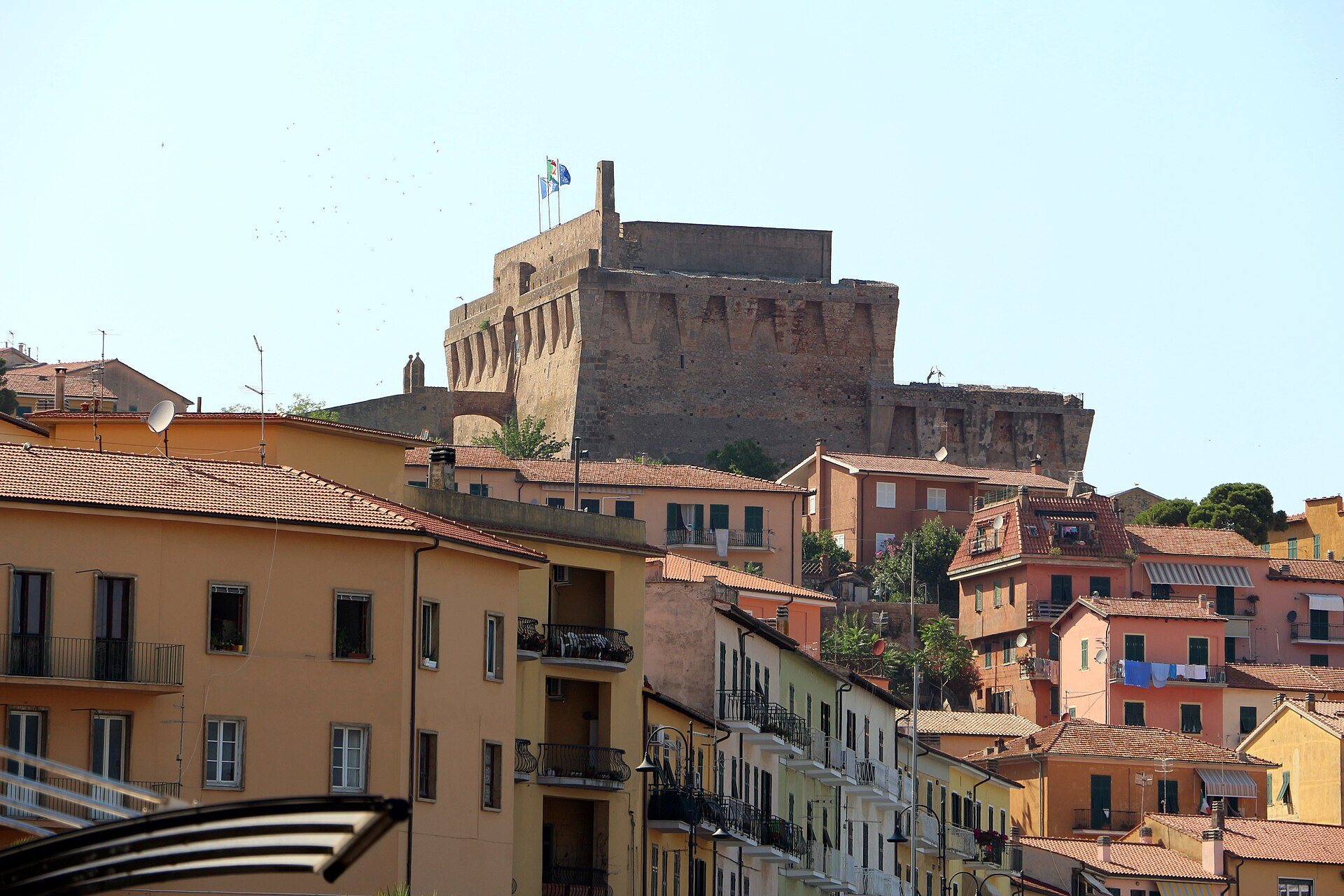
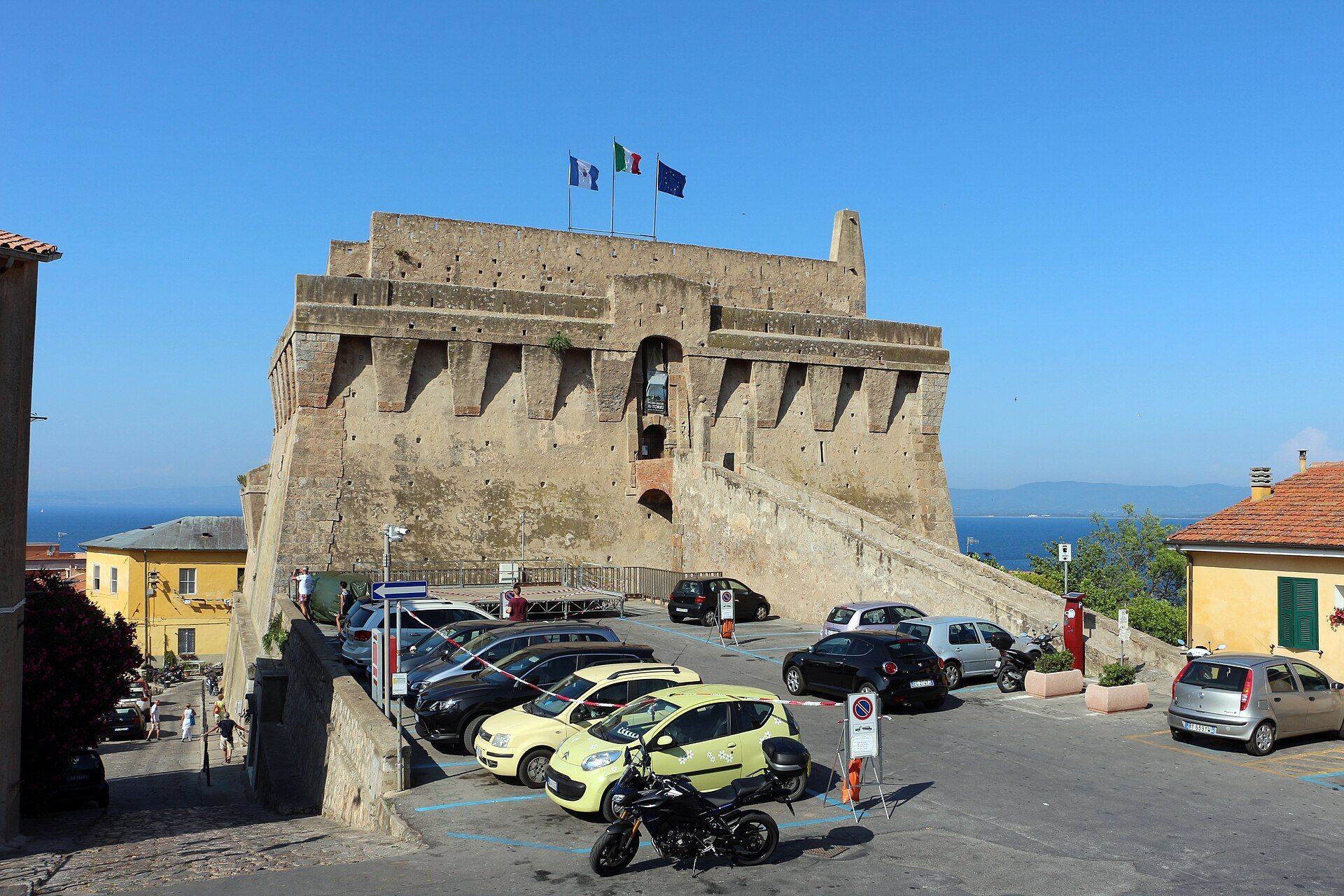
The fortress occupies a commanding position within Porto Santo Stefano and has a quadrangular plan measuring about 33 metres on each side, covering more than 1,000 square metres. It is formed by two adjoining building masses, with the lower one arranged along the sea-facing side. Massive sloping bases support a projecting corbelled crown, a projecting upper structure, that encloses machicolations, defensive openings through which defenders could observe or attack enemies below. A parapet above the crown defines the upper terraces, and this treatment recalls the nearby Tower of Buranaccio.
The exterior combines stone facing, particularly at the corners, with whitewashed plaster. Loopholes, narrow wall openings used for weapons or observation, appear at different heights. The entrance from the landward side opens at the upper level. A long exterior staircase reaches a bridge that replaced the original wooden drawbridge, which no longer survives.
Covered stair ramps and walkways protected by curtain walls connect the various parts of the fortress and lead to the highest terrace. The two postwar buildings that once housed municipal offices occupy this upper level. The summit originally had a series of sentry turrets, all of which have been lost.
Water storage and underground spaces
The interior of the sloping foundations contains cisterns, tanks used to collect and store water, while the upper levels provided accommodation for sentries. The cisterns held approximately one million gallons and supplied water to the inhabitants of the port for centuries.
Rainwater fell onto the buildings’ broad roofs and passed through gutters to four cistern inlets. Two survive and were later converted into skylights for the underground rooms. The other two were blocked after the upper floors were constructed. The underground structure has its own access beneath the bridge, separate from the main entrance. Its water was drained in the 1930s, and the underground system ceased its original function permanently in 1990.
Maritime archaeology and local collections
Memorie sommerse
The central courtyard contains a reconstruction of a Roman ship carrying transport amphorae, large vessels used to carry commodities. The two levels of Memorie sommerse present archaeological material from wrecks near the Formiche di Grosseto, Talamone, Monte Argentario, Giannutri, Punta Ala, and Giglio. The objects illustrate the movement of commercial cargoes along Mediterranean routes.
Among the displays are finds from a wreck near Punta Scaletta on Giannutri, discovered in 1961 at a depth of 37 metres. Work carried out from 1963 recovered part of the oak-plank hull and much of the cargo, including amphorae, black-gloss pottery, and tableware dating from approximately 140 to 130 BC. Another Giannutri wreck, identified near Cala Scirocco in 1959 and partly recovered during the 1960s, carried wine amphorae and shipboard equipment from the beginning of the second century BC.
Material from a Roman wreck found near the modern port of Punta Ala during the 1970s includes oil amphorae, pottery made in Africa, and coins issued under the Roman emperor Severus Alexander, who ruled from AD 222 to 235. A wreck identified at Punta Hidalgo in 1993 carried Greek-produced wine and oil amphorae together with bucchero, a distinctive black Etruscan pottery, dating between the late sixth and late fifth centuries BC.
Other collections include wine and oil amphorae, glass cups, and Italian terra sigillata pottery from a wreck at Cala del Barbiere dating to about the beginning of the second century AD. Near Giglio Porto, the remains of a third-century AD Roman ship, possibly from the African coast, were recovered with amphorae containing fish and fish sauce. Two second-century BC wrecks near Punta Lazzaretto on Giglio carried Greek-Italic wine amphorae.
Near the Bay of Campese, the cargo of a Greek ship wrecked in the sixth century BC was recovered. The vessel probably came from the Ionian port of Clazomene and was bound for Marseille. Its cargo included Greek and Etruscan amphorae, aryballoi, small vessels often associated with oils or perfumes, metal ingots, ornaments, furnishings, shipboard tools, fishhooks, and net weights.
The exhibition also includes cargo from a vessel wrecked at Capel Rosso on 14 June 1646 and identified as the Spanish frigate Santa Catalina. Finds from near Punta degli Stretti in the Orbetello Lagoon provide evidence of settlements dating to the Final Bronze Age.
Maestri d’ascia
Maestri d’ascia documents the boatbuilding tradition of the Argentario, especially the construction of fishing boats. Its displays include boatbuilding tools and scale models of typical vessels, ranging from early boats to modern fishing craft, together with photographs and explanatory panels. The collection presents the practical knowledge and changing forms associated with local maritime work.