Burg Borghausen: A Ruined Hill-Spur Castle in Germany


Site at a Glance
- Rating
- 4.4
- Popularity
- Very Low
- Country
- Germany
- Primary era
- Medieval
- External website
- Open
- Eras represented
- Medieval
- Civilizations
- Holy Roman Empire
- Site type
- Military
- Remains
- Castle
On this page12 sections
History
Burg Borghausen is a ruined medieval hill-spur castle near Borghausen in Attendorn, Germany. Its beginnings are unknown, although construction of the castle may have started in the twelfth century. The surviving site occupies a rocky height above the Lenne and Repe valleys and was later closely associated with the Borghausen manor estate and the Vogt von Elspe family.
Prehistoric and Medieval Origins
An earthwork barrier about 350 metres south-southeast of the castle may represent a separate prehistoric fortification rather than an early part of Burg Borghausen. It consists of a rampart and an outer ditch. Bronze finds make a Hallstatt-period installation, dating approximately from 620 to 450 BC, possible, while a later Iron Age phase is also possible. Metal dress ornaments point to connections with the Lahn-Sieg cultural group during the La Tène period, approximately from 380 to 150 BC. La Tène material is associated with communities influenced by Celtic cultural traditions, but it does not by itself establish the identity of the people who used the site.
The medieval castle developed separately from this uncertain prehistoric earthwork. Pottery from the area includes Pingsdorf-type earthenware, used between the eleventh and thirteenth centuries, and Paffrath ware, associated mainly with the eleventh and twelfth centuries. Most of the recovered pottery, however, dates from the fourteenth and fifteenth centuries. These finds reflect activity at the castle across several medieval phases.
The Borghausen and Bamenohl Estates
Burg Borghausen became closely connected with Haus Bamenohl during the fifteenth century. In the middle of that century, Heidenreich von Plettenberg brought the Bamenohl and Borghausen estates under his control after his wife, Angela von Heggen, brought a share of Bamenohl into the marriage. A claim that Burg Borghausen was identical with Burg Bamenohl is not supported by documentary evidence.
Around 1540, Bernhard Vogt von Elspe moved his residence to the Borghausen estate below the castle, in the Repetal. He had received the property in an inheritance division with his brothers in 1539. This change marked the development of the Borghausen manor estate as a separate residential and administrative focus below the ruined hilltop fortification.
Seventeenth-Century Conflict and Decline
On 20 May 1609, Wilhelm von Neuhoff and his wife, Ursula von Hatzfeld of Ahausen, pledged the Borghausen estate to Dietrich and Catharina von Hatzfeld of Schwarzenberg. A tax assessment from 1631 still placed Bernt Vogt von Elspe at the castle, where he lived with a servant, a male farmhand, three boys, three girls, and a maid responsible for livestock.
The castle was stormed and destroyed in 1632 by Hessian-Swedish troops under Colonel von Linteloe during the Thirty Years’ War, a European conflict fought from 1618 to 1648 amid dynastic, political, and religious struggles. Bernhard Vogt von Elspe is said to have hidden for an extended period in the place known as the Küllenloch, receiving food from a loyal servant while avoiding peasants and soldiers.
Later Ownership and Protection
On 5 July 1649, Johann Bernhard Vogt von Elspe of Borghausen married Mechthild Katharina von dem Broel, called Plater. They had nine children. The family later moved to Westhemmerde, which became the principal residence, and their youngest child was born there around 1673 rather than at Borghausen.
Konrad Wilhelm Vogt von Elspe of Westhemmerde and Borghausen granted a sixteen-year lease for the aristocratic Borghausen estate to Jobst Edmund Michael Christoph von Beckman and his wife, Sybilla Elisabeth von der Heesen, on 30 July 1690. This agreement probably concerned the manor estate rather than the ruined castle. A further lease for Burg Borghausen was concluded on 4 November 1706 with Franciscus Andreas Antonius Außel and his wife, Helena Burghoff.
Borghausen remained in the possession of the Vogt von Elspe family into the eighteenth century, though not always through direct male descent. In 1790, Freiherr Voigt von Elspe, also called von Voß, was described as hereditary lord of Borghausen among several other estates. Gisbert Moritz Vogt von Elspe, the last of the Vögte von Elspe, died in The Hague during the night of 11 to 12 March 1800, aged eighty. He had served as chief court official to William of Orange-Nassau and made his niece, Anna Luise Gisbertine von Bodelschwingh, born Vogt von Elspe, his universal heir. Her daughter Christine Sophie Luise had married Freiherr Karl Wilhelm Georg von Plettenberg in 1788, and his family remains in possession of the ruin.
In 1987, the castle ruin and the section rampart were entered in the monument list of the city of Attendorn. The designation recognized both the surviving castle remains and the defensive earthwork associated with the hill spur.
Remains
Hill-Spur Setting and Surviving Fabric
Burg Borghausen stands at approximately 288 metres above sea level on Breiter Hagen, a rocky massif about 60 metres high within the Attendorn-Elsper double basin. The ground falls steeply toward the Lenne and Repe valleys, making the projecting ridge a naturally defensible position. The fortification was built mainly of rubble stone and lies within the Breiter Hagen nature reserve.
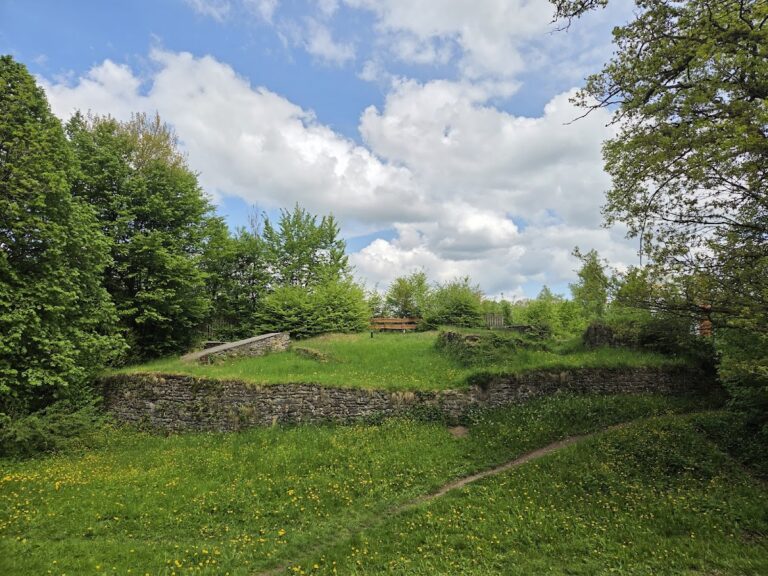
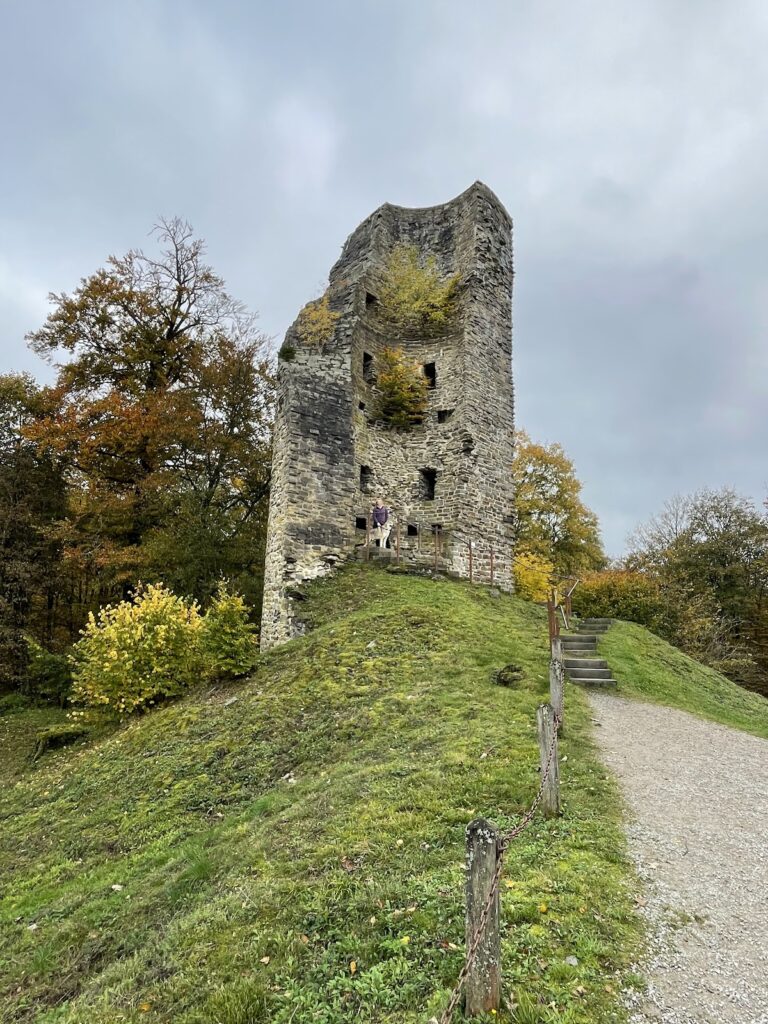
Only dilapidated remains are visible today. The foundations of a tower survive on the northern rocky projection overlooking the two valleys, and several angular cellar rooms can still be identified. Trees and other vegetation have spread over the remains, while the ruin continues to deteriorate. Stone was also taken from the castle by inhabitants of surrounding villages and reused in house construction.
The castle must be distinguished from the Borghausen farm or manor estate below it in the Repe valley. That estate stood on the site of the present sewage-treatment plant and had a surrounding ditch, visible in the original cadastral survey of 1831 and the initial survey of 1840.
Defensive Works and Access
Section Rampart
A section rampart, a crosswise earthwork that cuts off a projecting ridge from higher ground, defended the approach to the castle. It completely blocked the plateau of the Benner from the mountain spur approximately 200 metres before the fortification. The rampart formed the principal artificial barrier in front of the hilltop position.
Prehistoric Barrier
The possible prehistoric barrier south-southeast of the castle consists of an earth rampart with a ditch in front. Its relationship to the medieval castle remains uncertain, and it may have been an independent fortification rather than part of the later defensive system.
Wall at the Massif Foot
A rubble-stone wall along the former bed of the Lenne may also have belonged to the castle complex. It survives to a height of up to three metres, although it has been cut down to the level of the ground behind it.
The likely approach did not cross the plateau. It probably followed a hollow way from the Repe valley to the section rampart and then continued along the mountain spur toward the castle. The main entrance may instead have been reached from the valley where the Repebach flows into the Lenne.
Archaeological Finds
Metal ornaments from the wider fortification context include the head of a western Hessian-type Tutulus pin, a prehistoric dress fastener with a raised head, and an arm ring decorated with groups of bosses. These objects provide evidence for prehistoric activity in the broader defensive landscape.
Medieval pottery from the site includes Pingsdorf-type earthenware and Paffrath ware, as well as a larger quantity of ceramics dating from the fourteenth and fifteenth centuries. Together with the surviving tower foundation and cellar rooms, these finds help place the castle’s use within the medieval history of the Borghausen estate.
Nearby sites