Castle of Pietrarossa: A Medieval Fortress in Caltanissetta, Italy


Site at a Glance
- Rating
- 3.4
- Popularity
- Very Low
- Country
- Italy
- Primary era
- Medieval
- Eras represented
- Medieval
- Civilizations
- Ancient Greek, Byzantine, Roman
- Site type
- Military
- Remains
- Castle
On this page6 sections
History
The Castle of Pietrarossa is a medieval fortress in Caltanissetta, Italy, probably built during the Byzantine period between AD 750 and 800. It is regarded as one of the city’s oldest buildings, although its earlier history is difficult to reconstruct. The first certain information concerns the period after Roger I of Hauteville, the Norman count who established Norman rule in Sicily, consolidated his authority on the island.
Origins and Medieval Conflict
The castle’s origins remain disputed. The most widely accepted interpretation places its construction under the Byzantine Empire, the medieval continuation of the Roman Empire centered on Constantinople. Other theories attribute it to Saracens, pre-Greek communities, Romans, Goths, or Greeks. The Greek hypothesis proposes that Syracusans built the fortress and that the Athenians later attacked it without success. Marks once thought to represent a pre-Greek or Sican alphabet are now understood as thirteenth-century signs made by stonemasons.
During the Angevin period, when the French ruling house contested control of Sicily, Pietrarossa became a center of resistance. Nicolò Maletta defended the castle against Angevin forces commanded by Guglielmo d’Estendard. Betrayed by his own supporters, Maletta was compelled to surrender to the French commander and was later hanged.
Aragonese Prestige and Decline
Under Aragonese rule, the castle reached its greatest prestige. The Aragonese were an Iberian dynasty that governed Sicily during this period, and Pietrarossa was chosen for three general Parliaments of Sicily, held in 1295, 1361, and 1378. These assemblies brought together representatives of the Sicilian kingdom and gave the fortress an important political role.
Ownership passed to Matteo of the Moncada family in 1407. The Moncadas were a major Sicilian aristocratic lineage. After the transfer, the castle declined because it served only military purposes and was considered unsuitable as a noble residence. Toward the end of the fifteenth century, its underground spaces were converted into prisons.
Collapse and Dismantling
Much of the fortress collapsed during the night of February 27, 1567, when the unstable rock beneath it gave way. Several earthworks, two towers, and a slender watchtower survived the collapse, although the watchtower fell in the early twentieth century.
Maintenance work that began in 1591 gradually led to the castle’s dismantling for building stone. In 1600, workers found the body of Adelasia, a relative of Roger I of Hauteville, within the ruins. She wore a copper crown bearing her name and identifying her lineage.
Remains
Fortress Ruins and Setting
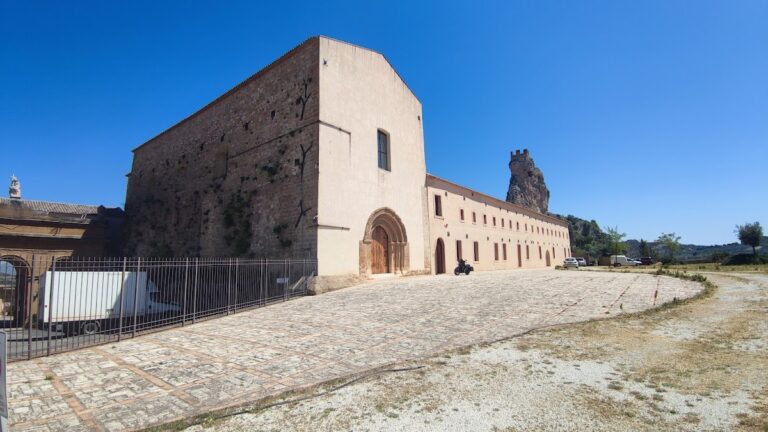
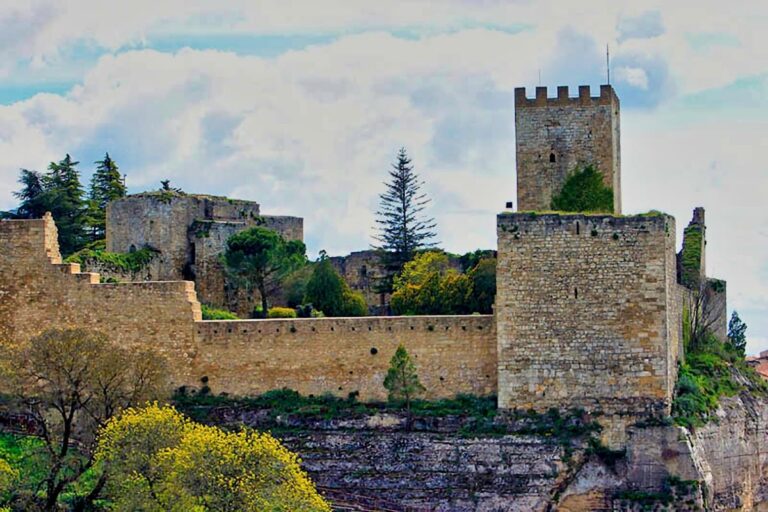
The ruins stand beside the Church of Santa Maria degli Angeli and the monumental cemetery, near Caltanissetta’s former Arab quarter. The fortress occupies the summit of a ravine and overlooks the valley toward the Salso River. Its position on unstable rock helps explain the destruction of much of the structure in 1567.
The surviving remains consist of several earthworks and two towers. A slender guard tower also endured the sixteenth-century collapse before falling in the early twentieth century. Some structures identified as bastions carry graffiti made up of letters or other marks. These were once taken for signs of the Sican alphabet, associated with an ancient population of central and western Sicily, but are now regarded as thirteenth-century stonemasons’ marks.
The name Pietrarossa has a disputed origin. It may refer to the red color of the bricks that formerly covered the towers, traces of which remain. The underground areas preserve the memory of their later use as prisons, before the progressive dismantling of the fortress turned the site into a source of building material.
Nearby sites