Beldiletto Castle: A Da Varano Fortress and Renaissance Residence in Italy


Site at a Glance
- Rating
- 4.2
- Popularity
- Very Low
- Country
- Italy
- Primary era
- Medieval
- Eras represented
- Medieval
- Civilizations
- Unclassified
- Site type
- Military
- Remains
- Castle
On this page10 sections
History
Beldiletto Castle is a fourteenth-century castle in Italy, located at Pievebovigliana, now part of Valfornace in Macerata Province. It belonged to the Da Varano family, the rulers of the Duchy of Camerino, and served both as an official seat and as a private residence. Tradition attributes its construction to Giovanni da Varano, known as Spaccaferro, but the castle probably existed earlier. Between 1370 and 1380, Giovanni enlarged and fortified it as part of the Chienti castle system, a defensive network of fortresses and castles protecting Camerino.
The Da Varano fortress
Beldiletto occupied an important place in the political and military life of the Da Varano territories. In 1382, it hosted Louis of Anjou and Amadeus VI of Savoy during their passage through the Marches toward the Kingdom of Naples. During the wars against Fermo, Carlo Malatesta captured the castle and imprisoned Costanza Smeducci, the second wife of Rodolfo III da Varano.
The castle changed hands during the conflicts of the early fifteenth century. The condottiero Braccio Fortebracci da Montone, a professional military commander who led troops under contract, occupied it in 1420, after which it was returned to the Da Varano family. Rodolfo III da Varano died at Beldiletto in May 1424. Francesco Sforza, another prominent Italian military commander and later founder of the Sforza ducal dynasty in Milan, occupied the castle in 1436.
Renaissance court and political residence
In the second half of the fifteenth century, Giulio Cesare da Varano transformed the fortified residence into a sumptuous Renaissance villa and established his court there. The castle was consequently associated not only with defense and administration but also with aristocratic life and literary traditions. Courtly-love narratives connected Giulio Cesare’s unrequited love for Madonna Pierozzi with the poet Agnolo Pierozzi’s love for Camilla da Varano. The repeated pear decoration on the upper floor was linked to the coat of arms of the Pierozzi, Perretti, or Perozzi family.
An inventory made for Pope Alexander VI Borgia when he took possession of the duchy in 1502 called the castle the “Roccha del Bel Delecto.” It later passed to Sigismondo da Varano, son of Venanzio, and in 1522 to Sigismondo’s son Egidio da Varano, who married Ippolita of the Ranieri family of Perugia. In 1504, Giovanni Maria da Varano hosted Cardinal Alessandro Farnese, the papal legate to the Marches. Farnese later became Pope Paul III.
Pope Julius II stayed at Beldiletto on 5 September 1510 with seven cardinals and a personal guard of 50 janissaries. The duke prepared for the larger papal party, which included 500 mounted crossbowmen and baggage carts, by ordering the access gates to Serravalle and Valcimarra demolished. A mountain was also cut through to facilitate the passage.
From 1527 to 1528, the castle housed the 300 armed followers accompanying Beatrice Colonna, the wife of Rodolfo da Varano, a natural son of Giovanni Maria. She had come to assist her husband in an attempt to conquer the duchy. The inhabitants of Pievebovigliana besieged the castle for five days, until Sciarra Colonna arrived with mercenary troops to aid his sister.
From ducal residence to agricultural estate
After the Duchy of Camerino was annexed to the Papal States, territories governed by the papacy in central Italy, Beldiletto gradually lost its residential and military functions. The complex became an agricultural estate. By 1823 it belonged to the Strada and Cianni families of Camerino. It later passed from the Canni, or Cianni, family of Serravalle to the Paparelli family of Muccia, which retained it at least until the last recorded survey in 1993. During this period, the former residence was used as a farmhouse, hayloft, and agricultural storehouse.
Restoration of the masonry and roofs on the northern and eastern sides took place around 1990. The earthquake of September 1997 caused extensive cracking and damage throughout the structure, leading to a project for repairs and reconstruction. Further restoration in 2002 revealed previously unknown painted cycles and decorations in several rooms.
In March 2000, the Court of Camerino ordered the building’s sale after legal proceedings. On 9 February 2001, the Roman company Beni culturali, a real-estate company belonging to the entrepreneur Franco Sensi, acquired the castle and 25 hectares of surrounding land. The Sensi family sold the property to the Fabrizi family of Fiastra in March 2012.
The 2016 earthquake in Central Italy caused additional damage. As of 2024, Beldiletto was partly restored but unsafe and inaccessible, with serious deterioration affecting the structure. Recovery and restoration remained urgent, and the castle was privately owned.
Remains
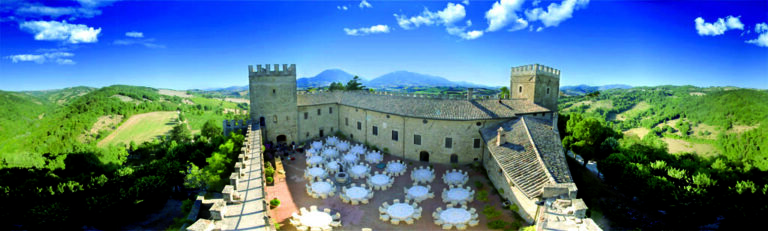
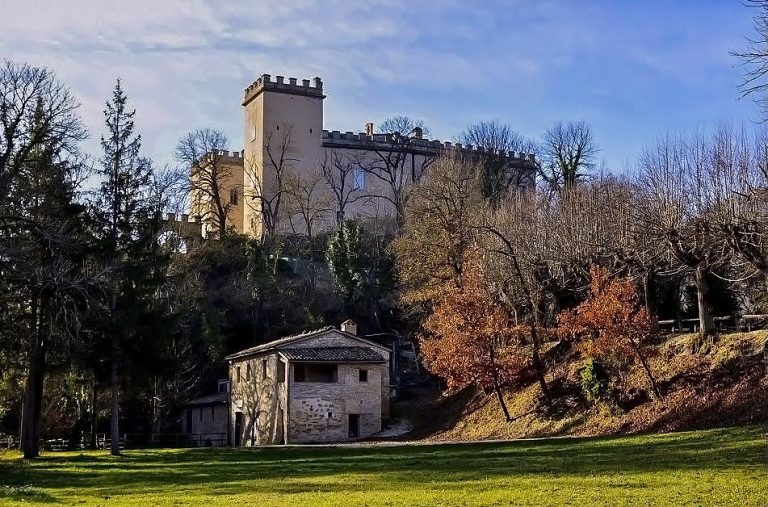
Beldiletto is a substantial sandstone complex whose quadrangular, fortified layout was later adapted to the form of a Renaissance villa. A broad, deep moat once surrounded the castle and was supplied with water from the Chienti River. The plan has a single entrance and a vaulted passage covered by a barrel vault, a continuous curved ceiling. A square-based tower rises at each corner, preserving the building’s defensive character within its later residential arrangement.
Fortifications and courtyard
Inside the enclosure, a courtyard contains a loggia, an open-sided gallery or covered passage, supported by octagonal pillars. Its pointed arches, which rise to an apex rather than forming a semicircle, are made of alternating white and red stone. These elements belong to the complex’s architectural combination of medieval fortification and Renaissance residential design.
Painted interiors
Fresco cycle in the great hall
The largest hall retains visible remains of an extensive fifteenth-century fresco cycle. A fresco is a wall painting made on fresh plaster, allowing the pigments to become integrated as the plaster dries. The paintings depict knights, including Robert Guiscard, his son Roger, identified as king of Naples, and Tancred of Hauteville. Their subject matter refers to the culture of chivalric poems, literary works centered on knights, heroic deeds, courtly ideals, and aristocratic romance.
Upper-floor decorations
Several rooms on the upper floor retain painted decoration, including repeated representations of pears. The motif is associated with the courtly-love traditions involving the Da Varano and Pierozzi families and with the coat of arms of the Pierozzi, Perretti, or Perozzi family. The discovery of previously unknown painted cycles and decorations during restoration in 2002 expanded knowledge of the castle’s interior decoration.
Earthquake damage and present condition
The 1997 earthquake left lesions and other damage across much of the structure, prompting repair and reconstruction. The 2016 earthquake caused further harm. Although portions of the castle have been restored, the building remains unsafe and degraded, with its masonry, roofs, and decorated interiors requiring continued recovery and conservation.
Nearby sites