Moorish Castle: Medieval Fortification in Gibraltar


Site at a Glance
- Rating
- 3.5
- Popularity
- Very Low
- Country
- United Kingdom
- Primary era
- Medieval
- Eras represented
- Medieval
- Civilizations
- Marinid
- Site type
- Military
- Remains
- Castle
On this page12 sections
History
Moorish Castle is a medieval fortification in Gibraltar, a territory of the United Kingdom, whose strategic position made it a bridgehead between North Africa and Iberia. Muslim forces associated with Tariq ibn Ziyad and Musa ibn Nusayr may have landed at or near Gibraltar in 711, and construction of the fortification probably began around that year. Gibraltar then served as a starting point for the Muslim conquest of much of Iberia and parts of France.
Early Muslim foundations
The first construction phase belongs to the eighth century, although its completion date is unknown. One tradition holds that Tariq ibn Ziyad built a small fort on the summit of the Rock. A separate tradition says that Abd al-Mu’min ibn Ali, the first caliph of the Almohad dynasty, later ordered a larger settlement called the City of Conquest, completed in 1160. The Almohads were a North African Muslim dynasty that ruled parts of the Maghreb and Iberia.
Gibraltar remained under Muslim rule from 711 to 1309 and again from 1333 to 1462, a total of 727 years. During the later period, it became an important communications and supply point between the Emirate of Granada and Muslim territories in North Africa after Christian forces had reconquered the Guadalquivir valley.
Castilian attacks and Muslim recovery
In 1309, Ferdinand IV of Castile and James II of Aragon attacked Gibraltar while their principal objective was the Nasrid kingdom of Granada. The small garrison was poorly prepared for a siege and surrendered after about a month. Ferdinand expelled the local population and replaced it with Christians. A Nasrid attempt to recover Gibraltar in 1315 ended when its forces withdrew after learning that Castilian relief forces were approaching.
Eighteen years later, Muhammad IV, sultan of Granada, and Abu al-Hasan Ali ibn Uthman, sultan of the Marinid kingdom of Fez, besieged Gibraltar with land and naval forces. The inhabitants surrendered after several months of hunger. A Castilian relief force arrived after the surrender and began another siege, but could not break the defences. The opposing sides eventually accepted concessions and a four-year truce.
Alfonso XI of Castile besieged Gibraltar in 1349. The inhabitants resisted behind the strong walls built under Abu al-Hasan, and the siege ended in 1350 when the besieging forces withdrew after plague spread among them. A dispute between Granada and Fez followed in 1362, and the Marinids ceded Gibraltar to Granada in 1374. In 1410, the garrison revolted against the Nasrid rulers, who suppressed the uprising by sending an army to besiege the fortress.
End of Muslim rule
In 1436, Enrique Pérez de Guzmán, the second Count of Niebla, launched the seventh recorded siege of Gibraltar. The assault ended disastrously for the Christian forces. Enrique drowned while trying to escape, and his body was recovered, beheaded, and displayed on Gibraltar’s walls for twenty-two years.
Muslim rule ended in 1462 when Alonso de Arcos captured Gibraltar in a rapid attack. Many leading commanders and inhabitants were in Granada, pledging allegiance to a new sultan. The small garrison surrendered, and the local population was again expelled and replaced with Christians. The present Tower of Homage and most of the visible fortifications were rebuilt in the early fourteenth century during the later Muslim period, after the defences had been almost entirely destroyed during the Spanish reoccupation from 1309 to 1333 and the subsequent Muslim recapture.
Later use and survival
The castle forms part of the Fortifications of Gibraltar and remained in use from approximately 711 to 1945. Part of the complex housed Gibraltar’s prison until its relocation in 2010. Moorish Castle remains one of Gibraltar’s principal historical attractions, and its image appeared on the reverse of the 1995 Gibraltar five-pound banknote, whose design remained in circulation. The name Moorish Castle, or El Castillo in Spanish, is also used locally for the residential area adjoining the castle.
Remains
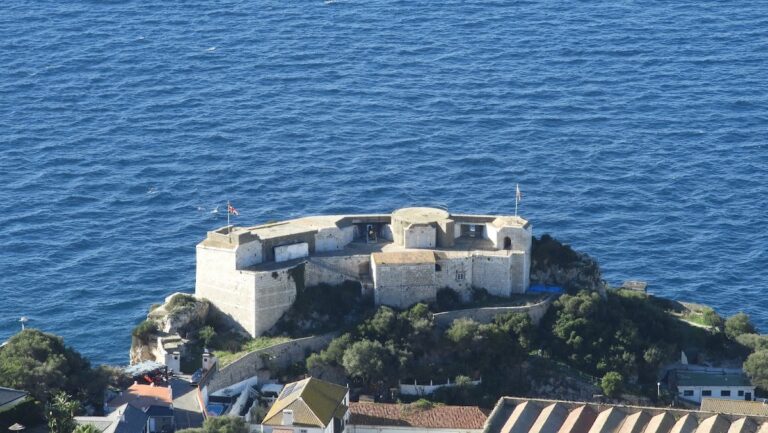
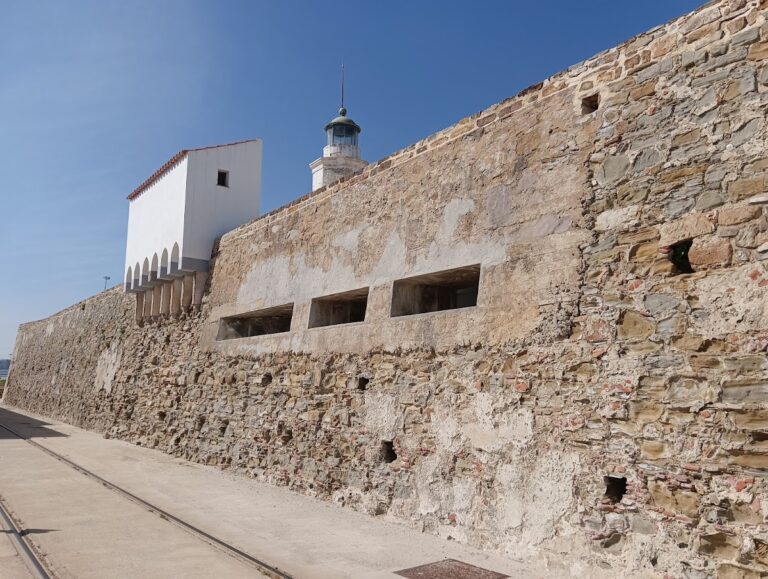
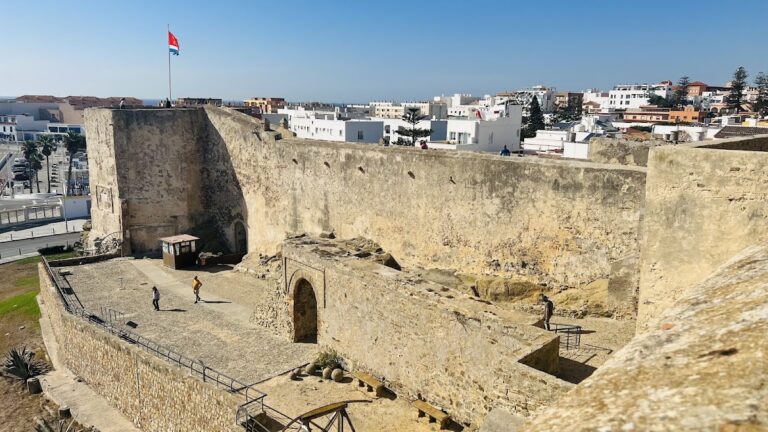
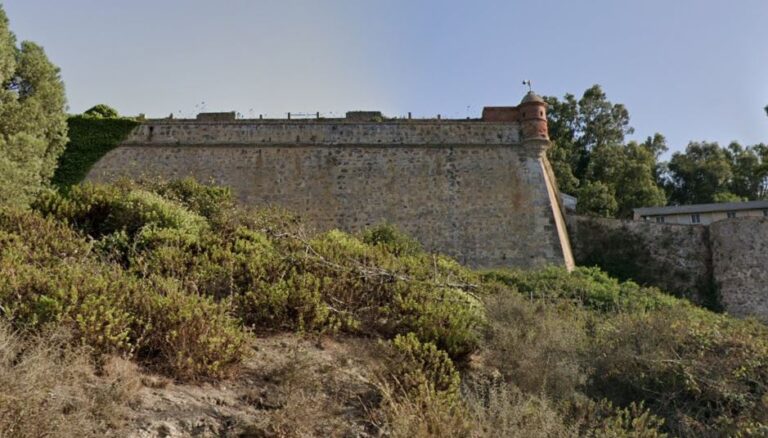
The Moorish Castle is a broad medieval defensive complex of buildings, gates, walls, towers, terraces, and battlements. Its walls enclosed a substantial area extending from the upper part of the Rock of Gibraltar down to the sea. The surviving complex stretches from the Gibraltar Nature Reserve to Grand Casemates Square and includes the inner and outer keep, the Qasbah, Villa Vieja, the Port or Barcina, the Tower of Homage, the Flanking Wall, the Gate of Granada, the Gatehouse, the Giralda Tower or North Bastion, the Landport, the Sea Gate or Grand Casemates Gates, Barcina Gate, and Galley House.
Main towers and defensive works
Tower of Homage
The Tower of Homage is the dominant surviving feature of the fortress. Approximately 100 metres high, it occupies a strategically commanding position and can be seen throughout Gibraltar. A tower of homage was the principal fortified tower of a castle, associated with command, defence, and the authority of its holder. The Moorish Castle’s tower is described as the highest tower of the period of Islamic rule in the Iberian Peninsula.
Gatehouse and outer defences
The most conspicuous remains also include terraces and battlements below the Tower of Homage and the massive Gatehouse, which has a cupola roof. These features form part of a wider system that included the Flanking Wall, several gates, the Giralda Tower or North Bastion, and the Landport. The Sea Gate, also called the Grand Casemates Gates, Barcina Gate, and Galley House belonged to the complex’s lower defensive and access arrangements.
Citadel and surviving complex
Qasbah
The Qasbah is a fortified citadel or defensive enclosure that formed the strongest part of the larger settlement. It is described as the largest in the region and stands among the principal components of the castle, together with the inner and outer keep and Villa Vieja.
Marinid construction
The castle was built by the Marinid dynasty, a North African Muslim dynasty that ruled the Marinid kingdom of Fez and controlled Gibraltar during part of the later medieval period. It is described as unique on the Iberian Peninsula because no other Marinid buildings have survived there. The complex is now partially ruined, while its surviving towers, walls, gates, terraces, and battlements preserve the scale of the medieval fortification.
Nearby sites