La Barben Castle: A Former Fortified Residence in Provence


Site at a Glance
- Rating
- 4.6
- Popularity
- Very Low
- Country
- France
- Primary era
- Early Modern
- Eras represented
- Medieval, Early Modern, Modern
- Civilizations
- County of Provence, French
- Site type
- Domestic
- Remains
- Castle
On this page7 sections
History
Medieval Origins and the Forbin Family
La Barben Castle is a former fortified castle in France, near Salon-de-Provence, whose origins reach back to the eleventh century. The castrum de barbentum was first mentioned in 1064 in the cartulary of Saint-Victor Abbey in Marseille, although the castle may have been built before 1000. Its construction and subsequent development extended from the twelfth to the nineteenth century.
The castle initially belonged to the Pontevès family. In the fifteenth century, it passed to King René, the Angevin ruler of Provence and Naples. René sold it in 1474 to Jean II de Forbin, whose brother Palamède de Forbin played a leading role in the political union of Provence with the French Crown in 1482. The Forbin marquises then retained La Barben for nearly five centuries.
Damage, Alteration, and Distinguished Residents
On 4 November 1630, the castle was severely damaged during the Cascaveous revolt, a political uprising in Provence. The building was altered afterward. During the reign of Louis XIV, the formal gardens were added, probably following designs associated with Le Nôtre, the leading French designer of geometric royal gardens.
Princess Pauline Borghèse, a Bonaparte and sister of Napoleon, lived at La Barben. Her stay was connected with a turbulent romantic relationship with Auguste de Forbin, a French nobleman and artist from the Forbin family.
Modern Ownership and Preservation
At the beginning of the twentieth century, a major earthquake caused the keep to collapse. Repairs were carried out to straighten the castle. The Forbin family’s ownership ended in 1963, when the agricultural engineer André Pons acquired the property. He lived there with his family and opened the castle to the public in 1965. In 1971, he established the La Barben animal park, while his descendants were still living in the castle at the beginning of the twenty-first century.
The castle and its garden were classified as historic monuments by the French Ministry of Culture on 21 December 1984. Vianney Audemard d’Alançon purchased the property on 31 December 2019 and installed Rocher Mistral, a park themed around Provence. In 2025, he entrusted the castle’s management to Paulin Reynard, the Capoulié, or head, of the Félibrige, a cultural movement devoted to Provençal language and culture. During the night of 27 December 2025, anarchists attempted to set fire to the castle.
Remains
Castle
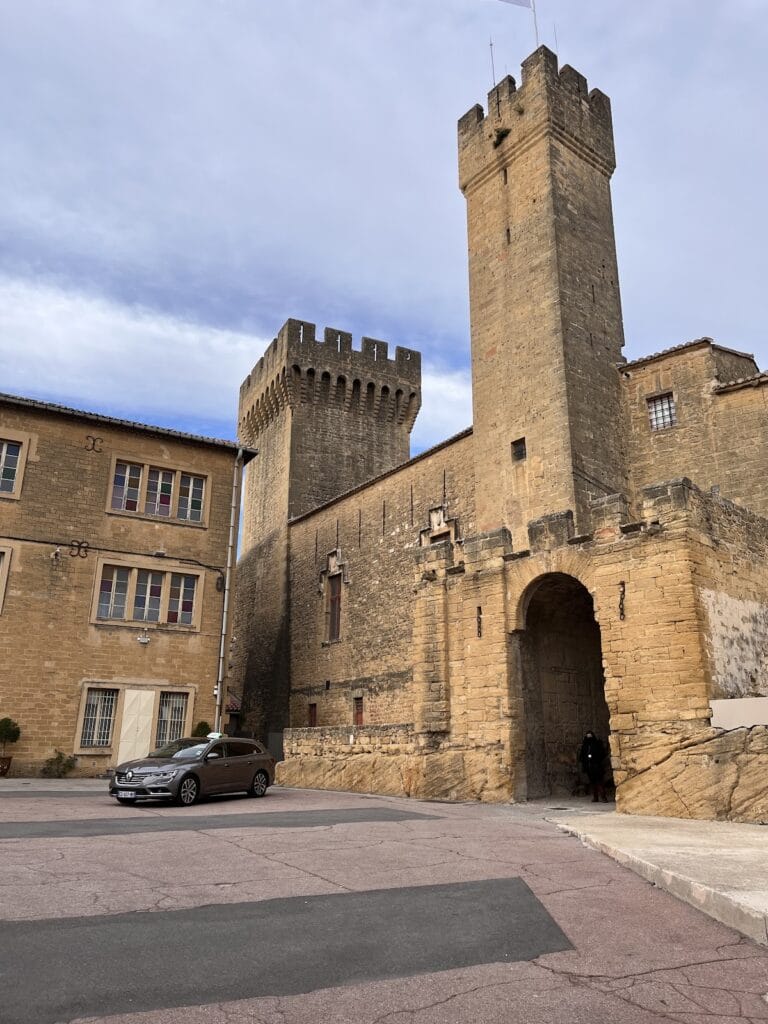
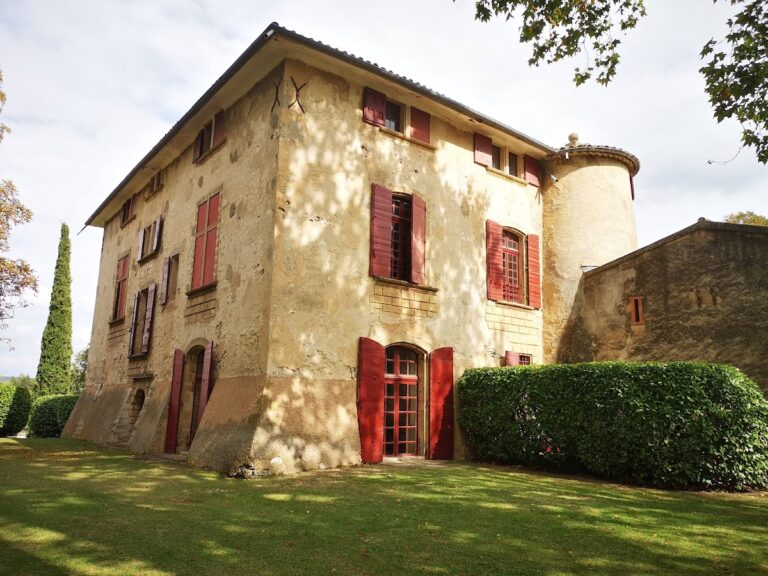
La Barben Castle stands in the commune of La Barben, in the Bouches-du-Rhône department of Provence-Alpes-Côte d’Azur. Its surviving form reflects successive medieval and later alterations. By about 1650, the medieval towers had been transformed into pavilions topped with merlons, the raised sections between the openings of a battlement, and machicolations, projecting defensive structures with openings for directing missiles or dropping objects downward.
Formal Garden
The castle garden is arranged as a formal composition with two entrance posterns, an avenue of plane trees, porticoes, a watercourse, four basins, two fountains, and terraces. Its ordered design is probably associated with Le Nôtre. The garden forms part of the historic monument classification together with the castle.