Barr Castle: A Late Medieval Tower House in Scotland


Site at a Glance
- Rating
- 3.9
- Popularity
- Very Low
- Country
- United Kingdom
- Primary era
- Medieval
- Eras represented
- Medieval
- Civilizations
- Kingdom of Scotland
- Site type
- Military
- Remains
- Castle
On this page11 sections
History
Barr Castle is a late medieval tower house in Scotland, United Kingdom, on a low ridge south of Lochwinnoch in Renfrewshire. The Glen family constructed the fortified residence in the fifteenth or early sixteenth century. Its compact masonry tower remained in use until the eighteenth century, when the Hamilton family abandoned it after moving to a new mansion.
From the Glens to the Hamiltons
After Alexander Glen died in April 1629, Barr Castle passed to the Hamiltons of Ferguslie. Margaret Hamilton, the eldest daughter of Allan Hamilton of Ferguslie, married John Wallace, the second son of William Wallace of Elderslie. Their marriage contract required John Wallace to take the Hamilton name and arms. A grant under the Great Seal authorized this change on 9 July 1647, establishing the Hamiltons of Barr.
Alexander Hamilton of Barr, the great-grandson of Margaret Hamilton and John Wallace, was born in 1670. The 1695 Poll Tax Roll for Lochwinnoch recorded him as “of Barr,” and in 1696 he became a Commissioner of Supply for Renfrewshire. This county office involved administering and collecting the land tax known as the supply. Alexander died in 1747 and was buried in the graveyard of St John’s Kirk in Lochwinnoch.
Later ownership and abandonment
The Hamiltons retained Barr Castle until the late eighteenth century, when they sold the estate and left the old tower for a new mansion. Alexander Hamilton’s grandson, John Hamilton, sold the estate to the MacDowall family. John died in 1825 and was buried in the family tomb at Lochwinnoch.
The 1695 Poll Tax Roll also lists the farms and settlements belonging to the Lands of Barr, including Sunnyaykers on the Lynthills, Bridgend, Johnshill, Cruiks, Knockbarton, Kame, and Barneich. Jabez Hamilton was among the last people to live in the castle. After her death in an upper room, the undertakers struggled to carry her coffin down the narrow spiral stair. The castle is now a ruin.
Barr Castle is a scheduled monument, a historic or archaeological site protected by law because of its national importance. In 2011 it was owned by Fergus MacDowall of Garthland, Chief of Clan MacDowall, and was regarded as the clan seat because of his position. The MacDowalls’ historical connection with the building is limited, however, as their association chiefly derives from owning the land on which it stands since the eighteenth century.
Remains
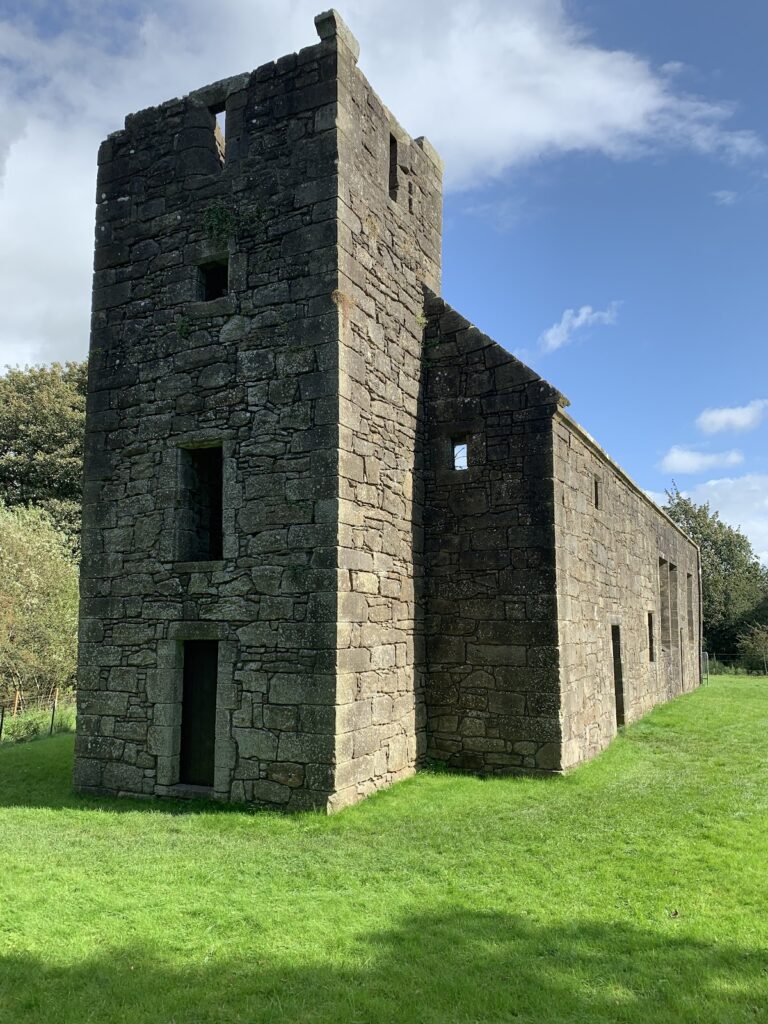
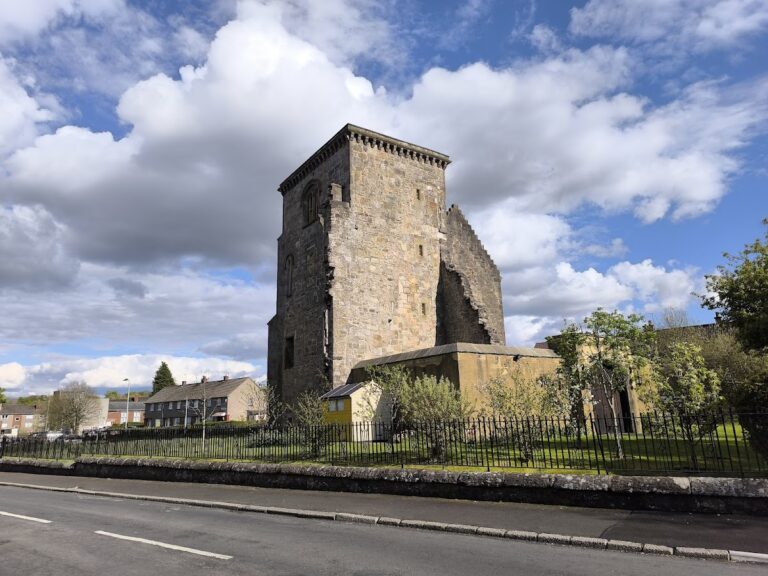
The surviving building is a plain rectangular tower of roughly coursed, square-faced masonry, strengthened at its corners with dressed stone quoins. It measures approximately 7.80 metres from east to west and 10.70 metres transversely, and rises about 12 metres to the level of the corbelling that formerly supported four angle turrets. The tower’s massive form gives it much of its character. A chimney stack and part of a gable remain on the south side, while window openings survive on all four sides.
Surviving layout
Tower form and entrance
The present principal entrance is at ground level on the west side, but this opening is a later alteration. The original entrance stood on the first floor and was reached by a stairway. The entrance pediment is the only surviving ornamental feature identified on the exterior. It bears the initials “IW” and “MH,” associated with John Wallace and Margaret Hamilton.
Interior rooms
The ground floor was divided into two apartments with low vaulted ceilings. The entrance led into a small passage that gave formal access to both rooms, while the circular stair to the upper floors began there. The kitchen contained a large fireplace with a very low arch.
The hall occupied the entire first floor and received light from all four sides. It had a low, flat ceiling rather than the loftily arched ceiling found in the halls of many Scottish castles. The second floor was divided into two apartments by a light partition that began between the doors of two garderobes, medieval or early-modern latrines built into a wall, in the south side. Separate staircases led from the hall to these rooms.
The third floor was likewise divided into two apartments. Each had a garderobe and separate access from the floor below, while closets were formed within the thickness of the walls. Alterations visible in the tower walls probably belong to the late seventeenth century, when the building was converted into a larger residence.
Courtyard buildings
Little survives of the courtyard shown by the nineteenth-century architectural historians McGibbon and Ross in their surveys and drawings of Scottish castles and domestic buildings. Photographs and plans indicate that the courtyard included subsidiary buildings, among them a wing attached to the tower’s south wall. That wing has disappeared.
Defensive features and inscriptions
Battlements and turrets
The battlements used an arrangement intended to protect the walls before lead roofing came into use. Their stones overlapped at the joints, and gargoyles were formed in the lower courses. The main stair and another stair in the north-west angle formerly led to the battlements, with a complete passageway running around the top of the building.
The four angle turrets were roofed and had checks for small doors and iron hinge crooks. A large stone gutter, hollowed along its upper surface, connected each turret with the main roof. The turrets themselves have disappeared, but their supporting corbelling survives at the upper level of the tower.
Carved inscriptions
Further inscriptions are carved into the masonry. “IH” and “IC 1680” appear above the lintel at the head of the stair, while “WO 1699” is carved on the battlements. Together with the initials on the entrance pediment, these inscriptions relate to the Hamilton lairds of Barr, John Wallace, Margaret Hamilton, John Hamilton, and Jean Cochrane.
Nearby sites