Fort Pépin: An Italian Alpine Defense Fortification


Site at a Glance
- Rating
- 4.7
- Popularity
- Very Low
- Country
- France
- Primary era
- Modern
- Eras represented
- Modern
- Civilizations
- Italian
- Site type
- Military
- Remains
- Fort
History
Fort Pépin is an Italian military installation in France, constructed as part of the late nineteenth-century defensive system around the Tende Pass. The pass provided a route through the Alps toward the Roya Valley and the Mediterranean coast at Ventimiglia in Italy, giving the area military importance. The fort’s construction was entrusted by contract to Giuseppe Maggia on 10 July 1883.
Fort Pépin belonged to a defensive line with Fort Central, Fort Marguerie, Fort Tabourde, Fort Pernante, and Fort Giaure. Together, these positions were intended to secure the pass, prevent the advance of French troops, and protect access to the Roya Valley.
Transfer to France
The fort’s national context changed after the Second World War. The Paris Treaty of September 1947, a peace agreement that redefined Italy’s borders and territorial arrangements, moved the French-Italian frontier northward and transferred Tende and La Brigue to France. Although the two areas had historically belonged to the County of Nice, political and strategic decisions had assigned them to the Kingdom of Italy. The transfer was intended to prevent the area from again serving as a strategic military position.
Remains
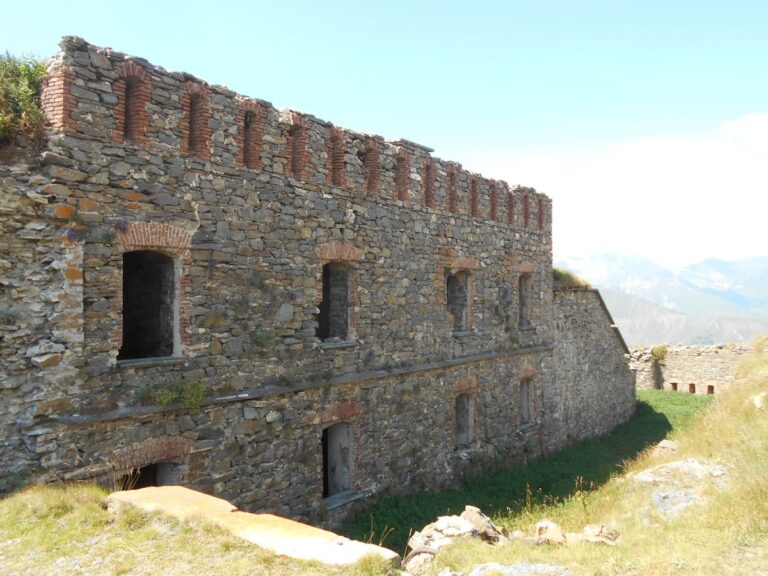
Fort Pépin stands at an altitude of 2,260 metres on the Cime de Pépin. It is the easternmost fort in the group surrounding the Tende Pass and is also known as Fort Pepino. The installation was designed to position a seven-gun artillery battery, an organized emplacement for several guns firing in coordination, across two fronts. Fort Pépin lies 1.5 kilometres from Fort Tabourde and 2.8 kilometres from Fort Central, with both distances measured in a straight line.
Nearby sites