Burg Siegenstein: A Medieval Hilltop Castle in Bavaria


Site at a Glance
- Rating
- 3.9
- Popularity
- Very Low
- Country
- Germany
- Primary era
- Medieval
- External website
- Open
- Eras represented
- Medieval, Early Modern
- Civilizations
- Duchy of Bavaria, Holy Roman Empire
- Site type
- Military
- Remains
- Castle
On this page9 sections
History
Burg Siegenstein is a thirteenth-century medieval hilltop castle in Germany, standing at the edge of the village of Siegenstein within the municipality of Wald in Bavaria. The settlement is traditionally said to have origins about 900 years ago, while the castle complex dates from the thirteenth century. Its history was closely connected with the territorial authority of Regensburg and with the estates and rights administered from the stronghold.
Transfer to the Prince-Bishopric of Regensburg
After Bavaria was divided in 1255, Siegenstein and the former Burgraviate of Regensburg passed to Duke Ludwig II of Bavaria. In 1282, Ludwig transferred the estate and its associated rights to the Prince-Bishopric of Regensburg, an ecclesiastical territory whose bishop also exercised secular authority. Bishop Heinrich II then granted the castle as a fief to Konrad von Ehrenfels.
Dietrich von der Au held the fortress from 1320. In 1329, Friedrich Hauzendorfer followed him as custodian, an official responsible for administering and often defending a lord’s castle or territory. In 1353, Friedrich Auer von Brennberg returned Siegenstein, together with its estates and tithe rights, to the Regensburg Cathedral Chapter, the body of cathedral clergy administering the chapter’s institutional possessions.
Pledged lordship and decline
The bishops later pledged Siegenstein to the dukes of Bavaria. Control subsequently passed to the Prackendorfer and Teuffel families, although the Prackendorfers retained the castle as a pledged holding, meaning property temporarily controlled by a creditor until an obligation was redeemed. Bishop Wolfgang II redeemed the lordship in 1606.
By the beginning of the sixteenth century, the castle had become so structurally dilapidated that the Prackenbachers moved to their seat at Wulkersdorf. Siegenstein was already in ruins by 1606. From the fourteenth century, its associated territory also included Schönfeld, a cadastral area about two kilometres away with a farm and the twelfth-century Romanesque Church of Saint Giles.
Chapel and later protection
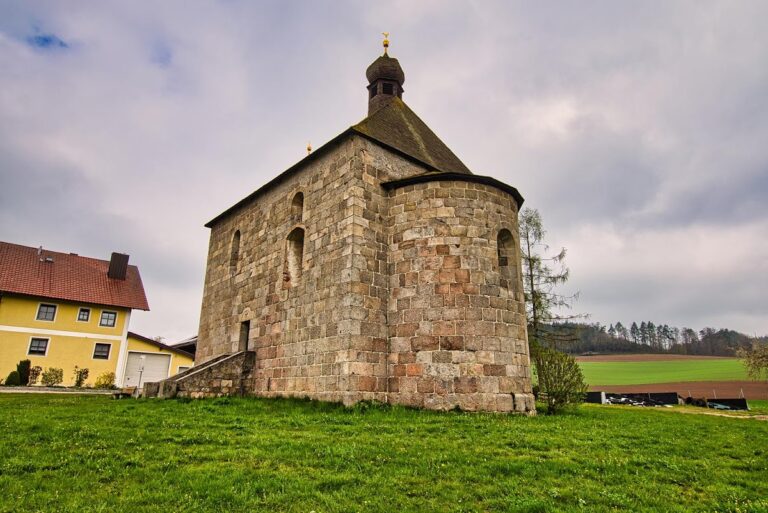
A chapel dedicated to Saints Lawrence and George was built east of the castle hill in the outer bailey during the thirteenth century. In 1353, it was assigned to Frauenzell Abbey. Its last exterior renovation took place in 1974.
The ruins are protected as a listed architectural monument of Siegenstein. The castle area and the former Chapel of Saint George are also recorded as an archaeological monument containing medieval archaeological evidence.
Remains
Castle fortifications
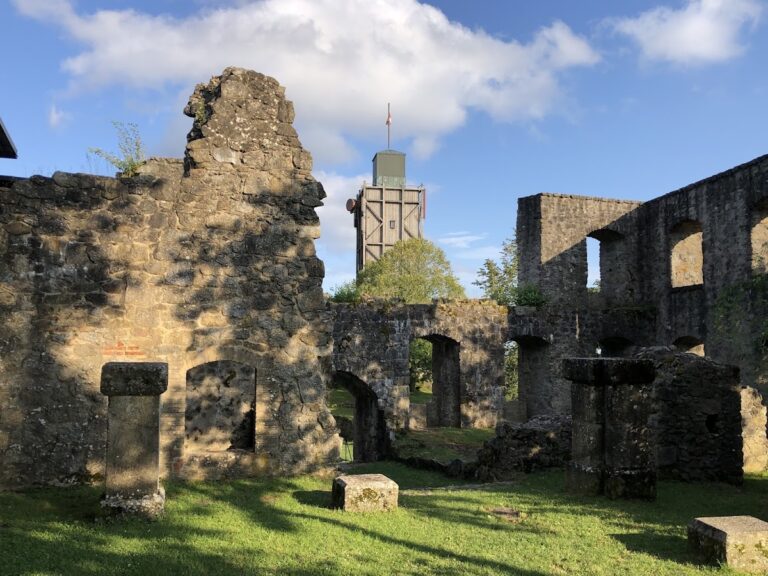
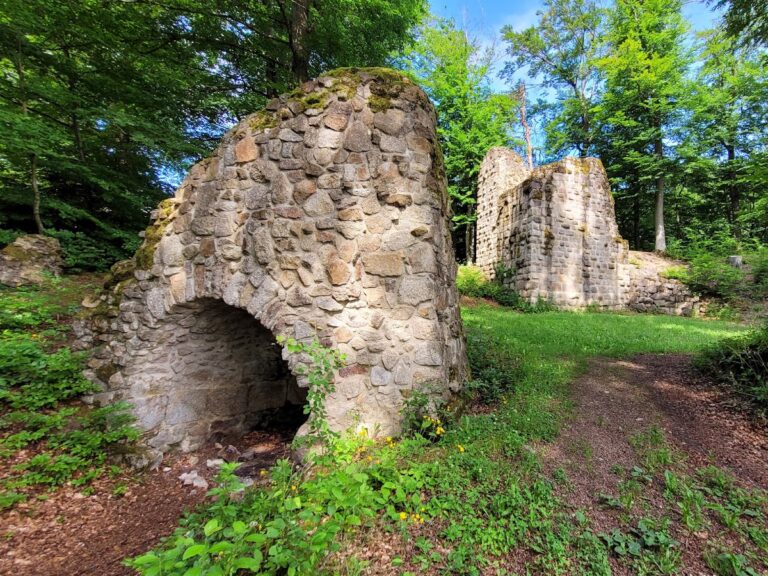
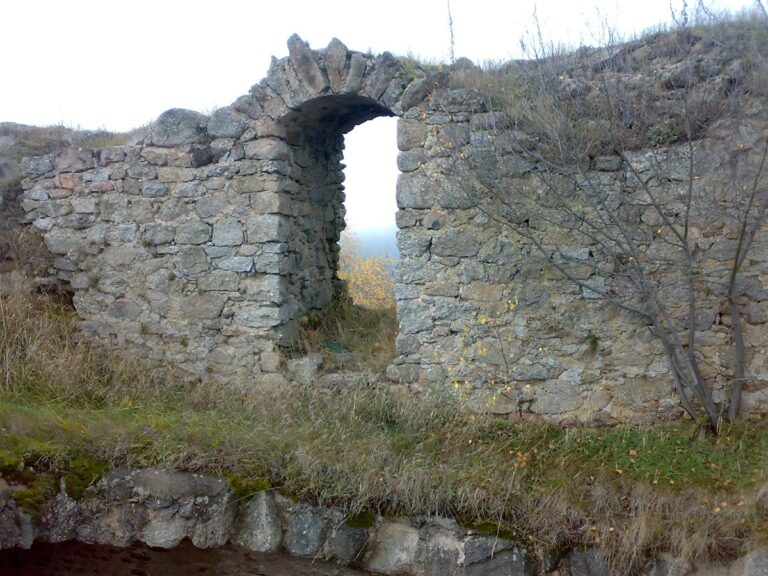
Burg Siegenstein occupies a trapezoidal hilltop position at 546 metres above sea level on a granite summit in the Falkensteiner Vorwald, a hilly upland region of eastern Bavaria. The ground falls steeply to the north. On the densely wooded castle hill, the principal surviving remains are projecting wall sections on the southern side and at the northeastern corner. The masonry uses granite ashlar, with areas of bossage, in which block faces project outward, and rubble construction.
The former rampart-and-ditch system remains recognisable. Parts of a zwinger wall, an outer defensive wall or space between the main fortification and an outer wall, also survive, together with the transition between the main castle and the former outer bailey.
Religious buildings
Chapel of Saints Lawrence and George
The chapel east of the castle hill is a plastered rubble-stone building containing Romanesque and Gothic elements, the two principal medieval architectural styles represented in its fabric. Dressed corner blocks and narrow pointed-arch windows shape its exterior. Inside, a semicircular apse forms the rounded end of the sanctuary, while a chamfered chancel arch separates it from the nave, which has a boarded ceiling.
A seventeenth-century altarpiece stands inside the chapel. It has fluted columns and figures of Saints Hedwig and Lawrence. A shingle-covered roof turret from the seventeenth century rises above the roof.
Church of Saint Giles at Schönfeld
The associated cadastral area of Schönfeld included a farm and the Romanesque Church of Saint Giles. The church was built in the twelfth century, predating the castle complex at Siegenstein.
Nearby sites