Montsalvens Castle: A Medieval Castellany Fortress in Switzerland


Site at a Glance
- Rating
- 4.2
- Popularity
- Very Low
- Country
- Switzerland
- Primary era
- Medieval
- External website
- Open
- Eras represented
- Medieval, Early Modern
- Civilizations
- Duchy of Savoy, Swiss
- Site type
- Military
- Remains
- Castle
On this page10 sections
History
Montsalvens Castle is a medieval hilltop fortress in Switzerland, above the Jaun Gorge near Broc. Established in the twelfth century and substantially developed around 1250–1260, it served as the seat of one of the three castellanies of the County of Gruyère, a territorial and administrative district governed from a castle. The lordship stood at the entrance to the Jaun Valley and was closely connected with the Counts of Gruyère, whose principal residence at Gruyère Castle lay about five kilometres to the southwest.
Origins and the County of Gruyère
The territory linked to Montsalvens was probably a group of scattered holdings associated with the Jaunbach, the Motélon Valley, the Tine Valley, and the Saane, rather than a single compact domain. The first recorded lord was Peter, son of Juliane de Glâne and husband of Pétronille d’Estavayer. He is first mentioned in 1156, while Montsalvens appears in documentary records from 1162. Peter probably founded the castle using property inherited through his mother. Its establishment may have been connected with the growth of a competing town near Freiburg and the need to protect the family’s possessions, although Peter’s precise relationship with Rudolf I of Gruyère remains uncertain.
From the twelfth century, the lordship was closely associated with the Gruyère dynasty. It was assigned to branches of the family, sometimes as property or revenue for junior members and sometimes to future counts before they assumed the comital title. In 1183, Rudolf I of Gruyère inherited Montsalvens from Guillaume de Montsalvens, a transfer that suggests that the earlier lords were related to the Counts of Gruyère. As a castellany, Montsalvens maintained a military contingent and provided a base for action against regional rivals, especially the nearby episcopal castle of Bulle.
Fortification and Wartime Occupation
On 2 June 1274, Peter II of Gruyère authorized his overlord, Philip I of Savoy, to strengthen Montsalvens with defensive works extending toward the Jaunbach. Freiburg and local lords occupied the castle a few years later, and Richard of Corbières held it as a fief from 1281 to 1283. The Peace of Payerne returned Montsalvens to the Counts of Gruyère. The transfer was finally recorded in 1291, after outstanding debts from the war had been settled.
Decline and Later Ownership
The Counts of Gruyère lost interest in Montsalvens during the fourteenth century and established Château d’En-Bas in Broc as their subsequent residence. A settlement that had grown beside the castle declined soon afterward and had disappeared by 1433.
In 1555, Freiburg acquired the lordship after Michael of Gruyère became bankrupt and incorporated it into the Gruyère bailiwick, an administrative district governed by a bailiff. The roof was repaired in 1556, and the work was repeated in 1671. During the later repairs, the government installed a flat roof to protect the increasingly ruined structure. The exact date of final abandonment is unknown, but it occurred after 1671. The ruins were probably later used as a source of building stone.
Rediscovery, Conservation, and Interpretation
Direct historical study began in the nineteenth century. The ruins were described in 1816, and their former connection with a small settlement, rather than with a vast castle complex, was recognized in 1856. Eighteenth-century literature had already drawn attention to the site, while Thomas Schöpf marked it on a map without discussing it in the accompanying text. In 1829, Joseph Caille tried to purchase the ruins, revealing that local authorities no longer knew who owned them. The state asserted ownership, and Broc’s acquisition of parts of the site was not completed until 1864.
The Swiss Heimatschutz and a castle-preservation association became involved in conservation during the 1940s. The main keep was restored during that decade, when the Swiss Army also installed a defensive system at the site. Montsalvens is listed in the Swiss Inventory of Cultural Property of National and Regional Significance as a category B object of regional historical importance, under KGS number 1964.
The ruins also acquired a literary and legendary interpretation. Philippe-Sirice Bridel mentioned a local legend that later appeared in O’Donnalt’s 1909 tale The Golden Eye, or Beautiful Luce. In 1976, L. Rybarczic searched at Montsalvens for the Grail castle of Munsalvaesche in Wolfram von Eschenbach’s Parzival. This was an interpretive tradition, not an established identification. The meaning of the name Montsalvens is likewise uncertain. Medieval forms included Montsalvan, Montsalvant, and Montsilvan, and several linguists have interpreted the name as meaning “mountain forest.”
Remains
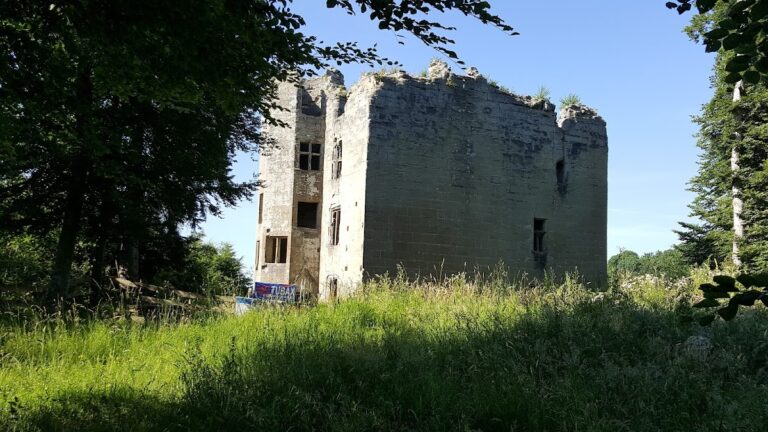
The ruins occupy a hilltop above the Jaun Gorge at an elevation of about 860 metres, in a strategic position at the entrance to the Jaun Valley. The original castle consisted of a square principal tower surrounded by a protective enclosure wall. Surviving fabric is dominated by the partly standing tower, with additional fragments of buildings and defensive walls extending through the surrounding woodland.
Main Castle
Square Keep
The principal keep measures approximately 12 by 12.3 metres and has walls roughly three metres thick. It stands about 15 metres high today, with its entrance positioned approximately 10 metres above ground level. The entrance’s elevated position formed part of the tower’s defensive design. Construction is generally placed around 1250–1260. Daniel de Raemy proposed that the keep originally included another storey and reached a height of 20–22 metres. The surviving structure was restored in the 1940s.
Enclosure and Defensive Features
The keep was enclosed by a chemise, a protective wall surrounding a fortified tower. Sections of this enclosure and of the main ring wall survive, along with walls containing keyhole-shaped loopholes. A projecting multistorey oriel, or defensive bay, protected the eastern side. The outer bailey, an enclosed area outside the principal tower for subsidiary buildings and defenses, can be traced through surviving walls in the woodland and appears to have occupied a relatively small area. The castle also had a separate lower fortification.
Lower Castle
The lower castle was recorded in 1314 as the castrum de Montsalvein inferius, meaning the lower castle of Montsalvens. It stood about 250 metres southeast of the main fortress, directly beside the Jaunbach, and probably consisted of a tower enclosed by walls. Parts of those walls still existed in 1897. Records from 1433 and 1516 called the structure the “old castle,” but its age and importance remain uncertain.