Eyckholt Castle: A Medieval Feudal Holding in Heerlen


Site at a Glance
- Rating
- 4
- Popularity
- Very Low
- Country
- Netherlands
- Primary era
- Medieval
- Eras represented
- Medieval
- Civilizations
- Holy Roman Empire
- Site type
- Military
- Remains
- Castle
On this page8 sections
History
Medieval feudal estate
Eyckholt Castle is a medieval castle site in the Netherlands, situated west of Heerlen on the north bank of the Geleenbeek. It was a feudal holding of the Archbishopric of Cologne, an ecclesiastical principality of the Holy Roman Empire governed by an archbishop. The estate comprised the castle, an associated farm, and a watermill.
The castle was first recorded in 1385, when it belonged to Gerard van den Eycholtz, a knight from Aachen. He belonged to the Van der Lynden family, a noble lineage also known as Van der Lynden van den Eykholt or Van der Lynden van den Eykholtz.
Decline and demolition
The Van der Heyden–Belderbusch family became the final owners of Eyckholt Castle. They also owned Ter Worm Castle, and Eyckholt eventually passed into the Ter Worm estate. The estate was sold to the Oranje-Nassau Mines, a Dutch coal-mining company, in 1917.
In 1736, the associated farm and barn burned down. A new farm was built afterward, while the castle was left without maintenance and gradually fell into decay. It was no longer used as a residence and later served for storing agricultural products and crops. The castle was eventually demolished around 1760, and the replacement farm was demolished in 1925.
Protection and surviving estate elements
The castle ruin and the former farm site now form part of the Ter Worm nature area. Eyckholt Castle is identified as Dutch national monument number 21270, a designation used for legally protected heritage sites and structures. The associated Eikendermolen was first recorded in 1468. It was dismantled in 1975, and its complete drive mechanism and mill stand were donated for use in the Epense Volmolen after a fire in 1973 destroyed that mill’s turbine, drive, and milling machinery.
Remains
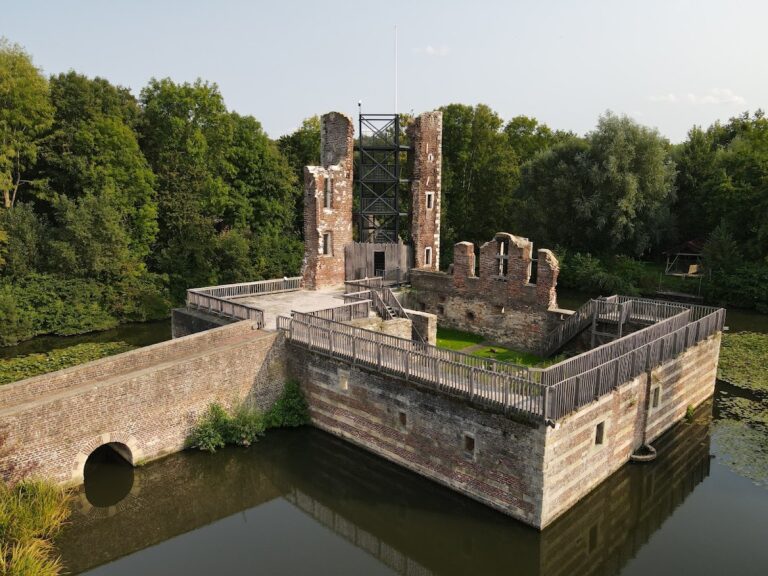
Castle ruin
The surviving castle ruin is in poor condition and consists of a curtain wall, a defensive perimeter wall, probably dating from the thirteenth or fourteenth century, together with a square tower probably built in the fourteenth century. The tower is constructed from marlstone, a soft stone containing clay and carbonate material, and Kunrader stone, a locally quarried limestone traditionally used in southern Limburg buildings and fortifications. Vegetation once grew over the remains so extensively that the ruin could no longer be seen.
Farm remains
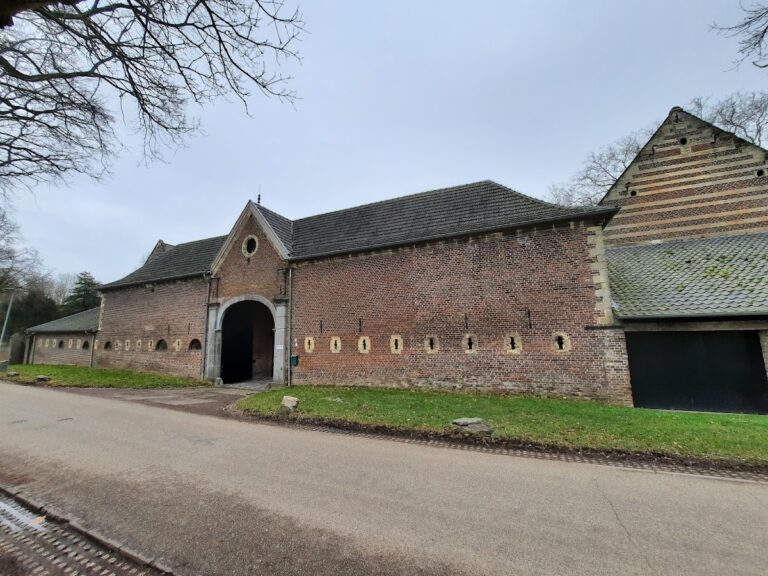
The associated farm has been reduced largely to ruins. It formed part of the estate surrounding the castle and was rebuilt after the fire of 1736 before being demolished in 1925.
Eikendermolen
The Eikendermolen was built using half-timbering, a construction method combining a visible timber frame with brick infill. The mill house remains in good condition. Because the Geleenbeek did not supply enough water to operate the mill continuously, water was stored at night in a weir pond, an impounded reservoir used to regulate the supply, and released during the day to power the machinery. The pond dried out during the twentieth century and was dredged in 2004.
Nearby sites