Burg Arnstein: A Ruined Rock Castle in Germany


Site at a Glance
- Rating
- 4.9
- Popularity
- Very Low
- Country
- Germany
- Primary era
- Medieval
- Eras represented
- Medieval
- Civilizations
- Holy Roman Empire
- Site type
- Military
- Remains
- Castle
On this page6 sections
History
Burg Arnstein is a ruined rock castle in Germany, near Ottendorf, built for an aristocratic lord during the fourteenth and early fifteenth centuries. Also known locally as the “Ottendorf Robber Castle,” it stood on a hilltop above the Kirnitzsch Valley and later became associated with raids against Saxon lands, the bishopric of Meissen, and the trade routes protected by the Upper Lusatian Six-City League, a medieval alliance of six towns that cooperated in regional defense and trade.
Raids and Sieges in 1436
Burg Arnstein first appears in written records on 4 August 1436. The Berken von der Dubá had pledged the castle to Siegmund von Wartenberg of Tetschen, a Bohemian nobleman. Siegmund used it as a base for raids that threatened neighboring territories and commercial routes. Saxony and the Six-City League besieged the castle that year, leading Siegmund to surrender. He agreed to a truce and then concluded a peace treaty before Emperor Sigismund in Prague on 19 October 1436. Emperor Sigismund was the ruler of the Holy Roman Empire, while Siegmund von Wartenberg was the Bohemian nobleman involved in the castle’s military activities.
About six months later, Siegmund’s associate Rauchfuß, known as Bauerfeind and a citizen of Tetschen, attacked six villages, including Krippen, Schöna, and Reinhardtsdorf. The raids carried away 360 cattle, 120 horses, and 200 sheep, while villagers were taken to Arnstein and held prisoner.
Destruction and Final Decline
On 17 August 1437, the Saxon princes joined Heinrich von der Dubá of Wildenstein in another siege of Burg Arnstein. The castle burned during the attack, and Siegmund von Wartenberg surrendered. On 17 April 1438, he was forced to make peace at Altenburg and sell the castle to the Elector of Saxony for 500 groschen. The Elector of Saxony was an imperial elector and a major territorial ruler within the Holy Roman Empire.
Afterward, the castle was placed in the hands of the Berken von der Dubá of Wildenstein, who carried out only provisional repairs. Following its transfer to Saxony, the complex entered a final decline and was definitively destroyed in 1451. The castle had developed through two principal building phases. The first belonged to the fourteenth and early fifteenth centuries, while a much smaller second phase is inferred after the destruction of 1437 and 1438.
A local legend holds that the last robber knight was broken on the wheel on a rock south of the castle and died there. The same tradition says that he concealed a treasure at Arnstein without disclosing its location. Excavations in the cistern during 1987 and 1988, prompted by the legend, found no treasure.
Remains
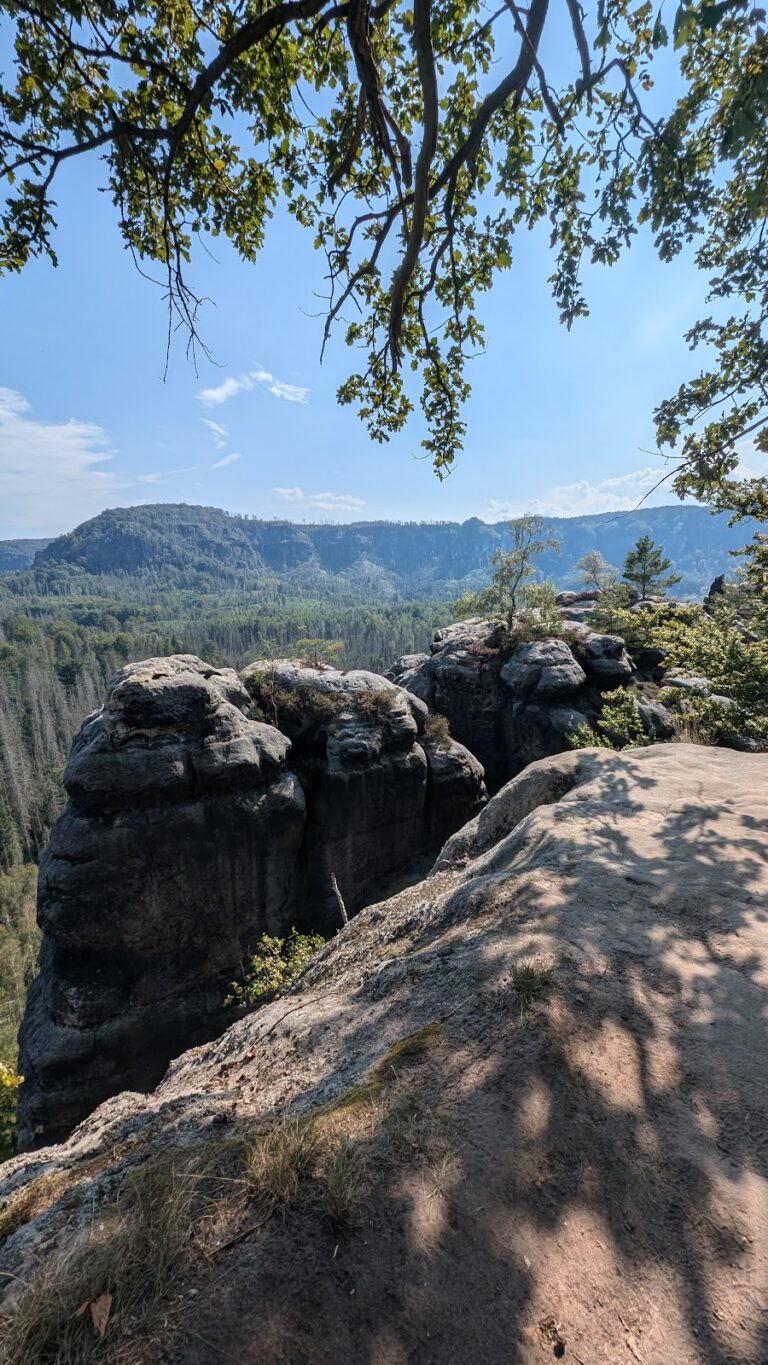
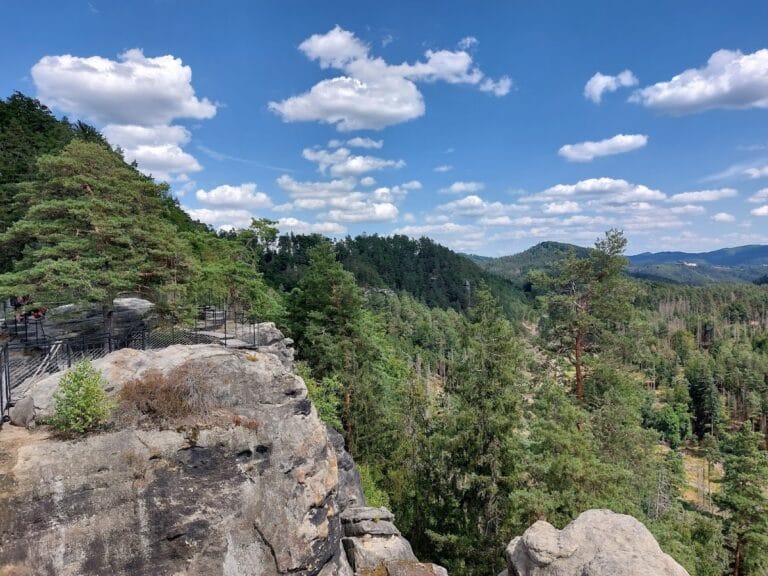
Burg Arnstein is a rock castle, or fortified site built directly into or around natural rock formations, on the 327-metre Arnstein mountain on the right side of the Kirnitzsch Valley in the Hintere Sächsische Schweiz. It stands near the meeting point of the Dorfbachgrund, which descends from Ottendorf, and the Kirnitzsch. The former castle complex occupied a summit plateau and included an inner castle, the main fortified core, together with an outer bailey, the adjoining area for service buildings and additional defenses.
Castle Layout and Surviving Structures
The first building phase included a residential tower, residential and kitchen buildings, and the gate installations of the inner castle. The outer bailey held economic buildings and further fortifications. In its original form, the complex was one of the larger castle installations in the Saxon Switzerland area and was comparable in scale with nearby Burg Wildenstein.
After the destruction of 1437 and 1438, the lowest rock of the inner castle was abandoned. The entrance was moved from the outer bailey directly into the middle section of the inner castle, with access passing through a narrow and difficult rock cleft. This altered arrangement reflects the castle’s reduced form after the fire and the loss of its earlier representative character.
Surviving features include beam sockets, stone stairs, a castle dungeon, rock clamps, sockets for the former keep, and a cistern. A cistern was a constructed reservoir for collecting and storing water, a practical feature for a fortified site. These remains, together with the identifiable summit plateau, preserve the basic physical evidence of the former castle complex.
Arnstein Cave
The Arnstein Cave was substantially incorporated into the castle’s construction. Human working is visible in the cave, which also contains rock drawings. It is listed in the Saxon Cave Register as number 5051/SH-03. The castle site lies near the former sawmills Neumannmühle and Buschmühle in the Kirnitzsch Valley.