Fort Lachaux: A Séré de Rivières Blocking Fort in France
Site at a Glance
- Rating
- 4.2
- Popularity
- Very Low
- Country
- France
- Primary era
- Modern
- Eras represented
- Modern
- Civilizations
- French
- Site type
- Military
- Remains
- Fort
On this page13 sections
History
Fort Lachaux is an eastern French blocking fort on Lachaux hill, at the boundary of Montbéliard and Grand-Charmont in France. Built between March 1876 and 15 May 1878, it formed part of the Séré de Rivières system, the network of French forts and defensive works constructed mainly after the Franco-Prussian War to protect the eastern frontier and strategic centers. The fort was intended to defend Montbéliard and was built by the contractor Adrien Hallier at a cost of 1,801,360 gold francs.
Defensive organization
Fort Lachaux belonged to the Lomont defensive center until 1906. This was a French defensive sector organized around the Lomont area. From 1906, the fort was incorporated into the fortified place of Belfort, the larger defensive system centered on Belfort. Its position on Lachaux hill, at an elevation of 410 metres, gave it a role within the wider network of works protecting the region.
The fort was briefly renamed Fort Razout by a presidential decree of 21 January 1887. The decree required forts, fortified artillery installations, and barracks to take the names of former military commanders, and the new name honored Division General Louis-Nicolas de Razout. War Minister Théophile Ferron revoked the change on 13 October 1887, restoring the name Fort Lachaux.
Modernization and wartime use
A proposed modernization in 1900 was not carried out, and the complementary program planned for 1908 also remained incomplete. The projected modernization cost was 3,075,000 gold francs. A rock magazine was nevertheless constructed between 1888 and 1890, providing storage for 83 tonnes of black powder. Reinforcement work began in 1913 and 1914 but stopped when the First World War began.
From 2 August 1914, men not subject to military service were requisitioned to restore the fort. The work formed part of the early wartime effort to prepare the defensive installation. From 1916, the fort was neglected as military attention shifted toward the front.
During the twentieth century, Fort Lachaux was largely demolished to make room for Peugeot factory buildings. Much of the site was consequently lost or built over. The surviving barracks are used as a shooting range by the French National Police, while the remaining installation is under the ownership of Pays de Montbéliard Agglomération.
Remains
Layout and surviving defenses
Fort Lachaux was arranged on a trapezoidal plan, with an outer envelope surrounding a central massif or redoubt. The outer envelope was the defensive zone beyond the main fortification, while the central massif formed the protected core. It functioned as a blocking fort, and its defenses were organized around a ditch, a protected entrance, and structures intended to cover the approaches.
Entrance and drawbridge
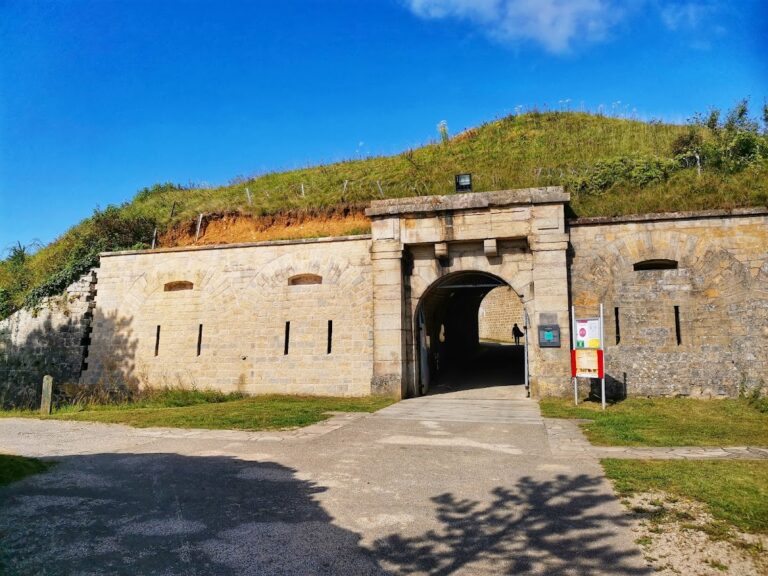
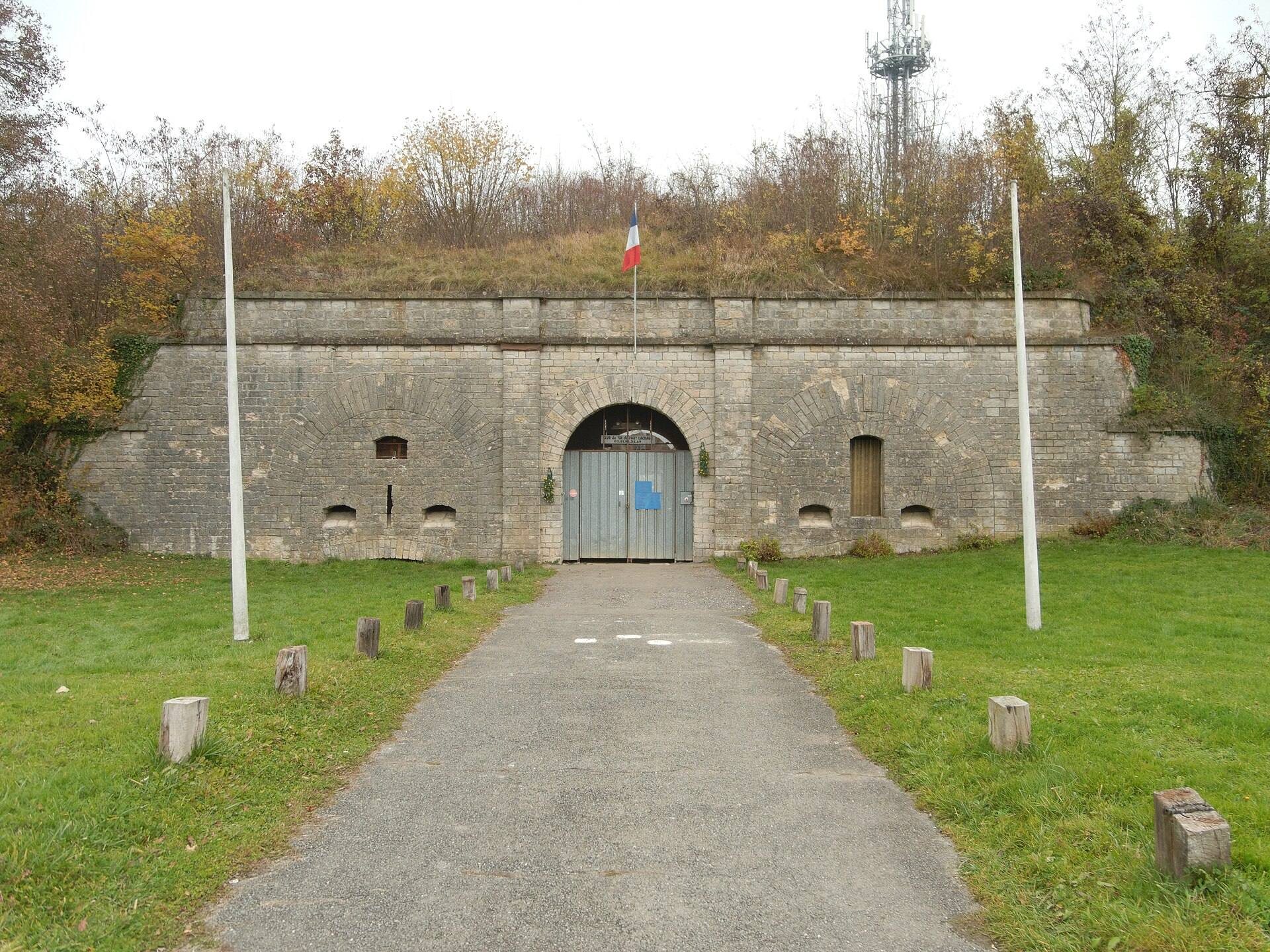
The entrance was protected by a drawbridge whose counterweight operated below the bridge as it pivoted. The surviving entrance is one of the principal elements that still identifies the fort. The entrance area formed part of the connection between the outer defensive arrangements and the interior buildings.
Ditch defenses
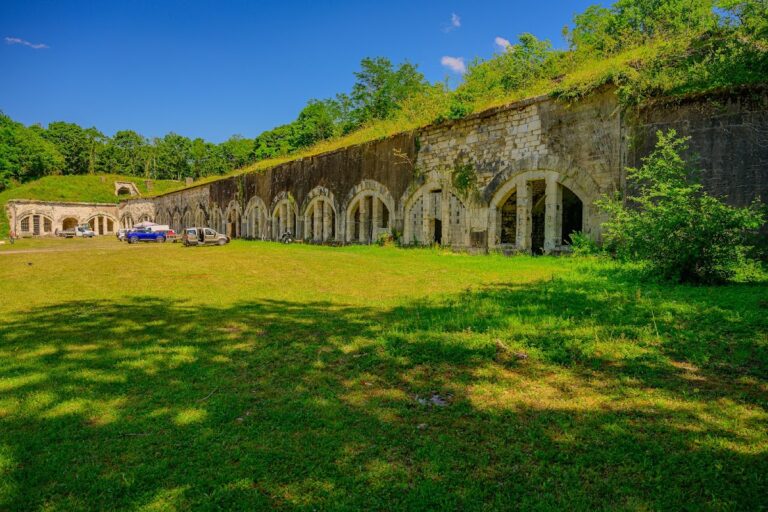
The ditch was defended by a double caponier, two single caponiers, and a tunnel caponier. A caponier was a fortified structure projecting into a ditch, allowing defenders to fire along the ditch and hinder an assault on the walls. The double caponier survives, together with sections of the ditch and the crest of the rampart. These remains preserve parts of the fort’s defensive outline even though much of the surrounding structure has disappeared.
Accommodation and supplies
Barracks and medical facilities
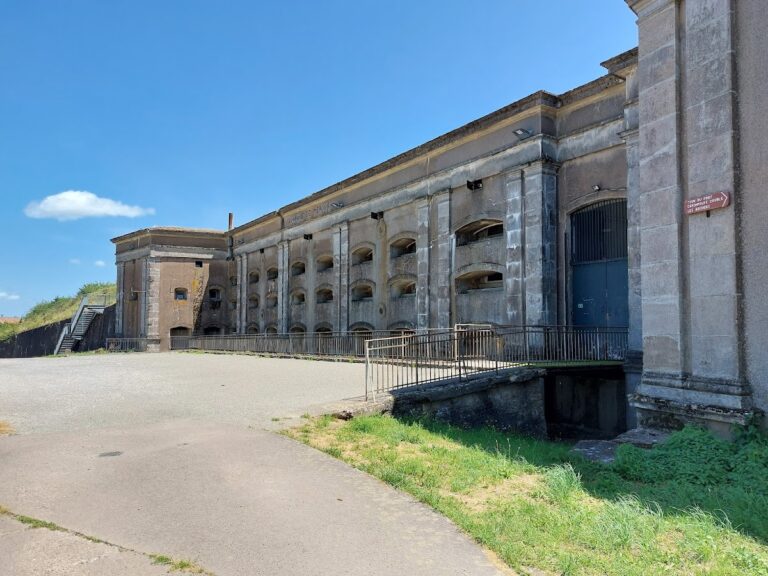
The fort was designed for a peacetime complement of 708 men, including 15 officers, 37 non-commissioned officers, and 656 enlisted men. Its wartime complement was 1,016. The barracks contained 450 sleeping places, and a medical station provided 20 beds. Part of the barracks survives and continues in a modern institutional use as a shooting range.
Water and food storage
Two wells and two cisterns supplied water, with the cisterns together holding 252.8 cubic metres. Provisions included a powder magazine with capacity for 110 tonnes of black powder and a cartridge magazine for 720,000 cartridges. The separate rock magazine, built between 1888 and 1890, held a further 83 tonnes of black powder.
A bakery contained two wood-fired Lespinasse ovens. One could produce 200 loaves per day and the other 180, providing the fort with a substantial internal bread-making capacity. These service spaces supported the large garrison planned for the work, although the surviving fabric now represents only part of the original complex.
Communications and armament
Signal and telegraph connections
An optical light-signal apparatus linked Fort Lachaux with Fort du Mont Vaudois, Fort du Mont Bart, Fort du Lomont, and Fort du Bois d’Oye. An electric telegraph connected it with the defensive works around Montbéliard. Together, these systems allowed the fort to exchange signals with nearby positions and with the regional defensive network.
Artillery arrangements
The recorded armament changed repeatedly as French artillery was reorganized. In 1879, the fort had 12 7 cm guns, eight 4 cm guns, six 22 cm mortars, four 15 cm mortars, four additional 4 cm guns, six grapeshot guns, and four breech-loading 12 cm guns. Breech-loading weapons were loaded through a rear opening rather than from the muzzle. Excluding ditch-defense weapons, the overall armament declined from 43 guns and mortars in 1879 to 25 in 1914.
The 1903 inventory listed three 155 mm long guns, eleven 40 mm revolving guns, three breech-loading 12 cm guns, two 90 mm guns, nine 120 mm long guns, two 138 mm guns, and two 15 cm mortars, with 155 mm guns also held in reserve. The 40 mm revolving guns were multibarrel Gatling-type weapons, not ordinary revolvers.
In 1906, the listed weapons included three 155 mm long guns, three 120 mm long guns, five 90 mm guns, eleven 40 mm revolving guns, three breech-loading 12 cm guns, twelve additional 90 mm guns, two 120 mm guns, six 22 cm mortars in reserve, and two 15 cm mortars in reserve. The 1908 inventory recorded three 155 mm long guns, three 120 mm long guns, two 22 cm mortars, two 15 cm mortars, eleven 40 mm revolving guns, three breech-loading 12 cm guns, twelve 90 mm guns, ten 120 mm guns, and one additional 22 cm mortar.
By 1912, the armament comprised three 155 mm long guns, three 120 mm long guns, two 22 cm mortars, two 15 cm mortars, three 40 mm revolving guns, three breech-loading 120 mm guns, four 90 mm guns, eleven 120 mm guns, and two additional 15 cm mortars. In 1914, the listed armament included three 120 mm long guns, two 22 cm mortars, two 15 cm mortars, eleven 40 mm revolving guns, three breech-loading 12 cm guns, four 90 mm guns, and eleven 120 mm guns. Fort Lachaux had no armored turret, Bourges casemate, or observation post.