Castle Ruins in Czarny Bór: A Gothic Route Fortress in Poland


Site at a Glance
- Rating
- 3.9
- Popularity
- Very Low
- Country
- Poland
- Primary era
- Medieval
- Eras represented
- Medieval
- Civilizations
- Holy Roman Empire
- Site type
- Military
- Remains
- Castle
On this page5 sections
History
Castle ruins in Czarny Bór are the remains of a Gothic castle in Poland, built during the first half of the fourteenth century, probably before 1355. Its precise construction date is unknown. The fortress guarded a trade route leading to Bohemia, and a toll was reportedly collected at a crossing near Czarny Bór in 1471 on the route between Boguszów and Kamienna Góra.
Fourteenth-century fortress
The castle appears in the historical record in 1355, when Bolko II the Small, the Piast duke of Świdnica, undertook military action against fortifications generally associated with rebellious knights. The identity of the castle’s lord at that time is uncertain. A record from 1364 shows that the fortress remained under Bolko II’s control at least until that year.
In 1371, Witek Czech of Rodov near Jaroměř granted the castle and its dependencies to his wife, Jutta, for her lifetime. The fortress was mentioned again in 1373 as a landmark in the sale of the Heine thickets between Czadrów and Czarny Bór. In 1390, Zygmunt von Schwarzwaldau, described in documents from 1368 as Witek Czech’s son, recorded his estates and the castle for Tammo of Łażany should he die without children. Zygmunt was still mentioned in 1394.
Destruction and protection
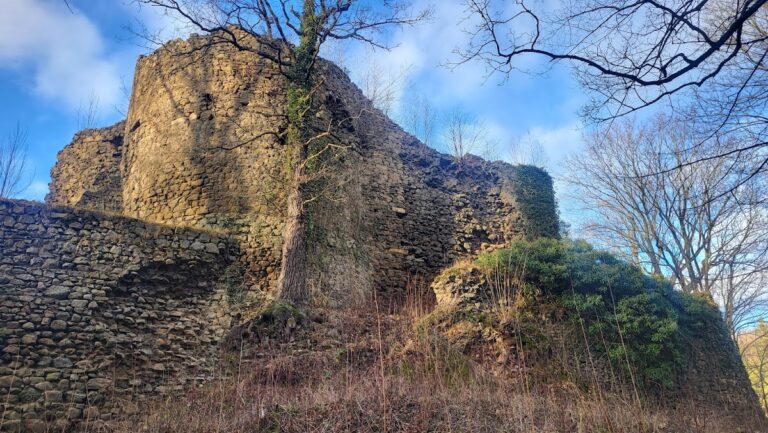
The fortress was reportedly destroyed in 1509 and remained in ruins afterward. The surviving remains were entered in the heritage register on 25 August 1959 under number A/4135/593.
Remains
The castle occupied a small hill in the Lesk valley, surrounded by waterlogged meadows. Two moats added to the natural protection provided by the marshy ground. The site lies in the Central Sudetes, between the Wałbrzych and Stone Mountains, within the Czarny Las and Lesista ranges. It stands near the Grzędzki Stream, a tributary of the Lesk, which flows into the Bóbr from the right bank.
Surviving fortifications
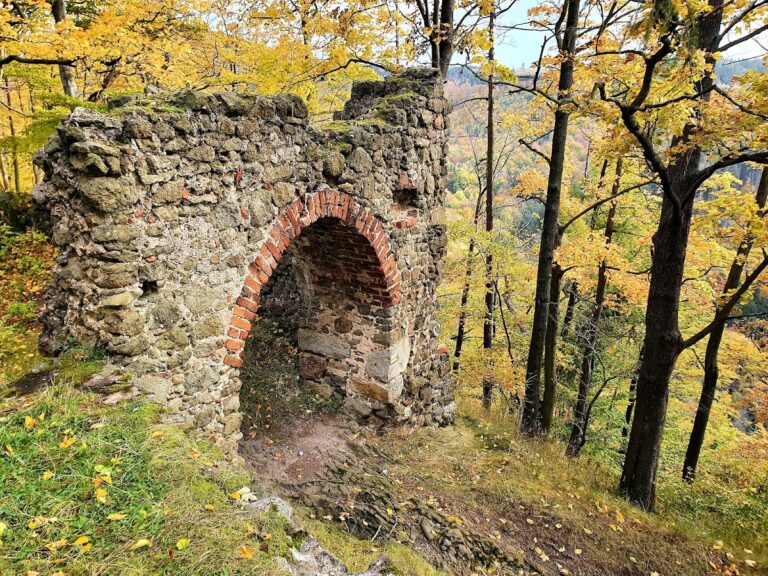
Only part of the tower and fragments of the surrounding walls survive. Clear, intense fire marks remain on the tower wall. The ruins now stand among a clump of forest, making them difficult to see from a distance.