Sperrstelle Beatenbucht: A Swiss Army Defensive Position on Lake Thun


Site at a Glance
- Rating
- 4.8
- Popularity
- Very Low
- Country
- Switzerland
- Primary era
- Modern
- External website
- Open
- Eras represented
- Modern
- Civilizations
- Swiss
- Site type
- Military
- Remains
- Fort
On this page7 sections
History
Sperrstelle Beatenbucht was a Swiss Army defensive position in Switzerland, in the municipality of Sigriswil, developed during the Second World War as part of General Henri Guisan’s Réduit strategy. This strategy concentrated Switzerland’s principal resistance in the Alpine interior after a withdrawal from more exposed areas. Swiss Army designation No. 2113, the position formed the seventh defensive barrier along the right shore of Lake Thun between Thun and Interlaken.
The Second World War defensive system
The position emerged when the Réduit front was withdrawn from the Zulg valley to the Sigriswilgrat. The ridge became the main defensive position on Lake Thun’s right shore and was expected to be held without fail. The 3rd Division moved from the Limmat position into the Lake Thun operational area on both sides of the lake.
In March 1941, the Lake Thun group was divided into the Grünenberg, Sigriswilgrat, Kander, Gantrisch, and Lake groups. The Lake Group, formed by Mountain Infantry Regiment 15, defended the lake and built its fortifications. Its duties included monitoring the entire lake with a motorboat detachment and preventing enemy crossings, landings, and seaplane landings that might outflank the Sigriswilgrat and Kander groups. A mountain fusilier battalion remained in reserve near Aeschi, and the group command post was at Därligen.
The Beatenbucht road barrier was completed in January 1941 and passed to the Merligen local defense force in April 1942. The Fischbalmen cavern followed in 1941 and 1942. The first deployment exercise in the new works took place in December 1942. Behind Beatenbucht, toward the Bödeli near Interlaken, the defensive system consisted only of demolition obstacles. Along the lakeside route, neighboring barriers stood at Eichbühl, Längenschachen, Gunten, Oertli, Stampbach, and Merligen.
Cold War use and declassification
During the Cold War, troops regularly occupied the barrier and the Fischbalmen infantry bunker during refresher courses. This military use continued until the end of 1994. Sperrstelle Beatenbucht was declassified in April 1999 and opened to the public in July of the same year.
Remains
The surviving position consists of the Beatenbucht road barricade, the Fischbalmen infantry bunker, and the Beatenbucht lake observation post. Together, these works combined an obstacle on the road with protected firing and observation facilities directed toward movement along the lakeshore and across Lake Thun.
Fischbalmen infantry bunker
The Fischbalmen infantry bunker, designated A 1883, was built into a natural rock cavern in 1941. Its 15-meter tunnel contained a weapons firing slit and an observation slit for directing fire. Rest and dining rooms lay farther inside the protected tunnels, making the cavern both a fighting position and a crew facility.
The bunker’s original weapon was a 4.7-centimeter infantry cannon mounted on a pivot mount, which allowed the gun to traverse around a fixed point. In 1952 it was replaced by a 4.7-centimeter Pak 41 antitank gun, a weapon designed primarily to engage armored vehicles. A 9-centimeter Pak 50 PL replaced that gun in 1962. The Pak 50 had a range of 500 to 700 meters and could fire 8 to 10 rounds per minute.
In 1980, the garrison consisted of 21 men. It included a commander, two fortification-security soldiers, three six-man interior guard shifts, an external observer with a Field Telephone 50, three men serving the gun, and one man preparing ammunition.
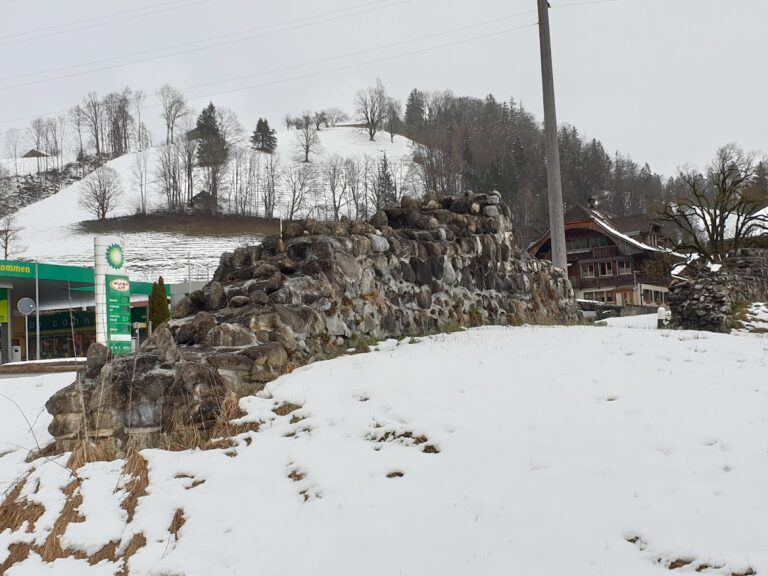
Beatenbucht road barricade
The Beatenbucht road barricade formed the position’s direct obstacle on the lakeside route. Completed in January 1941, it was later assigned to the Merligen local defense force. Its purpose was linked to the wider barrier system that controlled movement along the right shore of Lake Thun.
Lake observation post
The Beatenbucht lake observation post, designated A 1884, was designed to monitor Lake Thun. It contained an armored observation cupola with several closable openings and observation telescopes. The exterior was camouflaged to resemble a stone block, disguising the military installation within the lakeside landscape.