Jevišovice Castle: A Medieval Castle Site in Czechia


Site at a Glance
- Rating
- 4.5
- Popularity
- Low
- Country
- Czechia
- Primary era
- Medieval
- External website
- Open
- Eras represented
- Medieval
- Civilizations
- Holy Roman Empire, Margraviate of Moravia
- Site type
- Military
- Remains
- Castle
On this page7 sections
History
Jevišovice Castle is a late-thirteenth-century medieval castle site in Jevišovice, Czechia. Boček, son of Kuna of Zbraslav and Kunstadt, built it between 1278 and 1288, establishing the Jevišovice branch of the Lords of Kunstadt, a Moravian noble family that controlled several castles and family territories. The rocky spur had already been inhabited during the Copper Age and is associated with the Jevišovice culture, an archaeological culture identified through material remains from the region.
Foundation and the Kunstadt lords
The castle was first mentioned indirectly in 1289, when Boček and his brother Kuna used the territorial designation “of Jevišovice” for the first time. A fuller description followed in 1398. A record from 1389 refers to a front and rear bailey, several bridges and passageways, a chapel, and a large quadrangular tower, showing that the site had developed into a substantial fortified residence.
At the turn of the fourteenth and fifteenth centuries, Jevišovice Castle was the seat of Hynek Dürrteufel of Kunstadt, who died in 1407. During the struggle between King Wenceslaus IV and his brother Sigismund, and the rivalry between Jobst and Prokop of Moravia, Hynek supported Wenceslaus and Prokop together with John Sokol of Lamberg. He operated as a robber knight in Moravia and the Marchfeld, resisting the forces of Sigismund and Duke Albert V.
Destruction during the Hussite Wars
After the Hussite Wars began, Hynek’s sons, Hynek II and Boček Dürrteufel of Kunstadt, joined the rebels. The Hussite Wars were fifteenth-century religious and political conflicts in the Bohemian lands that followed the reform movement associated with Jan Hus. Because Jevišovice had become a Hussite stronghold in southwestern Moravia, Duke Albert V captured and destroyed the castle in 1421. Hussite forces held it again from 1423 until 1431, although imperial troops probably recaptured it in 1425.
The second castle and abandonment
During this unsettled period, Sezema Zajímač of Kunstadt built a new castle on the opposite spur, on the right bank of the Jevišovka. The two castles were first mentioned together in 1432. In 1448, when Hynek and Boček Dürrteufel of Kunstadt transferred half of Střelice to their cousin Jan Zajímač of Kunstadt, the older castle was described as deserted. The abandoned site is now protected as a cultural monument.
Remains
Jevišovice Castle occupied a wooded rocky spur on the left bank of the Jevišovka, above a bend in the river. The river enclosed the spur on three sides, while steep rock faces protected its western side. The narrow inner castle extended for approximately 60 metres along the spur and reached a maximum width of 38 metres. A curved rear bailey, an enclosed outer court used for access, defense, storage, and service buildings, lay to the northeast. It was separated from the inner castle by a broad ditch and measured approximately 60 by 15 metres. The buildings in the baileys are thought to have been timber-framed.
Earthworks and surviving walls
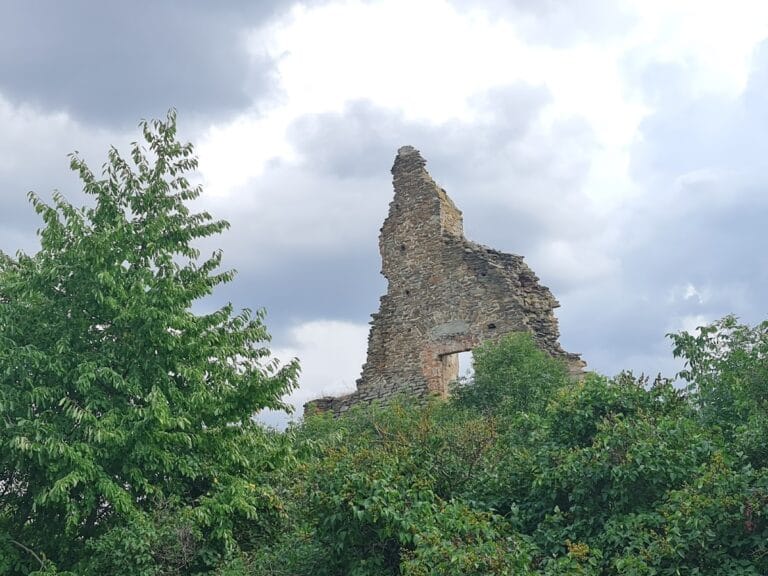
Today the site is an abandoned castle area with few visible structural remains. The ditch can still be traced through the ground relief, while a rubble mound marks the position of the inner castle. A small section of the northern castle wall survives, and wall fragments from a building with a curved ground plan remain in the southwestern part of the site.
The opposite castle spur
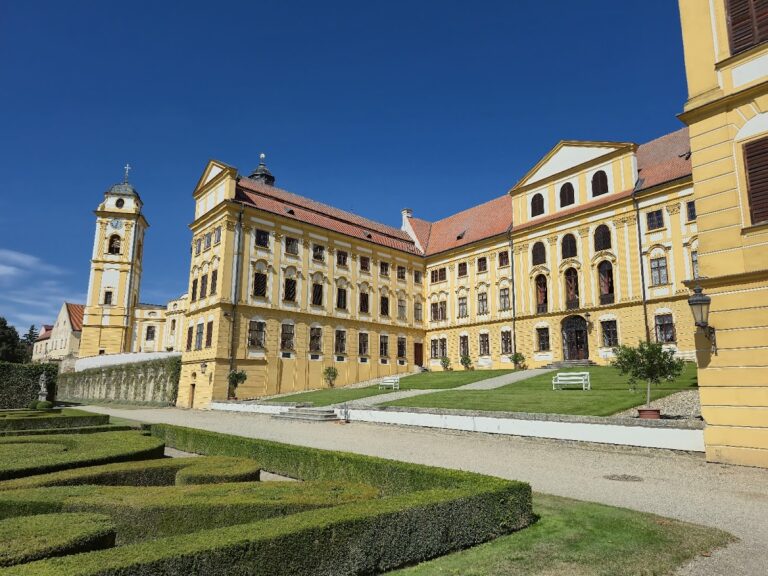
Old Castle Jevišovice stands on the spur opposite the abandoned castle site, on the right bank of the Jevišovka. Its position reflects the later development of a second castle during the period of conflict, when Sezema Zajímač of Kunstadt established the new stronghold. The abandoned older site provides a view of Old Castle Jevišovice across the river.
Nearby sites