Festung Rüsselsheim: A Former Fortress in Germany


Site at a Glance
- Rating
- 4.5
- Popularity
- Low
- Country
- Germany
- Primary era
- Early Modern
- Eras represented
- Medieval, Early Modern
- Civilizations
- Holy Roman Empire
- Site type
- Military
- Remains
- Fort
On this page6 sections
History
Festung Rüsselsheim is a former fortress in Rüsselsheim am Main, Germany, whose transformation into a major defensive complex began in 1479 during the late medieval and early modern periods. Its origins lie in a castle, described as a fortified house belonging to the Counts of Katzenelnbogen, which was first documented in 1399. The site was intended to secure the southern part of the counts’ territory.
From comital castle to Hessian fortress
Rüsselsheim passed to the Landgraviate of Hesse under Henry III, Landgrave of Hesse, and the castle began to be converted into a fortress in 1479. The Hessian state expanded it with ramparts, ditches, and five bastions, projecting fortified platforms designed to direct defensive fire along adjoining walls. This work continued until 1546 and gave the site a central role in defending Hessian territory during the wars of the following centuries.
The fortress was drawn into the Schmalkaldic War, a conflict in the Holy Roman Empire between Emperor Charles V and the Protestant Schmalkaldic League in 1546 and 1547. After the war, Philip the Magnanimous, Landgrave of Hesse and a leading Protestant prince, surrendered the fortress to Charles V in 1547. The emperor ordered its demolition, but the complex was rebuilt between 1560 and 1563. At the beginning of the Schmalkaldic War, it had held 58 guns.
Destruction and changing uses
French troops captured the fortress in 1688 during the Nine Years’ War, also known as the War of the Palatine Succession, a European conflict fought from 1688 to 1697. On 6 April 1689, they blew up the fortress. After this destruction, it lost its military importance, and the ruins remained largely without significant use for centuries.
Over time, the surviving complex served several nonmilitary purposes, including use as a prison, hospital, mushroom-growing facility, and youth hostel. The City of Rüsselsheim acquired the fortress in 1954 and opened it to the public. Restoration sensitive to its heritage has continued since the 1990s. The Stadt- und Industriemuseum Rüsselsheim, founded in 1976, has been housed at the fortress and received a museum award from the Council of Europe in 1979. The complex also accommodates the city archive, a café, and the local heritage association.
Remains
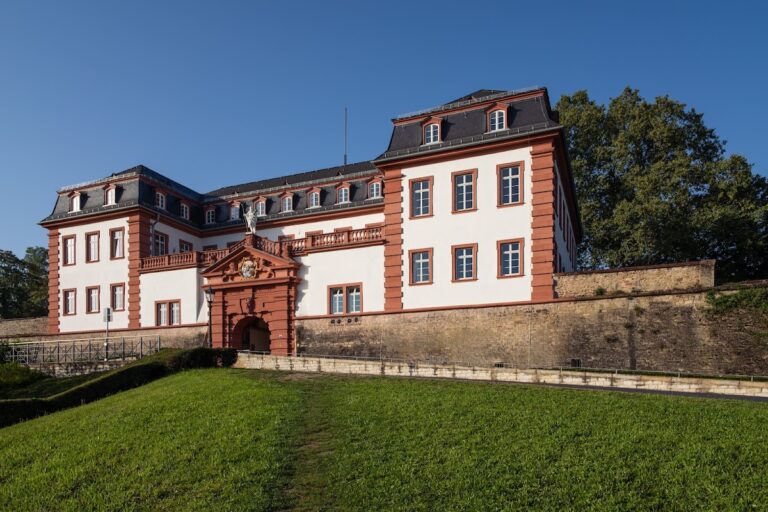
The surviving site is a fortified complex organized around ramparts, ditches, and five bastions. These defensive works formed the principal structure of the fortress after its expansion from the earlier castle or fortified house. The remaining fabric reflects both its military construction and the later damage that ended its defensive function.
Defensive earthworks and bastions
Ramparts and ditches define the fortress’s defensive arrangement, while the five projecting bastions provided positions for fire along the adjoining walls. The complex was rebuilt after the 1547 demolition and later destroyed by explosive demolition in 1689. Its surviving ruins have undergone heritage-sensitive restoration since the 1990s.
Adapted ruins and present institutions
The ruins were adapted for successive civilian uses, including a prison, hospital, mushroom-growing facility, and youth hostel. In their restored form, the buildings accommodate the Stadt- und Industriemuseum Rüsselsheim, the city archive, a café, and premises of the local heritage association. These uses occupy a complex whose present character combines surviving fortress remains with later adaptations.