Schönrain am Main: Benedictine Monastery and Later Administrative Residence in Germany


Site at a Glance
- Rating
- 4.7
- Popularity
- Low
- Country
- Germany
- Primary era
- Early Modern
- External website
- Open
- Eras represented
- Medieval, Early Modern
- Civilizations
- Holy Roman Empire
- Site type
- Domestic
- Remains
- Castle
On this page7 sections
History
Schönrain am Main is a former Benedictine monastery and later administrative residence near Gemünden am Main in Germany, founded around 1080 during the medieval reform of monastic life. A local tradition assigns an earlier foundation to Saint Lioba in the Carolingian period, around 750, but firm historical information begins in the eleventh century. The monastery became a Hirsau priory and an important outpost of the Cluniac reform in Franconia.
Foundation under Hirsau
The foundation took shape during the Investiture Controversy, the eleventh-century conflict between the papacy and secular rulers over the appointment and authority of bishops and other church officials. The Ludowinger counts Ludwig the Springer and Berengar of Sangerhausen gave Schönrain, two mills with their rights and property, and their estate at Wiesenfeld to Abbot Wilhelm of Hirsau. Their stated purpose was to establish a religious house for the salvation of their ancestors.
Cluny in Burgundy had launched a medieval Benedictine reform movement that promoted stricter observance and greater independence from secular authority. Hirsau adapted these principles for German monasteries. Schönrain formed part of this wider reform network and served the region between Lohr, Gemünden am Main, and Karlstadt am Main. Its position may also have helped link reformers in southern and northern Germany.
The first known prior, Adelhelm, appears in 1085. Building had begun by that date at the latest, although the monastery developed over a lengthy period. Abbot Gebhard of Hirsau, who succeeded Wilhelm in 1091 and remained in office until 1105, oversaw a substantial stage of the church’s completion, probably following Wilhelm’s plans. After Hirsau finished its own church in 1091, it could send additional lay brothers to Schönrain. The monastic facilities were completed by 1139 and had required at least ten to fifteen years of work.
In that year, Bishop Embricho of Würzburg issued a protection charter, a formal document placing a religious institution or its property under the authority and protection of a powerful church leader. The charter confirmed the original donation and the obligation to establish the monastery. Schönrain’s resources remained comparatively modest, with income derived largely from scattered properties, and the priory housed approximately five to ten monks.
Landholding, fortifications, and reform
The Counts of Rieneck, relatives of the founders, held Schönrain’s protective bailiwick. This secular office involved defending and supervising the monastery and its property, but it could also provide a noble family with political influence. The Rienecks repeatedly tried to acquire the priory’s possessions. In 1159 Schönrain exchanged property at Massenbuch for Hofstetten. Hirsau sold the undeveloped land surrounding the monastery to the Rienecks in 1319, but the land returned to Hirsau 43 years later. In 1376 the Rienecks sold their local properties to Würzburg while retaining their role as Schönrain’s lay stewards.
Before 1243, the Rienecks added fortifications to strengthen their position against the Bishopric of Würzburg. Following a power struggle with the bishop, they were compelled to demolish these defenses. In the fifteenth century, Schönrain joined Hirsau and other Benedictine houses in the Bursfeld Congregation, an association that coordinated monastic observance and reform. Nikolaus Basellius, a Benedictine scholar and pupil of Johannes Trithemius, served as prior in 1511 and 1512. He later edited and published a continuation of Johannes Nauclerus’s world chronicle in 1516 and made substantial contributions to Trithemius’s annals of Hirsau.
Destruction and secular administration
The German Peasants’ War brought a decisive rupture. In 1525, Schönrain was partly burned and plundered, and the monks fled to Hirsau. Hirsau was subsequently secularized, meaning that its monastic institution and property were transferred out of ecclesiastical administration. Count Philipp III of Rieneck, the lay steward of Schönrain, adopted Lutheran teachings and acquired the monastic property in March 1526.
Philipp III ordered the church to be demolished and replaced with an administrative and residential building. Completed in 1556, the new structure became the residence of his wife, Margareta, after his death in 1559. Schönrain passed to Philipp’s nephews through the Rieneck succession in 1574. When they died without children, the property reverted as a fief to the Prince-Bishop of Würzburg and became a Würzburg administrative seat. A district official and a forester administered the surrounding forests and the localities of Hofstetten, Massenbuch, and Halsbach.
The Franconian territories were secularized in 1803, and Schönrain became a royal Bavarian forestry office. That office moved to Massenbuch in 1818. The roof structure of the former residence was dismantled, allowing its usable material to be reused, and inhabitants of neighboring villages later removed further building materials. The complex consequently became a ruin. Parts of the former priory survive in Wiesenfeld, Hofstetten, and Massenbuch. Since 1973, the remains at Schönrain have been protected by the Lohrer Heimatfreunde historical and environmental preservation association. The Schönrain Tunnel, completed in 1993, passes beneath the site.
Remains
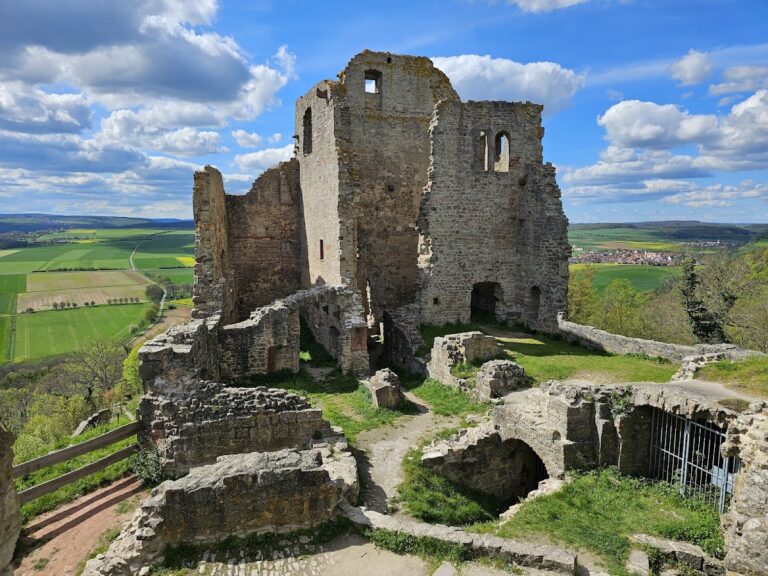
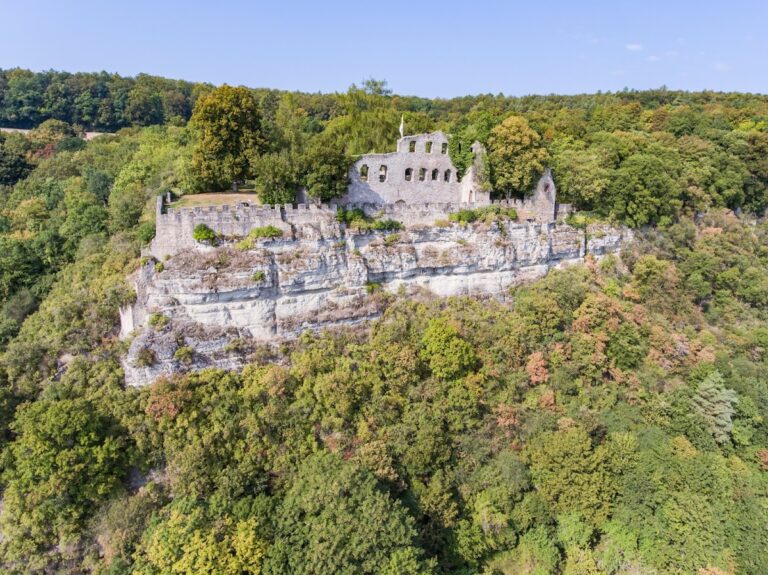
Schönrain stands above the Main opposite Neuendorf, at the southwestern edge of the Gemünden am Main municipal area in Bavaria’s Main-Spessart district. The surviving complex combines fragments associated with the medieval priory with later fabric from the residential castle and accommodation used by forestry officials. The remains are in ruinous condition after the removal of the residence’s roof structure in 1818 and the subsequent reuse of building materials. The tunnel completed beneath the site in 1993 forms part of its modern physical setting.
Church remains and reconstruction
The former monastic church can be reconstructed only through surviving architectural fragments and written evidence about its construction and altars. A base belonging to a crossing pier was exposed and photographed by the Lohr Historical Society. A column with capitals and a checkerboard frieze also survives. These elements relate to a church probably designed as a flat-roofed basilica with three aisles and columns.
The church’s precise arrangement remains debated. The priory’s limited endowment has supported an interpretation of a single nave without a transept, while documentary evidence supports a three-aisled building with three apses at the eastern end and perhaps an eastern transept. A transept is a crosswise part of a church that intersects its main axis, while a crossing is the area where those sections meet. The church contained three altars: one dedicated to Saint John the Evangelist and the Virgin Mary, a probable principal altar dedicated to Saint Lawrence, and another dedicated to Saint Nicholas. The joint dedication to John and Mary connected Schönrain with Cluny, whose monastic church also had an altar dedicated to those saints.
Residential and administrative buildings
The visible remains are concentrated largely in later additions connected with the building that replaced the monastic church. This structure was subsequently known as a mountain castle or residential castle and served both domestic and administrative purposes. Its later use included accommodation for forestry officials after Schönrain became a royal Bavarian forestry office. The dismantling of its roof in 1818 and the removal of additional usable materials left the building as a ruin.
The surviving column fragments, the crossing-pier base, the checkerboard frieze, the altar dedications, and the construction history provide the principal evidence for understanding the former church and its relationship to the later residence. Parts of the former priory were also reused elsewhere, surviving in Wiesenfeld, Hofstetten, and Massenbuch.