Palamidi: A Venetian Fortress in Nafplio, Greece


Site at a Glance
- Rating
- 4.7
- Popularity
- High
- Country
- Greece
- Primary era
- Early Modern
- External website
- Open
- Eras represented
- Early Modern, Modern
- Civilizations
- Greek, Ottoman, Venetian
- Site type
- Military
- Remains
- Fort
On this page11 sections
History
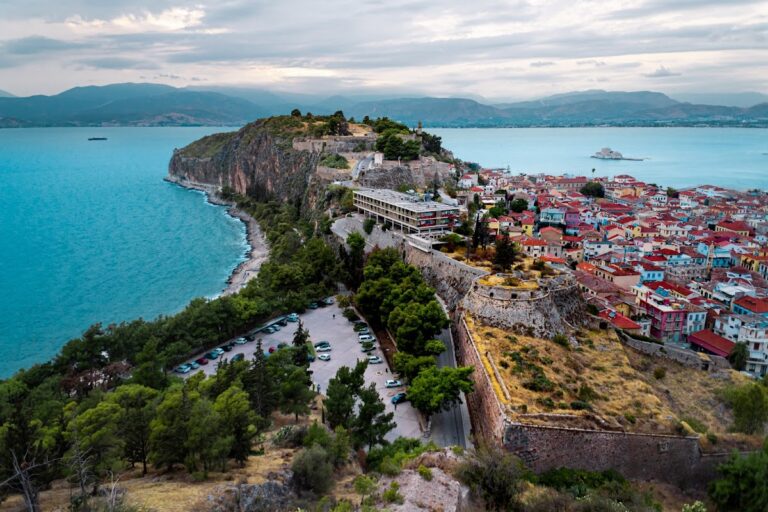
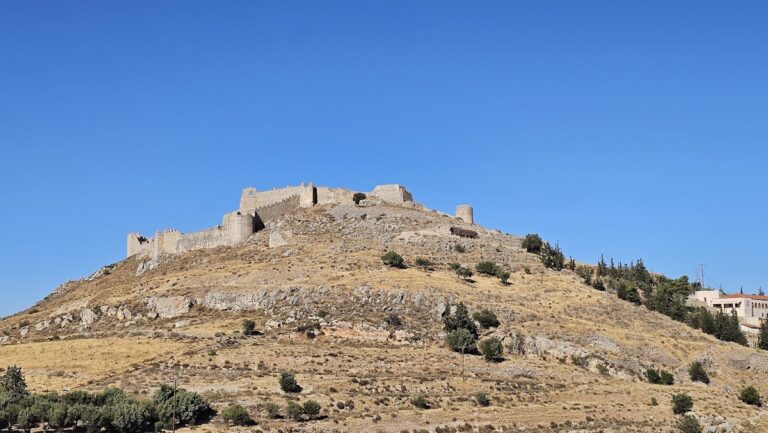
Palamidi is a Venetian fortress in Nafplio, Greece, built on a hill about 216 to 220 metres high during the early eighteenth century in the baroque defensive tradition. The hill and fortress take their name from Palamedes, a hero of the Trojan War in Greek mythology. Palamidi controlled access to Nafplio, its harbour, and the Argolic Gulf, giving it an important position in the defence of the city and its surrounding waters.
Venetian construction
After Francesco Morosini led the Venetian conquest of Nafplio during the Morean War, the conflict in which Venice temporarily seized parts of the Peloponnese from the Ottoman Empire, a major fortification was considered necessary. The Venetians captured the hill from the Ottomans and developed the fortress during their rule in the Morea, which lasted from 1686 to 1715.
Augustin Sagredo conceived the project, and construction took place between 1711 and 1714. The designs are attributed to the French military engineers Antonio Giancix and Pierre de la Salle. Palamidi was the last fortress built by the Venetians outside Venice. Its eight independently defensible bastions were intended to continue resisting even if neighbouring sections had fallen.
Ottoman rule and Greek recapture
The Ottomans captured Palamidi in 1715 after blowing up part of the fortress. They expanded the complex during their rule, while Christians were forbidden to enter it. Ottoman control continued until the Greek War of Independence, the nineteenth-century revolt through which Greek forces challenged Ottoman rule and established the modern Greek state.
Greek forces retook Palamidi in late November 1822 under the command of Staikos Staikopoulos. About 300 men entered through the eastern fortifications, where they overcame a weakly held garrison. The recapture is commemorated annually on 30 November.
Prison and later protection
After the Greek Revolution, Palamidi became a prison and continued in that role until 1926. Theodoros Kolokotronis, a leading commander of the Greek War of Independence and a prominent figure in the early Greek state, was imprisoned there in 1833. He spent eleven months in confinement before King Otto, the first king of modern Greece, pardoned and released him.
A guillotine was brought to the fortress in 1833, and 25 people were executed there between 1833 and 1913. Palamidi has been open to visitors since 1969 and is protected in Greece as an archaeological site and monument. The Palamidi and Akronafplia areas also belong to a 3.7-square-kilometre Natura 2000 biotope, part of the European Union network protecting habitats and species of ecological importance.
Remains
Palamidi occupies the summit and slopes of its steep limestone hill east of Nafplio. The surviving complex is a baroque defensive system formed by eight independent bastions joined by a continuous wall. Storage rooms, cisterns, and artillery positions are incorporated into the fortifications, creating a connected military layout across the hilltop and its slopes.
Bastions and internal structures
Saint Andrew Bastion
The large Saint Andrew bastion served as the headquarters of the fortress. Its chapel of Saint Andrew is built into the defensive walls. After the Greek recapture, the chapel was cleaned and rededicated to Saint Andrew, one of the Twelve Apostles in Christian tradition. The feast associated with the chapel is held on 30 November.
Miltiades Bastion
The Miltiades bastion contains the central entrance and was later used as a prison. It is also known as the Prison of Kolokotronis, linking the surviving structure with the confinement of Theodoros Kolokotronis in 1833.
Other bastions
The bastions were first assigned Venetian names, then Ottoman names, and finally Greek names connected with historical figures and mythical heroes. Names still associated with the complex include Robert, Saint Andrew, Leonidas, Miltiades, Achilles, Grimani, and Phokion. The Phokion bastion was constructed during Ottoman rule and belongs to a later phase than the original Venetian fortifications. The eastern bastion is also known by a Turkish-era name and by the Greek name Achilles.
Entrances, walls, and staircase
The eastern defensive wall received less substantial treatment because its steep mountain setting was considered difficult to assault. During the Greek recapture in 1822, forces entered through this sector after overcoming a wall about two metres high. The eastern gate is reached by a road that ends near the entrance, while a staircase approaches the fortress from the western side, east of the Grimani bastion.
The staircase is traditionally said to have 999 steps. A legend claims that the thousandth was destroyed by Kolokotronis’s horse, while counts associated with the surviving route range from 847 to 901, with 857 identified as the actual number. The present staircase was built by prisoners under the supervision of the Bavarian army during King Otto’s reign. It replaced an earlier covered, vaulted route designed to protect movement from bombardment and to accommodate horses and donkeys.
Surrounding environment
The protected hill environment consists of rocky shrubland with phrygana, a low, drought-resistant Mediterranean vegetation type, together with steep limestone slopes supporting cliff vegetation and areas of pine woodland. The protected fauna includes green turtles, Morea lizards, Peloponnese lizards, tree snakes, and other species.